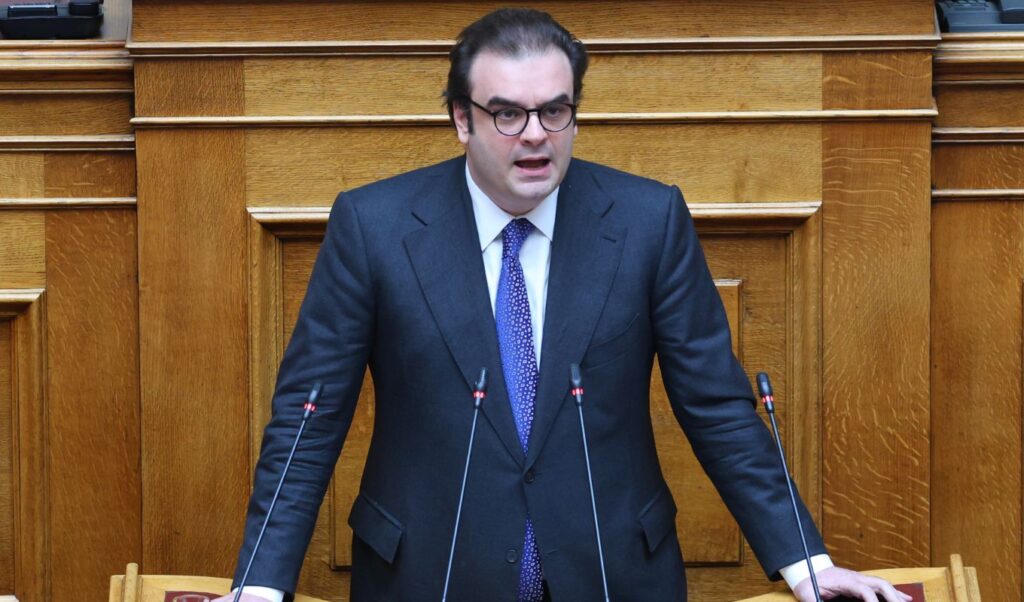
The need to complete the European Banking Union was highlighted by Greece’s Minister of National Economy and Finance and Eurogroup President, Kyriakos Pierrakakis, in an interview with the European Central Bank‘s quarterly Banking Supervision Newsletter. Pierrakakis also addressed the Eurogroup’s pivotal role in shaping the conditions that will contribute to Europe’s future prosperity.
He further discussed the challenges of banking supervision and the Savings and Investments Union, stressing that Europe needs a financial system capable of mobilizing more European capital and directing it where it can best support growth, competitiveness, and the European Union’s strategic priorities.
Kyriakos Pierrakakis’ interview with the ECB Supervision Newsletter
Q. During your candidacy for the Eurogroup presidency, you stated that European capital remains “trapped in national silos that fragment liquidity and limit market depth.” What needs to change in supervision, the regulatory framework, and market structure for the Banking Union to function as a truly integrated market?
A. The core challenge facing the European financial sector today has fundamentally shifted. For many years, our priority was to build a banking system that was strong, stable, and resilient. We achieved that goal. Today, Europe faces a different challenge: ensuring that its financial system becomes a driver of competitiveness and long-term growth.
Europe’s competitiveness depends on its ability to invest in innovation, in the green and digital transitions, in defence, in infrastructure, and in the businesses that will shape our continent’s future. That is why the Savings and Investments Union and a competitive banking sector are two sides of the same coin. European banks remain the primary source of financing for our economy. If we want the Savings and Investments Union to succeed, we need banks that can truly operate at European scale, support businesses across the Single Market, and effectively channel capital towards Europe’s strategic priorities.
The recent European Commission Communication addresses exactly the right issues. First, cross-border banking must become the rule, not the exception. Capital and liquidity must be able to flow more freely within the Banking Union, supported by stronger common safeguards and greater trust among supervisory authorities. An integrated banking market is not an end in itself — it is the means by which capital can be directed towards the most productive investment opportunities across Europe, broadening financing options for businesses and making more effective use of European savings.
Second, we need a regulatory framework that reinforces both resilience and competitiveness. Europe must continue to maintain high standards of supervision and regulation, while ensuring that its rules reflect the real operating conditions of the European banking sector. Adapting the regulatory framework does not mean relaxing standards. It means a more predictable framework that more effectively supports investment, innovation, and sustainable growth.
Third, simplification is essential. Complexity must not become a competitive disadvantage. By reducing unnecessary administrative burdens and making prudential and resolution frameworks more coherent, we can allow banks to focus on what they do best: financing households and businesses, rather than navigating unnecessary regulatory complexity.
Ultimately, this issue goes far beyond the banking sector. It is about Europe’s future itself. Europe does not lack talent, nor ambition. And it certainly does not lack savings. What we have lacked is the ability to connect those savings with the investment opportunities that will shape the next chapter of European growth. Bridging that gap is one of the most important economic challenges before us.
Q. In this context, what could help break the political deadlock surrounding the European Deposit Insurance Scheme (EDIS) and the completion of the Banking Union?
A. I believe we need to start by shifting our perspective. For many years, the debate around EDIS revolved around the balance between risk reduction and risk sharing. That remains important. However, fragmentation is no longer merely a financial inefficiency — it constitutes a strategic vulnerability. Can Europe finance its future if its banking market remains divided along national lines? Common protection and market integration must advance in parallel.
The path forward should build on the sequencing agreed at the Eurogroup in 2022: first, strengthen the common framework for managing banking crises and national deposit guarantee schemes; then, assess by consensus the remaining elements required to complete the Banking Union. The CMDI framework reform adopted this year completes the first stage of that process. It improves the management of bank failures, enhances depositor protection, and helps limit the burden on taxpayers. Effective implementation is now the priority.
I also welcome the European Commission’s intention to replace the 2015 EDIS proposal with a simpler framework — one that distributes responsibilities and funding more proportionately between the national and central levels, addresses potential liquidity needs, and ensures equal protection of covered deposits across the entire Banking Union.
The Eurogroup’s July work agenda provides us with a clear roadmap for the second stage: to assess progress made since 2022 and identify, through consensus, the additional measures required to remove the remaining barriers to Banking Union completion and strengthen the competitiveness of the euro area banking sector, ahead of the legislative proposals the European Commission is expected to present in 2027.
A stronger Banking Union is the foundation both for the successful implementation of the Savings and Investments Union and for Europe’s ability to finance its own future. That is why I believe the conditions exist today to forge a new political consensus. It is our responsibility to translate that shared understanding into concrete, realistic, and consensual steps that will strengthen the Banking Union for the benefit of all European citizens.
Q. The Eurogroup plays a central role in coordinating euro area economic policies and shaping common approaches. Why do you consider this forum so important in the current environment, and what is your vision, as President, for further strengthening this coordinating role — particularly with regard to the banking sector?
A. The stronger Europe wants to become, the more important economic coordination becomes. The challenges we face can only be addressed collectively: slowing productivity growth, intensifying international competition, geopolitical fragmentation, growing investment needs, and a rapidly shifting security environment. All of these require shared ownership and coordinated action.
That is precisely where the Eurogroup’s added value lies. It is the space where finance ministers can meet and have frank, strategic conversations. It allows us to step back from individual agenda items and gain a comprehensive picture of the challenges we face. I often say that the Eurogroup’s most important contribution is that it helps Europe develop a common vocabulary. When we agree on how we understand a challenge, it becomes much easier to agree on the direction we need to take. That political convergence is often what opens the door to legislative agreement.
The Eurogroup has repeatedly demonstrated its value — from its contribution to managing the sovereign debt crisis and the pandemic, to shaping the debate on the digital euro, the Savings and Investments Union, and the Banking Union. More recently, we also developed a common approach on the particularly dynamic and promising field of digital finance.
As President, I want a Eurogroup that is even more dynamic, more strategically oriented, and more forward-looking. Coordinating fiscal and economic policies will remain at the core of our work, especially as fiscal space narrows while investment needs in defence, the green transition, digitalisation, and addressing demographic challenges continue to grow. That is why I strongly support the quality of public finances initiative. Assessing not just the level of public spending but also its effectiveness, efficiency, and governance will help us learn from one another, reduce fragmentation, and make better use of public resources.
At the same time, the Eurogroup should devote greater attention to the structural shifts that will define Europe’s future — artificial intelligence, demographic developments, the European investment gap, geopolitical fragmentation, and economic sovereignty. In my view, the Eurogroup’s role in coordinating today’s economic challenges goes hand in hand with preparing Europe for what lies ahead.
Advancing Banking Union completion and driving forward the Savings and Investments Union will be key priorities of mine as President. These are two reforms of critical importance for Europe’s competitiveness and its ability to finance its strategic ambitions. The Eurogroup is uniquely placed to bring finance ministers together and build the political consensus needed to remove the remaining barriers to integration, strengthen trust among member states, and maintain the momentum of these reforms.
My role as President will not be to impose solutions, but to create the conditions for consensus to emerge, to build bridges, and to help ministers move from a national perspective to a genuinely European one. My ambition is for the Eurogroup to be recognised as a driving force for Europe’s future prosperity. In today’s world, stability, competitiveness, and strategic autonomy are increasingly interconnected — and I believe the Eurogroup is at the heart of that conversation.
Q. How do you assess the European Commission’s recent work on banking sector competitiveness? What should the key priorities be if Europe wants a banking sector that is not only resilient, but also better equipped to finance growth, innovation, and strategic investment?
A. Resilience remains the foundation of the European banking sector, but it is no longer sufficient on its own. Today, Europe also needs a banking sector that can finance a new growth model. Our continent does not lack ideas, talent, or scientific excellence. Yet when innovative companies try to scale up, they often lack the necessary financial depth and scale to transform their ideas into global businesses. That is why the Savings and Investments Union is so important. It creates the framework for mobilising Europe’s abundant savings — which today, far too often, remain locked in low-yield deposits rather than being channelled into productive investments.
However, the Savings and Investments Union must be complemented by the Banking Union. Banks still provide around 70% of financing for the European economy and will remain, for the foreseeable future, the primary source of financing for businesses — especially small and medium-sized enterprises. This does not undermine the Banking Union’s original purpose of strengthening financial stability. On the contrary, resilience remains its foundation. But in today’s environment, the Banking Union is simultaneously a competitiveness project.
Europe needs banks that can operate at European scale, support businesses across the Single Market, and channel capital towards our strategic priorities. The European Commission Communication was published only recently and I would not want to prejudge the discussions that will follow in the Eurogroup. However, I believe our work should focus on three core objectives:
First, completing the European architecture of financial integration, with the effective implementation of the new CMDI framework as the central pillar.
Second, facilitating cross-border banking activity and cross-border consolidation in the banking sector. We must continue the discussion in the Eurogroup on how deeper integration can improve the allocation of capital and liquidity, generate economies of scale, and broaden financing options for European businesses.
Third, building consensus on areas where we can simplify the regulatory framework while maintaining resilience and enhancing the scale and competitiveness of the banking sector. Adapting the regulatory framework does not mean relaxing standards — it means ensuring that European banks can compete effectively while preserving financial stability.
Our ultimate goal is a banking sector that is resilient, competitive, and truly European — one that complements the Savings and Investments Union and contributes to financing Europe’s growth and long-term competitiveness.
Q. How can policymakers and supervisors simplify rules and processes while maintaining the resilience and credibility that underpin trust in the banking system?
A. The starting point must be absolutely clear: simplification cannot mean weakening safeguards. The resilience of the European banking sector is the result of sustained efforts made over many years by both banks and supervisory authorities. It is a hard-won achievement, and it forms the foundation of trust in our financial system. But we must not take it for granted. In an environment of heightened geopolitical uncertainty, intensifying cyber threats, and rapid technological change, banks must continue to strengthen their resilience and maintain a high state of crisis preparedness.
A strong regulatory framework does not necessarily imply unnecessary complexity. On the contrary, excessive complexity can make the system less transparent, harder to supervise, and more costly to operate. Our goal should be a rulebook that is rigorous but also coherent, proportionate, and predictable.
The role of supervisory authorities also matters greatly. Closer coordination, clearer supervisory expectations, and more consistent application of the Single Rulebook across all member states would reduce uncertainty and unnecessary overlap. Banks should not face different interpretations of the same European rules depending on the member state in which they operate.
Technology can also be part of the solution. Better data sharing, further harmonisation of reporting obligations, and broader application of the principle of collecting information once — and reusing it where feasible — can reduce administrative burdens while providing supervisors with a clearer and more timely picture of risks. The guiding principle should be simple: every regulatory requirement must serve a clear prudential purpose, and similar risks should be treated consistently.
Trust does not flow from the number of rules. It flows from the quality of the institutional framework, the effectiveness of supervision, and the certainty that risks are properly understood and addressed. Europe does not need to choose between resilience and competitiveness. With a banking framework that is simpler, more transparent, and more proportionate, it can strengthen both — while maintaining the high standards that form the bedrock of financial stability.
Q. Before taking on the economy portfolio, you led the digital transformation of the Greek state. Which lessons from that experience do you consider most relevant today for the banking sector and supervision — particularly regarding data quality, efficiency, and the interaction between supervisory authorities and banks?
A. Leading Greece’s digital transformation taught me a lesson that goes far beyond technology itself: digital transformation is not simply about moving existing processes online. It is about redesigning the way institutions function. In banking supervision, everything starts with data. Better data leads to better supervision, and better supervision builds trust.
One of the most important lessons from the gov.gr experience was that citizens should not be asked to submit the same information repeatedly to different public services. Instead, information should be collected once, shared securely where necessary, and reused across the full range of public services. This is how we reduced bureaucracy, improved service quality, and strengthened citizens’ trust in the state.
I believe the same philosophy must guide the future of banking supervision in Europe. When supervisory authorities receive the same information in different formats, at different times, and through different channels, they spend too much time reconciling and processing data — rather than analysing risk. Our goal should be straightforward: banks should not be required to submit the same information repeatedly to different supervisory authorities in different formats. Information should be collected once, according to common standards, and reused securely where necessary.
Interoperability is fundamental. One of the key reasons behind gov.gr’s success was that it connected previously siloed registries into a single digital ecosystem. Banking supervision should follow the same logic. Imagine the ECB, the European Banking Authority (EBA), national competent authorities, and resolution authorities all working from the same high-quality data foundation, rather than relying on fragmented reports and repeated information requests. This would improve the quality of supervision while significantly reducing compliance costs and administrative burdens for banks — allowing them to focus more on financing households, businesses, and innovation.
High-quality data is also the foundation for smarter supervision. Artificial intelligence and advanced data analytics can help supervisory authorities identify emerging risks earlier, detect anomalies more effectively, and focus attention where it is truly needed. The value of AI lies not in replacing human judgment, but in enabling supervisors to ask the right questions sooner and make better-informed decisions. Ultimately, digital transformation is an investment in better supervision and better governance. By harnessing the potential of digitalisation, we can build a supervisory framework that is more transparent, more efficient, and better equipped to support Europe’s competitiveness — without ever compromising financial stability.
Q. Supervisory authorities have recently highlighted operational risks and cybersecurity issues associated with increasingly powerful AI tools such as Mythos. How can banks and competent authorities ensure that resilience keeps pace with innovation — particularly regarding governance, timely security patching, and operational resilience?
A. Artificial intelligence is one of the most transformative technologies of our era. For Europe, however, the stakes go far beyond the technology itself. They concern our resilience and our capacity to shape our own economic future. That is why the discussion we recently had in the Eurogroup