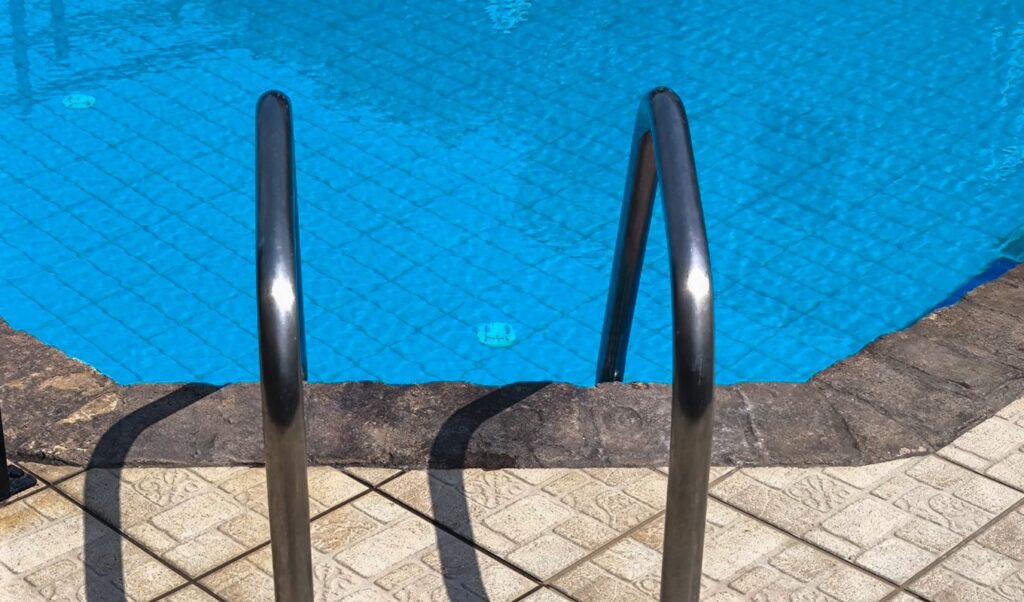
The family of a 4-year-old child who drowned in a beach bar pool in Paros is in mourning. The 69-year-old beach bar owner, who was released from custody, is also listed as a lifeguard. However, authorities are investigating whether he held the required qualifications and a valid license to carry out those duties, and whether he was present at the scene at the critical moment.
Investigators are also focusing on the circumstances under which the child became separated from his parents, made his way to the pool, and ultimately ended up in the water. Nikos Rigas, vice president of the Athens Police Officers’ Association, spoke on Tuesday morning (11/08) on MEGA about the case.
The drowning of a 4-year-old in Paros – Justice has now spoken
“Justice has now spoken. The parents and the beach bar owner have been arrested. They were released, of course, and a regular trial date will be set. This is yet another drowning incident in a long list we’ve seen. We recently had another case, if you recall, involving a six-year-old who slipped away from his mother’s attention while she had gone to clean a house. Because it’s not just hotel pools — private pools are also places where young children are present, and it’s being investigated whether all necessary safety measures were in place. That means whether there was a lifeguard, a defibrillator, and first aid equipment. Where the parents were, whether the child slipped away and why. And of course whether the beach bar had all the required pool fencing in place. Unfortunately, we lose many lives every year — both at sea from drownings and, sadly, in pools, which are supposed to be a more controlled and, one might say, more private environment,” he stressed.
Responsibility coexists with grief
Psychologist Vasilena Stavropoulou commented on the issue of responsibility and the psychological burden of such a tragic event. “This is one of those cases where, unfortunately, responsibility coexists with grief and loss. And you can understand how incredibly painful that is, because a small child has lost his life under circumstances that could have been prevented. From my perspective, what I need to say — because other parents are watching — is that we have very specific guidelines, even from the World Health Organization, regarding the supervision of children aged zero to four. As Mr. Rigas mentioned earlier, even older children aged six and eight are sometimes at risk — for instance, if they’ve eaten too soon before swimming — and we do see drowning cases as a result. So you can understand that for children aged zero to four, leaving them unsupervised near water is like putting a child in the middle of traffic and telling them to cross the road on their own,” she said.
“Supervision near water is absolutely mandatory at these ages, because a child cannot be responsible for their own safety. A child this age often gives the impression — especially if they’re lively — that they’d be able to call out if something went wrong, or that someone would be able to intervene in time. As Mr. Galenteris can confirm, drowning is relatively silent. It happens quietly. So the more continuous and attentive adult supervision is, the lower the chances of a child being in danger. And a child doesn’t have to fall into the water to be at risk — a child this age can easily slip out of an adult’s line of sight. The critical factor is the amount of time that passes between when the child enters a dangerous situation and when an adult notices and intervenes.”
What Dimitris Galenteris said
Forensic pathologist Dimitris Galenteris explained: “I want to highlight two key points. First, that drownings in a pool are silent — as strange as it may sound, a child sinking and remaining underwater is usually completely silent. No one even notices. But more importantly, drowning in fresh water is entirely different from drowning in salt water. We need to pay very close attention to this, because death can occur far more quickly, since the mechanism of drowning is completely different compared to what happens in the sea. Every time I’ve had the opportunity to speak publicly, I genuinely stress and underline that pools require extreme caution. A pool is a very particular environment, and if we’re not careful, death can come very fast. There are two key factors when it comes to children and pools — it’s the combination that matters. On one hand, a child’s lungs and airways are extremely small, which means breathing can stop very easily. On the other hand, fresh water can cause death very rapidly, and that death may be irreversible. So a child’s presence in a pool carries very serious risks. It comes down to salt content and osmosis — the way water moves inside the lungs is entirely different depending on whether it is salt water or fresh water.”
The statistics of recent years
Panagiotis Paschalakis, president and founder of the non-profit organization Safe Water Sports, made the following remarks: “This is undeniably a source of immense grief — for the family and for all of us — to be mourning the loss of a young child today, under circumstances that I think everyone recognizes could have been prevented. Over the past five years, based on the data we’ve collected, there has been a consistent number of drowning deaths in inland waters — not as large as at sea, but significant, because they occur primarily in hotel pools. We’re talking about approximately twenty people over the last five years who have lost their lives in what we call inland waters — that is, pools, lakes, and rivers. Of course, the figure at sea is much higher, at around 370 people per year. However, fifty percent of pool-related drowning deaths occur in hotel swimming pools or similar facilities — such as the beach bar in this case — and it’s a phenomenon that repeats itself every year. There is certainly a great deal more that can be done to address it,” he emphasized.
“It’s something that happens very, very fast”
“For young children — specifically those under five years old, as has already been mentioned — parental supervision and attention is the single most important factor. Drowning is something that happens extremely quickly as an event. That means even thirty seconds can sometimes be tragically enough to result in a loss of life. As for older children — because drowning incidents do occur among older age groups too — the most important thing, in my view, is ensuring that children have an adequate level of swimming ability. This is something our organization consistently works to achieve, in collaboration with the Ministry of Education — ensuring that every public school in the country provides at least a minimum level of swimming instruction, so that no young child is ever at risk in an aquatic environment in our country,” he added.
The legislative framework
On the legislative framework: “It is a critical issue, and as we mentioned, around 370 people lose their lives at sea every year. That is an enormous number, and many efforts are being made. It is very large indeed. I would just add, specifically regarding the pool at the beach bar, that the legislative framework governing safety conditions and the required training for lifeguards — or safety supervisors, as they are called — is quite outdated. I would say it dates back to 1973. It is an issue we have been raising for some time. It essentially refers to a circular from the Ministry of Health. It is something that absolutely needs to be upgraded and modernized, because there are many things that must change. It is something we have already proposed to the Ministry of Health, and I believe that — even as a result of such a tragic event — it could serve as a starting point for modernizing the legislative framework, which is also extremely important.”
“As for hotel swimming pools specifically, the entire regulatory framework was updated in 2020 — something our organization was very actively involved in — which for the first time established that the person supervising a pool must be a qualified lifeguard from an accredited lifesaving school, holding a certificate either as a pool lifeguard or an open-water lifeguard. Their presence at the pool throughout its entire operating hours became mandatory. Imagine that no such requirement existed before. However, regarding pools at non-hotel facilities, the 1973 framework under the Ministry of Health — which makes no such provision — remains in place,” he added.
“The pool must be fenced so that no one can fall in”
Mr. Rigas noted: “And if I may add — there is also a set operating schedule for pools, and a lifeguard must be present throughout the entire period the pool is in operation. When there is no lifeguard on duty, there must be a clear sign indicating that no lifeguard is present. At that point, the pool must be fenced off so that no one can fall in. The water doesn’t go away. But let us be clear — we do now genuinely see lifeguards on duty in many cases. I agree with the figures — we lose approximately 400 people a year to drownings at sea. But pools are equally dangerous, especially for children.”
“Our reflexes are far too slow”
“Allow me to add something to what Mr. Rigas — quite rightly — said. On the issue of vigilance we mentioned earlier: the primary responsibility lies with the parent, the caregiver, the person who takes it upon themselves to accompany the child near the water, whether at sea or at a pool. I want to say that very often we see tragedy strike precisely because of the assumption that ‘if something happens, I’ll notice. If something happens, I’ll catch it in time.’ In most cases where something actually does go wrong, everything unfolds extremely fast, and ultimately our reflexes are far too slow compared to what is happening to a drowning child in that moment. So I say that vigilance falls on the caregiver. Because if someone needs to intervene — whether it’s a fellow swimmer or a lifeguard who needs to be alerted — by the time that alert is raised, it is most often already too late. Consider that the guidelines we have, even from the American Academy of Pediatrics, state that at these ages, when a child is near water, they should be within arm’s reach — meaning the distance of an outstretched arm. That is the distance a child should be from you when they are near water,” added Ms. Stavropoulou.