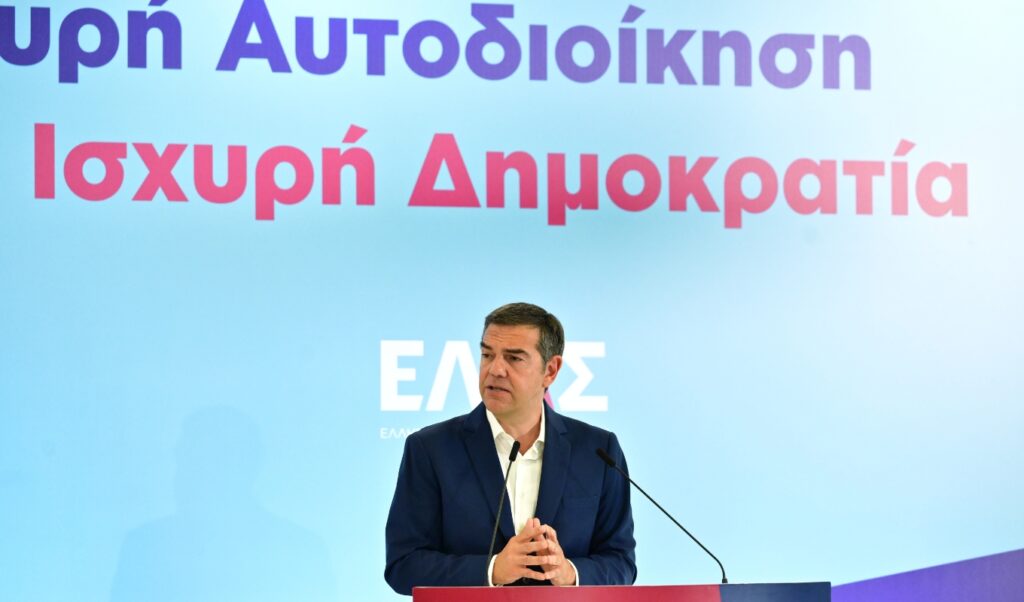
Alexis Tsipras, president of the Greek Left Alliance and former prime minister, launched sharp attacks against the government over the cost-of-living crisis and against the Greek judiciary over its functioning — while asserting that, armed with his governing experience, he now knows not only what he wants but how to achieve it.
In an interview with in.gr — the first part of which was published on Monday, 10/8 — he noted that “it’s a good thing that European institutions exist,” and described the Greek judiciary as “essentially castrated by its leadership, which is appointed by this government.” “It would not be an exaggeration to say that a regime has been created,” he stated bluntly.
“We have become the European Public Prosecutor’s Office’s best customer,” he said pointedly, referencing the wiretapping scandal, the Tempi rail disaster cover-up, and the OPEKEPE agricultural payments agency scandal. He also referred to a series of other cases currently under investigation by the European Public Prosecutor’s Office. Tsipras places corruption alongside the cost-of-living crisis as the two major problems facing Greece today. “If the first great issue is the high cost of living,” he argues, “corruption is also the second critical factor affecting Greek society.”
“A large part of the cost-of-living crisis,” he explains, “is due to this very corruption,” because it “drains critical resources.” He connects the issue directly to everyday life: “Every euro missing from the public purse because it goes to bribes or direct procurement contracts is a euro missing from the public school. It is a euro missing from the public hospital.”
On the economy, Tsipras focuses on the high cost of living and the three key factors driving it — energy, food, and housing. He speaks of intervening in the public power corporation (PPC/DEI), reducing energy costs, monitoring prices “from field to shelf,” and adopting a different model for housing policy.
He rejects the notion that the cost-of-living crisis can be addressed primarily through subsidies and welfare passes, insisting instead on the need to confront oligopolies, cartels, and profiteering practices.
Tsipras also opens the discussion about his political future and personal journey. He states that today he “not only knows what he wants, but also how to do it,” describes political instinct as his personal “GPS,” and reflects on the “sirens” of politics — among them vanity and narcissism.
Tsipras: “A regime has been created”
Tsipras is particularly sharp when the conversation turns to the quality of democracy and the functioning of institutions. “I am referring to the fact that we have become the European Public Prosecutor’s Office’s best customer.”
“I don’t think there is another country whose relationship with the European Union is defined as much as ours by its relationship with the European Public Prosecutor’s Office,” he argues.
He then lists the cases he is referring to: “One is the wiretapping scandal, one is the cover-up of the Tempi disaster and the evidence tampering, and one is the corruption surrounding OPEKEPE.”
The former prime minister then directs his criticism at the functioning of the Greek judiciary: “On the other hand, one looks at all this and says — it’s a good thing that European institutions exist,” he notes, before concluding that “here, it would not be an exaggeration to say that a regime has been created.”
Tsipras: “Corruption and the cost-of-living crisis are twin brothers”
“If the first great issue is the high cost of living,” says Tsipras, “corruption is also the second critical factor affecting Greek society — and not only in its moral dimension. Because it drains critical resources.”
He continues: “Corruption and the cost-of-living crisis are twin brothers, because a large part of the high cost of living is due to this very corruption.”
To explain what this means in practice, he uses a direct example: “Every euro missing from the public purse because it goes to bribes or direct procurement contracts is a euro missing from the public school. It is a euro missing from the public hospital — from those critical services that, in times of economic hardship, could support the average Greek family.”
Tsipras: “Today I know not just what I want, but how to do it”
Regarding his political comeback and how he differs from who he was in 2015, Tsipras draws primarily on his experience in government. “In 2015, I knew what I wanted to do and what I wanted to happen, but I didn’t know exactly how it could be done,” he stresses.
“Having now gained that governing experience, I am in a position today to say that I not only know what I want, but also how to do it. And I know what is achievable and what is not.”
Tsipras: “Politics is the art of expanding the possible”
Tsipras also distances himself from the logic of reckless, populist promises.
“I could promise you that overnight your life will become paradise. That your salary will triple. How credible would that be?” he asks.
“Politics,” says the president of the Greek Left Alliance, “is not the art of the possible — it is the art of expanding the possible.” He speaks of “small everyday victories” that can gradually change people’s lives and broaden “the interests of the many.”
“We can stop this terrifying profiteering, this accumulation of wealth in the hands of the top one percent of Greek society”
On economic policy, the former prime minister identifies the unequal distribution of wealth and the high cost of living as the core problems. “This terrifying profiteering can be stopped — this accumulation of wealth in a limited percentage,” he says, arguing that “one percent of Greek society is getting richer and richer while the vast majority is struggling enormously.”
The answer, he says, lies not in promises of “miracles” but in concrete interventions targeting wages, prices, energy, and housing.
At another point, he noted that today’s problem is not the market economy itself, but its distortion by monopolies and oligopolies: “Where we have ended up… what we must first and foremost say is that capitalism needs to function under normal conditions,” he said specifically.
“The most significant problem is the high cost of living” — “The cost-of-living crisis is not exclusively imported”
At the top of Greek society’s problems, Tsipras places the cost-of-living crisis, which he breaks down into three key factors: housing, energy, and food.
He rejects the view that it is exclusively an imported problem, arguing that “a very large part is due to the profiteering that exists in our country, to cartels and mainly to oligopolies, and to the government’s lack of political will to take them on.”
On food prices, he proposes the creation of a Digital Price Observatory, monitoring the journey of each product “from field to shelf” and checking profit margins at every link in the supply chain.
Tsipras: “The cost-of-living crisis cannot be solved with welfare passes”
Tsipras rejects subsidy policy as the primary tool for addressing the cost-of-living crisis. “The issue of high living costs cannot be addressed with welfare payments.” “Our logic is not to subsidise our way out of the crisis, because you don’t solve any problem that way.” Without ruling out emergency support for those who need it, he insists that the root causes must be tackled: “The cost-of-living crisis is not solved with passes and subsidies. It is solved with a more decisive policy of confronting powerful vested interests.”
Tsipras: “Airbnb must be regulated and Golden Visa in residential property must stop”
On the housing crisis, he proposes utilising public real estate assets, incentives to bring vacant private properties back onto the market, and the development of social and affordable housing programmes. “Airbnb must be regulated and Golden Visa schemes for residential property must stop — while at the same time programmes to create new housing must be launched,” he says.
He acknowledges that the results of such a policy will not be seen overnight, but estimates that within a horizon of one to two years, the first meaningful changes can begin to emerge.
“Wage increases and a lower cost of living”
On the question of incomes, Tsipras shifts the conversation from the minimum wage to the average wage and, above all, to purchasing power. “We don’t have wage cuts, but we do have rising prices. So disposable income — purchasing power — has been significantly eroded,” he notes. He sums up the goal in a single phrase: “Wage increases and a lower cost of living.”
He also sets convergence with the rest of Europe as a broader political and economic objective: “Today, a serious national goal must be to finally converge with the European average and stop lagging behind.”
“Narcissism is one of the sirens you have to navigate around”
The interview also has a more personal dimension, taking its cue from Homer’s Odyssey and the poem “Ithaca.”
“In every person there are sirens. In every journey there are sirens — and they mostly come from within us,” says Tsipras. He elaborates: “Vanity, often a lack of a sense of weight, of staying grounded, narcissism in many people — these are sirens that one must navigate around, must balance.”
Tsipras: “In politics, the GPS is largely instinct”
As for his own compass, he says he continues to trust his instincts. “I listen to the advice of experts, communications consultants, and pollsters, but I value and rate political instinct more highly than their counsel, more often than not.” He makes his position clear: “I am not someone who will fit into a little box. Who will say things the way certain people tell me to say them.”
“The Mediterranean Maduro or a sell-out?”
When asked about criticism that he now appears more low-key and less confrontational, Tsipras invokes the contradictory critiques directed at him. “The main criticism I receive from New Democracy is that I am the Mediterranean Maduro. Others say I am a sell-out.” “When you hear exactly opposite criticisms,” says Tsipras, “the truth is probably somewhere in the middle.”