A labyrinthine plot involving target surveillance, at least two vehicles, heavy weaponry, fake license plates, and a deliberate plan to destroy all evidence — this is the picture painted by the court indictment in the murder of Vangelis Zambounis, shot dead in the early hours of January 14, 2024, in the Neos Kosmos district of Athens. Nearly 31 months after his cold-blooded execution outside a gas station at the corner of Amvrosiou Frantzi and Ilia Iliou streets, justice is now sending nine defendants — one of whom is excluded from the homicide charge but implicated in participation in a criminal organization — before the Athens Three-Member Court of Appeal for Felonies. All of them are now well-known figures in underworld circles, as police investigators believe they are key members of the Russian-speaking Mafia, also known as the “cigarette gang” of the notorious Edik. The image of two black-clad hitmen stepping out of a Lexus and riddling Zambounis with bullets is merely the surface of a far larger and more sophisticated operation — one that, according to the court’s indictment, extended from meticulous planning all the way to the systematic elimination of any evidence left behind. Judicial authorities believe that behind the hit lay an organized mechanism whose members allegedly played different and interchangeable roles: from triggermen and getaway drivers to lookouts and individuals tasked with surveilling the intended target.
Read also: Zambounis murder: The 35-year-old reportedly Edik’s “right-hand man” remanded in custody
The second car that was “watching” Zambounis
One of the most significant pieces of evidence in the case file concerns a silver-grey Nissan Pulsar with tinted windows. The vehicle was captured on security cameras moving through the area prior to the murder. According to the evidence assessed by the judicial council, it passed the location twice and at approximately 1:34 a.m. came to a stop at a position offering a direct line of sight to where Zambounis’s car was parked. Minutes later, the execution would begin. The Nissan was carrying the license plates ITM-5828, which the indictment describes as counterfeit, and is believed to have served as a “support vehicle” during the assassination. The presence of this second car is a critical element of the court’s theory, as it reinforces the assessment that the attack was not simply an armed ambush carried out by two individuals, but a premeditated operation involving multiple participants.
The 97 shell casings
It was approximately 1:45 a.m. when the Lexus pulled up outside the gas station. Two armed men stepped out of the vehicle. One approached Zambounis’s BMW X5 and opened fire at close range, while the second fired from a greater distance. The perpetrators used Kalashnikov-type military rifles, and at the end of the attack, one of them reportedly approached the vehicle while also carrying a handgun. A total of 97 shell casings were recovered from the scene, while Zambounis was found to have suffered multiple gunshot wounds to the head, chest, abdomen, and limbs. His death was instantaneous. Footage of the brutal killing circulated online for weeks.
The Lexus had been stolen in Milan
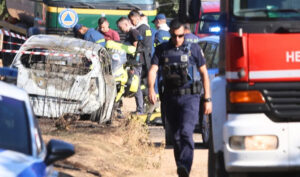
Equally revealing is the history of the hitmen’s vehicle. The silver Lexus had been stolen in the Milan area of Italy in June 2023 and on the night of the murder was fitted with counterfeit license plates bearing the number ZXT-9223. According to the indictment, the fake plates had been manufactured prior to the attack specifically for use with the Lexus during the execution. Approximately 25 minutes after the murder, at around 2:10 a.m., the vehicle was found on a dirt road in Chaidari, alongside Ethnikis Antistaseos Avenue — engulfed in flames. In the court’s assessment, the burning of the car was an integral part of the same plan: the vehicle had to be destroyed along with any trace that could lead investigators back to those who had used it.
The hideout in Aspropyrgos
The investigation also led authorities to a detached house at the end of Mentas Street in Aspropyrgos, which they treated as a key node of the alleged criminal organization. Among the items discovered on the premises were Kalashnikov magazines and ammunition. Of particular significance, however, was the footage recovered from the property’s security cameras. Authorities retrieved recordings spanning the period from December 19, 2023 to January 17, 2024 — covering both the days before and after the murder. The footage shows individuals whom authorities connect to the case, and remarkably, activity at the property was recorded even on January 14, just hours after the execution had taken place.
The eight defendants charged with murder
Eight of the nine defendants are being referred to trial on charges of premeditated homicide in a calm state of mind, committed jointly, as well as a series of related offenses involving the use of heavy weaponry, the illegal discharge of firearms, and the arson of the Lexus. The exception is a 43-year-old ethnic Greek born in Georgia. The judicial council determined that there was insufficient evidence of his involvement in the actual execution, as he was in custody at the material time. He is nonetheless being referred to trial on other charges within the same case file.
The mystery of the two triggermen
Despite the volume of evidence gathered, one of the case’s most pressing questions remains unanswered. The indictment refers eight defendants to trial for the murder on the basis of joint perpetration and also mentions unknown co-perpetrators — yet nowhere in the relevant sections of the document is there a clear, named identification of the two men captured on camera stepping out of the Lexus and opening fire. This leaves a critical chapter of the case wide open: Who were the two men holding the Kalashnikovs? Who was behind the wheel of the Lexus? Who were the occupants of the second vehicle, and who gave the order for the hit? The answers to these questions will now be sought in the courtroom of the Athens Three-Member Court of Appeal for Felonies.