Rapid developments are unfolding in the energy sector, as reports by “Parapolitika” regarding the “unfreezing” of the so-called “cable” for the electrical interconnection of Europe and the Middle East via Crete and Cyprus are now fully confirmed. An agreement has been signed for the entry of French giant Meridiam as the majority shareholder in the Great Sea Interconnector (GSI) company, which will undertake the project. In addition, a trilateral agreement was signed between ADMIE (Greece’s Independent Power Transmission Operator), GSI, and the also French company Nexans, covering seabed survey operations required for the project’s implementation — namely, the laying of the cable. On a financial level, Meridiam‘s involvement guarantees the project’s funding, which had been — at least ostensibly — one of the reasons the initiative had stalled.
Read also: The Greece-Cyprus electrical interconnection gets a French stamp: What the entry of French investment group Meridiam means for our country
Stavros Papastaurou: The Meridiam agreement creates a new and powerful dynamic
Speaking exclusively to “Parapolitika,” Greece’s Minister of Environment and Energy, Stavros Papastaurou, stated: “The agreement for Meridiam’s entry into the GSI shareholder structure creates a new and powerful dynamic for the implementation of a project of strategic importance for Greece, Cyprus, and Europe as a whole. The participation of an international investment group with experience in complex infrastructure projects enhances the project’s credibility, financial foundation, and implementation capacity.” The minister also explained that “GSI is not simply yet another energy infrastructure project. It represents an investment in Europe’s energy security, in the diversification of energy routes, and above all, in ending Cyprus’s energy isolation. Greece is moving forward with a plan, consistency, and confidence — leveraging its own capabilities and its strong European alliances, with an unwavering commitment to International Law.”
The strategic importance of the Great Sea Interconnector for Greece and Europe
This development must be read primarily in geopolitical terms. “The agreement confirms our vision for an energy-secure, resilient, and interconnected Europe. Our strategy in the Eastern Mediterranean is one of cooperation, development, and stability,” Minister Papastaurou noted emphatically. According to reliable sources, France’s active involvement has been in the making for approximately two years, following a trilateral meeting between Presidents Macron, Prime Minister Mitsotakis, and President Christodoulides in Paris. However, developments accelerated following the French president’s visit to Greece last April.
French interest in the Great Sea Interconnector and the backstory behind the deal
Specifically, the groundwork for “unfreezing” the cable project was laid in the autumn of 2024, following the Paris trilateral summit. It was there that French company Meridiam began to “activate,” broadening the prospect of entering the GSI cable consortium. Meridiam’s competitive advantage — beyond its strong French credentials and its cooperative relationships with both the European Investment Bank (EIB) and the European Bank for Reconstruction and Development (EBRD) — lies in its having already delivered a comparable project: the England-Germany subsea interconnector. As a result, the company possesses the relevant expertise and know-how.
Although initial discussions concerned Meridiam acquiring a stake of less than 50% in the cable consortium, the French group — with its broad investment portfolio — ultimately secured a stake exceeding 50%.
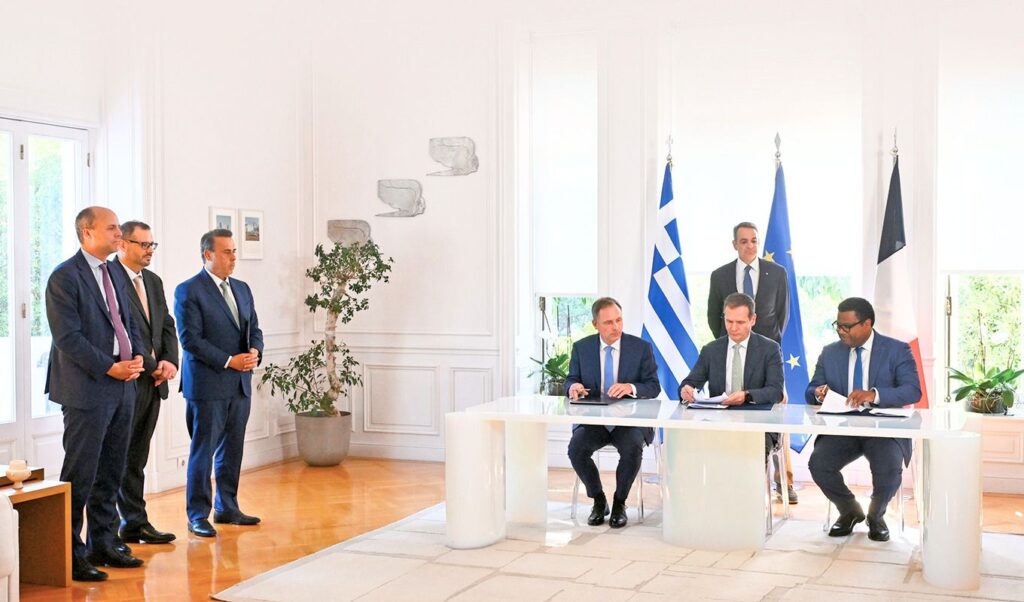
The agreements were signed at the Maximos Mansion, with Prime Minister Mitsotakis presiding over the ceremony, covering both ADMIE’s agreements with Meridiam and with the also French company Nexans — the firm that will manufacture the cables and which has, on various occasions, shown considerable hesitation. Informed sources, however, told this reporter that the “blessing” of President Macron on the one hand, and Meridiam’s entry on the other, are pushing Nexans to set aside any remaining reservations. The same sources trace the restart of discussions — which had seemed to have “short-circuited” — to Emmanuel Macron’s visit to Greece. At that time, Meridiam CEO Thierry Déau was a member of the French business delegation accompanying Macron and participated in talks with the Hellenic Federation of Enterprises (SEV); he came to Athens on Wednesday to sign the relevant agreements. A more substantive discussion took place during the meeting between the Greek prime minister and the French president, while in the preceding period Minister Papastaurou also held contacts with French investors.
Cyprus welcomes Meridiam’s entry into the GSI project
The Cypriot government also expressed its satisfaction at the French investment group Meridiam’s entry into the project. Cyprus’s Minister of Energy, Commerce and Industry, Michalis Damianos, stated that “the study will reveal exactly what the cost will be, because if it has risen above €1.9 billion, we will need to examine how any such additional needs will be covered by investors.” He also stressed that Nicosia insists on obtaining updated figures from the European Investment Bank before any final decisions are taken.
Seabed surveys for the Greece–Cyprus electrical interconnection
The surveys for the pipeline — that is, the seabed mapping and bathymetric measurements — still have a way to go, with sources indicating that the relevant NAVTEX notice is expected to be issued after the summer period, around late September. Leontios Portokalakis, a hydrocarbons expert and member of the Board of Directors of ELISME, explained to “Parapolitika” that approximately one-fifth of the route has been mapped so far, following a near-confrontation incident near Kasos, when Turkey sent warships to the area, dangerously “heating up” the waters. Athens maintains that surveys in that area were completed as planned; however, further work remains.
Experts explain that the cable-laying phase has not yet been reached. Seabed mapping along the entire pipeline route must first be completed. In practical terms, the necessary surveys must be carried out to determine the optimal routing — given the considerable water depths involved — after which Nexans personnel are expected to arrive to lay the cable.
Turkey and the “thorn” of Aegean surveys
The question that remains to be answered is whether this French “umbrella” guarantees that the required seabed surveys in the Aegean will proceed without obstruction — or whether Greece will once again face interference from Turkey, as occurred two summers ago. In response to a relevant question, senior government sources appeared reassuring and told this reporter meaningfully that the broader and more inclusive the investment consortium behind the project, the more difficult it will be for Ankara to react. What is certain is that these developments will not please Turkey — which, even before the latest cable-related news emerged and amid ongoing wildfires, decided to raise the temperature in the Aegean airspace.
Following a prolonged period of calm and limited aerial activity, a record number of violations was recorded on Monday, August 3rd. Experts describe it as a three-year record achieved in a single day.
Specifically, the counter logged 18 violations by four Turkish unmanned aerial vehicles across the northeastern, central, and southeastern Aegean. The last time a comparable number of violations was recorded in a single day was on March 14, 2023, when three Turkish helicopters committed 23 violations. Meanwhile, on Thursday, two armed Turkish F-16s, five unmanned aircraft, and one electronic warfare aircraft carried out 17 violations. A dogfight between Greek and Turkish F-16s also took place.
The incident is causing understandable concern among Greek military planners, as just a few days earlier, on July 30th, a Turkish drone flew over the island of Farmakonisi — the first overflight of Greek territory by a Turkish aircraft in more than forty months. Turkish drones also conduct surveillance operations, attempting to locate Greek weapons systems and their deployment configuration across the Aegean islands.
Kaja Kallas issues a warning to Turkey
Against this backdrop, the message sent to Turkey by Kaja Kallas — calling for respect for International Law and the sovereign rights of European Union member states — takes on significant weight. The EU High Representative for Foreign Affairs and Vice-President of the European Commission, responding to a question from the head of PASOK’s European Parliament group and Vice-President of the Socialists and Democrats Group, Yannis Maniatis, regarding the pending Turkish draft law on the so-called “Blue Homeland,” stated categorically that “the Commission is closely monitoring media reports and statements referring to preparations for the submission to the Grand National Assembly of Turkey of a draft law on maritime jurisdiction zones.”
Kallas further made clear that Turkey’s “abstention” from “unilateral actions that violate International Law and the sovereign rights of member states” is a prerequisite “for the development of a cooperative and mutually beneficial relationship between the European Union and Turkey.”
Published in Parapolitika