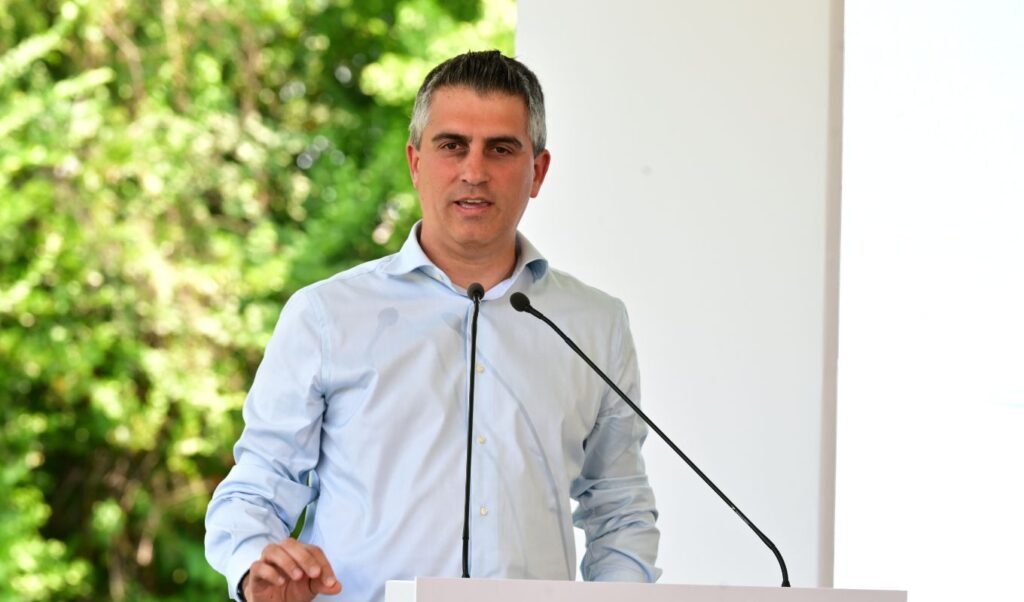
Greece’s Minister of Infrastructure and Transport, Christos Dimas, conducted an on-site inspection of the Northern Road Axis of Crete (VOAK) construction sites on Thursday, visiting Chania, Rethymno, Heraklion, and Agios Nikolaos. He was accompanied by Deputy Minister of Infrastructure and Transport Nikos Tachiaos and Secretary General of Infrastructure Dimitris Anagnopoulos.
During the visit, officials confirmed the progress of works across all sections of the new motorway, as well as the advancement of safety improvement interventions on the existing road axis — measures aimed at enhancing road safety until the full completion of the project. Following the inspection, Minister Dimas stated: “Today we conducted an on-site inspection along the entire length of VOAK, in Chania, Rethymno, Heraklion, and Agios Nikolaos, as construction is now actively underway across all sections of the new motorway.
Works on the bypasses of Chania, Rethymno, and Heraklion are progressing according to schedule and will soon be opened to traffic, significantly improving travel conditions and road safety in Crete’s largest cities. The Neapoli–Agios Nikolaos section is approaching completion, and the first approximately 10 kilometres of the new motorway — from Agios Nikolaos to Neapoli — are expected to open to traffic in the near future.
At the same time, road safety interventions on the existing VOAK corridor are advancing at an accelerated pace and remain an immediate ministry priority until the new motorway is fully completed. These works span a total length of 131 kilometres, from Kissamos to Heraklion, with the goal of ensuring safer travel for residents and reducing road accidents.
The interventions include resurfacing, reconstruction and reinforcement of road markings, installation of new vertical signage, separation cones, safety barriers, lighting upgrades, vegetation clearance, and a range of technical works designed to improve visibility and overall traffic safety.
Works have already been completed on the Chania–Kolymbari, Rethymno–Geropotamos, and Heraklion CHYTA–Linopereamata sections. The target is to complete the remaining four high-risk sections by the end of August: Souda–Georgioupoli, Petres–Atsipopulo, Kissamos–Kolymbari, and Geropotamos–Heraklion CHYTA.
The government’s goal is to deliver to the people of Crete a modern, safe, and fully functional motorway that will permanently transform how residents and visitors travel across the island, and serve as a powerful driver of development for the entire region.”
Deputy Minister of Infrastructure and Transport Nikos Tachiaos added: “Yet another visit by the political leadership of the Ministry of Infrastructure and Transport to Crete gave us the opportunity to witness first-hand the pace at which these major road projects — all of which have already been contracted — are moving forward.
These include both temporary interventions, such as the road safety works, and projects that are now taking their permanent form, such as the VOAK sections currently under construction. Crete has become one vast construction site, thanks to the personal commitment and ongoing oversight of Prime Minister Kyriakos Mitsotakis.”
Also present during the site inspections were Deputy Minister of Migration and Asylum and Chania MP Sevi Voludaki, Chania MP Alexandros Markogiannnakis, Heraklion MP Maximos Senetakis, First Deputy Speaker of the Hellenic Parliament and Lasithi MP Giannis Plakiotakis, and the Regional Governor of Crete Stavros Arnaoutakis.