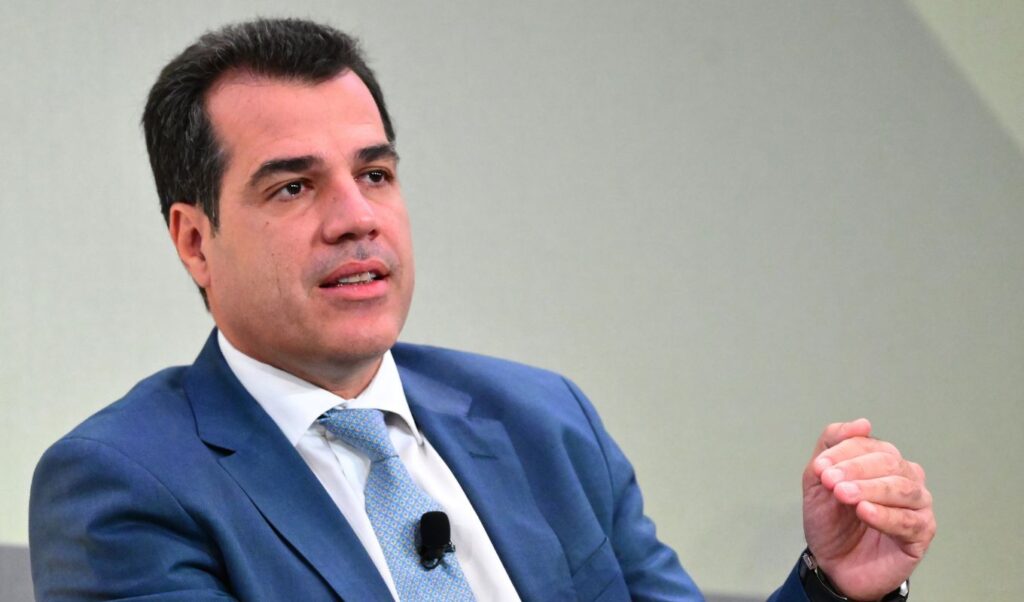
Migration and the events in Ceuta were at the center of remarks by Greece’s Minister of Migration and Asylum, Thanos Plevris, who noted among other things: “At the Council meeting where I represented our country, we expressed support for Spain. We are not among the countries that want to reopen the debate on Schengen.”
Speaking on MEGA television, the Migration Minister continued: “As you understand, first-entry countries are also the most exposed countries. What happened in Spain can happen in any country, and we must be prepared.”
Plevris on migration: Europe faces extreme situations and must be ready
Thanos Plevris recalled that “the same thing was about to happen in our country in 2020 at the Evros river, where we managed to hold the line — but the pattern was identical. Tens of thousands of migrants had gathered to cross. Since then, what the Prime Minister proposed in his Politico article — and what we have put into practice as a country, proposing it at the European Council — we implemented at Evros by sealing the border. We also implemented it last year when we suspended asylum processing after we observed what appeared to be a weaponization of migration from Libya, with thousands of people arriving in a single weekend. Around 3,000 individuals had entered when we made the decision to suspend asylum processing — meaning we were not examining asylum applications and were returning people immediately. 3,000 entered in one weekend, and then only 3,000 entered over the following three months. So the measure had worked. This is essentially what Spain is doing now. Spain has a socialist government. If it had wanted to operate strictly within the framework of the Pact, do you know what it would have had to do with the 72,000 who entered? Process each and every asylum application individually. Europe would have collapsed. Quite rightly, Spain — in practice, and at the limits of international law — is immediately returning those who entered as part of what amounted to an invasion. Spain’s minister informed us that over four-fifths have already been returned. So we can see that in extreme situations, Europe must be prepared.”
He then emphasized: “So what are we saying? Every tool we have placed on the table — asylum processing, respect for rights, second-instance appeals, legal guidance — all of that applies under normal migration flows. But if we see an obvious weaponization of migration by a state, or if we suddenly see flows spiraling out of control, then Europe must clearly protect itself. And it will do so through border protection and asylum suspensions where necessary, so that immediate returns can take place.”
The Greek proposal and the new migration pact
When asked whether he identifies any gaps in EU migration policy, the Migration Minister replied: “The truth is that in recent times Europe has made very significant progress, because it has moved closer to the Greek positions. Both the Migration Pact and the Returns Regulation — and next year, if all goes well, the goal is for five states — Greece, Germany, Austria, the Netherlands, and Denmark — to have a detention center outside Europe, in Africa. This may also coincide with the Greek presidency of the EU, and it shows that Europe is now moving toward a tougher migration policy.”
He then pointed out: “And it is already producing results. Yesterday the Commissioner told us that in the first half of this year, around 50,000 people in total entered Europe through all entry points. Bear in mind that Greece and Italy are the main entry points. To quote EU Commissioner Magnus Brunner directly: 50,000 people were entering Greece’s islands every single week in 2015. So we understand that Europe has made significant progress. But where does the gap lie? We identify it clearly: under current conditions, with relatively low migration flows across Europe, the Migration Pact and the Returns Regulation can function. However, Europe is not prepared for an emergency scenario like the one in Ceuta, which could occur at any entry point. In such cases, when weighing the theoretical rights of those entering illegally against the rights of European citizens to protection, the rights of European citizens must prevail.”
Plevris also responded to whether he is concerned that countries which are not migration entry points hold a different stance: “Yes, that is the core tension in Europe. Europe has traditionally been divided into two camps: what we call the Med 5 — the entry countries, Malta, Cyprus and primarily Greece, Spain, and Italy (though Malta and Cyprus are often bypassed because, as islands, they are not always the preferred route — migrants tend to choose countries with land borders into Europe to enable onward secondary movement) — and the Northern countries, which used to argue that Southern countries simply needed to do their jobs better. A balance was struck with the Pact.”
He continued: “On one side, the Southern countries agreed to do their part in border protection and controls — which we do — and in return, the Northern countries would provide solidarity. But what do we see now? We disagree, for example, with Spain’s policy approach. We believe that what happened in Ceuta is also partly the result of a misguided policy by Prime Minister Sánchez. Three months ago, he decided to regularize undocumented migrants based on a short period of residence on Spanish soil — with 1.2 million pending applications, mind you: 1.2 million undocumented migrants seeking regularization. It is obvious that the message you are sending — whether to desperate people, to criminal smuggling networks, or to people who are not desperate but simply want to be in Europe — is ‘Spain regularizes people.’ Such policies, as we have said, act as a magnet. And so does the ruling by the Spanish court — because at some point we need to look at court decisions. Do you know what the Spanish court ruled? That even though under the Pact, migrants must be held at the border — which is a deterrent, because if someone enters illegally and you keep them near the border while examining their asylum case, they know they may be returned — a Spanish court came along and said that due to overcrowding, they must be transferred to the interior. The smuggling networks, in turn — using both real events like the regularization policy and daily disinformation — are sending messages that Europe’s gates are open. When government policy makes that a reality, it has consequences. We follow a different approach.”
On migration flows
Regarding the possibility of a mass migration wave reaching a Greek island, Mr. Plevris noted: “Before we get to that scenario, the first priority is managing regular flows — reducing them. How do we believe we can keep flows low, and what do the data show? By implementing a deterrence policy — making clear that the borders are guarded. Second, because no matter how strong your deterrence at sea, some flows will always occur: you need cooperation with third countries. Turkey. Right now, our cooperation with Turkey on migration is in the best possible state, and flows from Turkey are almost negligible by Turkish standards — under 4,000 for the entire first half of the year. With Libya, which is a major entry point, we worked to develop a cooperation framework, because two things were happening there — and still are. On one hand, it is not a fully organized state and has significant governance gaps. On the other hand, there are clearly identifiable instances of migration being weaponized. There are two governments in Libya, and we — notably — speak with the government that the European Union does not officially recognize, because the flows into Greece come from the eastern side, not the western. In July, however, after we had established cooperation and supplied them with equipment they said they needed because they claimed an inability to control their own borders, and after Frontex assets moved closer to the Libyan coast to provide real-time monitoring, flows dropped from 3,500 in July of last year to 1,400.”
When asked whether he fears such a scenario could unfold in Greece, the Minister noted: “In the first seven months of this year, we saw a 35% reduction in flows — at a time when Spain, for instance, was seeing an increase. These are matters of policy. We also saw a 40% increase in forced returns. When we passed the law making detention mandatory for anyone entering illegally — with the option to avoid detention by voluntarily returning — we were told we were violating human rights. Currently, we have 1,400 cases of individuals who were either convicted or served sentences for minor offenses and have chosen to return voluntarily. Of those, 950 returns have already been carried out, with the rest currently being processed.”
He added: “So where is the country theoretically exposed? We have sealed the Evros border, so we believe that whatever happens there, we will be ready to respond as we did in 2020. Or the exposure lies in our maritime borders — if boats suddenly started departing en masse tomorrow morning. That is precisely why, having identified this gap in Europe’s preparedness, the Prime Minister is proposing: beyond border protection, which is the number one priority, the model we just saw in Spain should be adopted. In such conditions, anyone who enters should not have their asylum claim examined — they should be collected and immediately returned.”
“We are doing everything we can to be prepared”
The Migration Minister then turned to the recent wildfires, saying: “First and foremost, we must speak of the human losses, because above all else, lives are what matter most. We had firefighters who gave everything on the line of duty, and our thoughts and condolences are with their families. Beyond that, we have seen that across Europe — in France and Spain as well — there have been major wildfires, just as there have been in Greece. The priority is always to protect human lives while enabling the emergency response to operate as quickly as possible. To claim that wildfires can simply be eliminated entirely and will never occur again is unrealistic. Throughout this period, thousands of fires have been extinguished, and this particular fire has been contained. A full assessment will be conducted. We will move to the compensation process — I heard Deputy Minister Katsafados earlier, and today there is a meeting to activate the permanent mechanism we have had since 2019 for compensating affected people. Beyond that, this is a phenomenon we are doing everything we can to be prepared for and to address effectively.”
Concluding on the issue of prevention, he said: “On the prevention side, consider that for the first time we now have an electronic registry showing which plots of land have been cleared. There are obligations for both citizens and municipalities to carry out clearances. Beyond that, we must of course strive for the best possible outcomes — and nobody is saying everything is done perfectly — but we also need to look at the reality of the phenomenon. Prevention and response must be calibrated to the scale of what we are facing. These phenomena exist. We believe we have done everything possible to maximize protection, and we will look at the overall results in due course.”