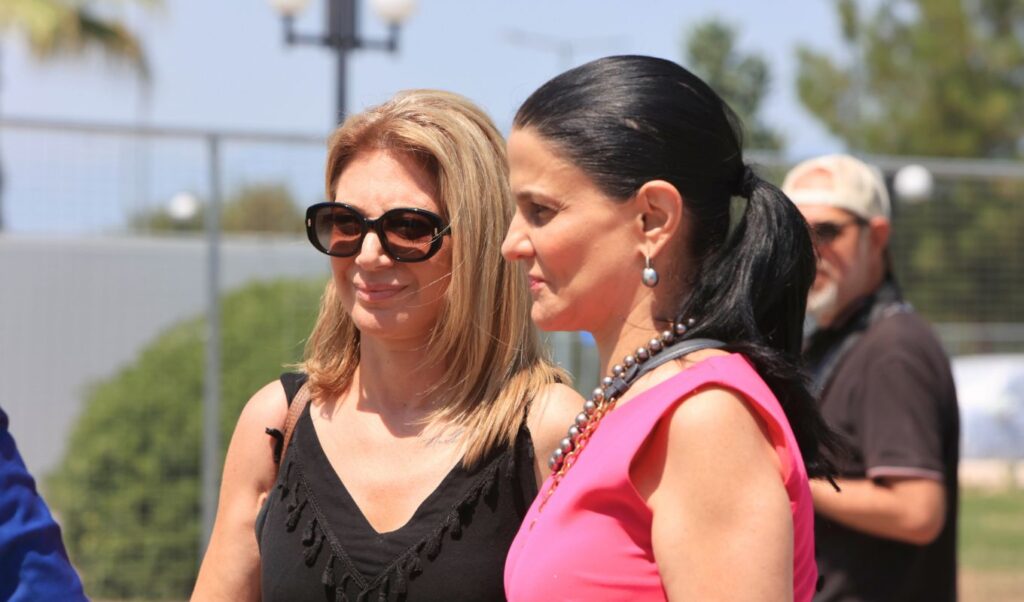
The case of the party “Hope for Democracy” could serve as a cautionary tale for anyone looking to build a political career in the future. All signs suggest that Maria Karystianou — once hailed as the “Maria of Tempi” and a symbol of a movement demanding transparency and accountability in public life — now risks being left with only her close friend and associate, Maria Gratsia.
Read also: Founding member of “Hope” blasts Karystianou and Gratsia: Just hearing the word “constitution” gave them a headache
Fresh allegations from close associates, including Thanasis Avgerinos and Ilias Michalas, regarding behind-the-scenes scheming and manipulation have caused uproar — particularly on social media — bringing to light the many troubling questions lurking behind the so-called anti-establishment credentials of this new party. The public statement by communications strategist and founding party member Ilias Michalas, who wrote, “Come on, not like this, Marias…”, adds to the sharp and sardonic posts that former close associate and journalist Thanasis Avgerinos — notably the emcee at Hope’s launch event in Thessaloniki — continues to publish on social media. In his post, Mr. Michalas directly pointed the finger at Maria Karystianou and her close associate Maria Gratsia, accusing both of authoritarian, backroom conduct and of allowing shadowy figures to pull strings away from public scrutiny.
“Unlike Maria Karystianou, who everyone knows had no political involvement before the Tempi tragedy, Maria Gratsia was actively politicized, having previously run as a candidate on the NIKI party ticket. The first problem that required immediate resolution was how Gratsia’s presence would ideologically balance a movement that was clearly aimed at a patriotic, progressive constituency — the largest ‘orphaned’ electoral pool out there. That’s where Thanasis Avgerinos played a pivotal role. We all knew him. We knew what he stood for and which side of the political spectrum he had chosen. Many from that same side found the ‘alibi’ they had been waiting for to declare their support for Hope’s journey. The balance we were looking for was already there. And then, suddenly… BRAKES,” wrote Mr. Michalas in his lengthy post, before continuing: “Strange delays, even stranger decisions. A strategy completely at odds with what was obviously the right approach. Shadowy figures and behind-the-scenes instructions. Inexplicable? Not to me. Clearly not to Avgerinos, or Fronimakis, or Kokotsákis, or many others who realized — some sooner, some later — what was really going on and that, once again, the establishment had made fools of us.”
These latest revelations were preceded, last June, by the damning accusations of Vasilis Kokotsákis — the forensic expert who became more closely associated than anyone with the Tempi victims’ families’ struggle — who launched a scathing attack on Maria Karystianou over the party’s organizational structure and management. In a lengthy letter, he described a centralized decision-making model, an absence of institutions and procedures, and a project that had strayed far from its original vision of an authentic citizens’ movement. Mr. Kokotsákis directed his criticism squarely at Ms. Karystianou, noting that as the leader of the endeavor, she bears primary political responsibility for the way the party was organized and operated. According to the forensic expert, the Founding Declaration was drafted without any collective process, and the same approach appears to have been followed in drafting the party’s constitution. “A model gradually took shape in which decision-making was concentrated in the hands of a very few people, completely outside any concept of collective governance. Maria Karystianou, as the leader of this project, bears primary political responsibility for how it was organized and how it functioned. I do not attribute the above observations to her associates, advisors, or entourage. The critical choices that defined the character, structure, and operation of this entity were made with her knowledge, tolerance, or approval. For this reason, my criticism is directed primarily at the political direction that was chosen and at the leadership’s responsibility for it.”
This very public exchange of fire has left the political project severely damaged, making it exceedingly difficult to rally citizens once again — and demonstrating just how fragile movements are when built solely on anger and emotion, without solid institutional foundations. The future of Karystianou’s party now looks bleak, exposing the limits and contradictions of modern anti-establishment politics and proving that the transition from symbol to political actor requires something far beyond collective outrage.