Hamas confirmed on Friday (July 31) that an agreement has been reached for its disarmament in the Gaza Strip, as outlined in the second phase of the ceasefire between the Palestinian Islamist movement and Israel — a cornerstone of US President Donald Trump’s peace plan.
Read also: Trump announces “historic deal” for the full disarmament of Hamas — confirmed by both sides, Israel expresses reservations
What the agreement includes
This marks the launch of the second phase of the ceasefire agreement signed in October 2025 between Israel and Hamas, following two years of war — a deal that has been the subject of weeks of negotiations in Egypt.
Hamas made “concessions for the good of our people and the Gaza Strip, in order to save them from death and displacement,” Ghazi Hamad, a member of Hamas’s negotiating team, told AFP.
During the first phase, which concluded in January, the remaining Israeli hostages held in Gaza since their abduction by Hamas on October 7, 2023 — during the movement’s unprecedented attack on Israel — were released in exchange for Palestinian prisoners held in Israeli jails.
According to Hamas, the second-phase agreement includes “the gradual withdrawal of Israeli forces from the Gaza Strip,” linked to the disarmament of the Palestinian movement — a process in which Israel will not be involved — and the deployment of an international force.
“This is a comprehensive framework whose elements must remain interconnected,” Hamad said, adding that other armed groups operating in Gaza must also be dissolved.
As Trump emphasized, the agreement calls for “the full disarmament of Hamas and any other armed group in Gaza.”
Who will be responsible for implementation
The Peace Council — an institution established by Trump — will play a central role in implementing the agreement. According to Hamas, the National Committee for the Governance of Gaza, a group of Palestinian technocrats appointed by the Peace Council to oversee the reconstruction of the enclave, will be the sole body responsible for inventorying and storing the weapons.
“Israel will not intervene in the matter of disarmament. The National Committee is the only body that will carry out this task,” Hamad stressed. Furthermore, according to a Hamas official, the movement is counting on the mediators and the Peace Council to hold Israel accountable to its commitments under the agreement.
However, on Thursday an Israeli political source told AFP that “there will be no Israeli withdrawal from the ‘yellow line’ in the Gaza Strip for as long as Hamas has not been fully disarmed and Gaza has not been completely demilitarized.”
The “yellow line” is the name Israel has given to the boundary separating the zone controlled by Hamas from the zone controlled by the Israeli military in Gaza. Following the withdrawal of Israeli forces, the International Stabilization Force — a newly established structure aimed at assembling multinational troops operating under the auspices of the Peace Council — will then work “with a new Palestinian police force to guarantee security in Gaza,” the US president said.
Next steps for the implementation details
Hamas announced that it will discuss the implementation details with the mediators — Egypt, the United States, Qatar, and Turkey — and will agree on a timeline for carrying out the agreement, a process it expects will take at least two weeks. A meeting of the mediators is scheduled to be held in Cairo in the near future.
“We need to agree on every detail: how the agreement will be implemented, when it will be implemented, and the mechanisms that will allow for its implementation. All of this will happen in the coming days,” Hamad explained. “The agreement contains a clear provision stating that Israel must commit to respecting and fulfilling its obligations. If Israel does not implement the agreement, neither will we,” Hamad warned.
Nikolai Mladenov, head of the Peace Council, said today that the implementation and verification of compliance with the agreement must “be real. The withdrawal [of Israeli forces] must proceed in tandem with disarmament.”
The current situation in Gaza
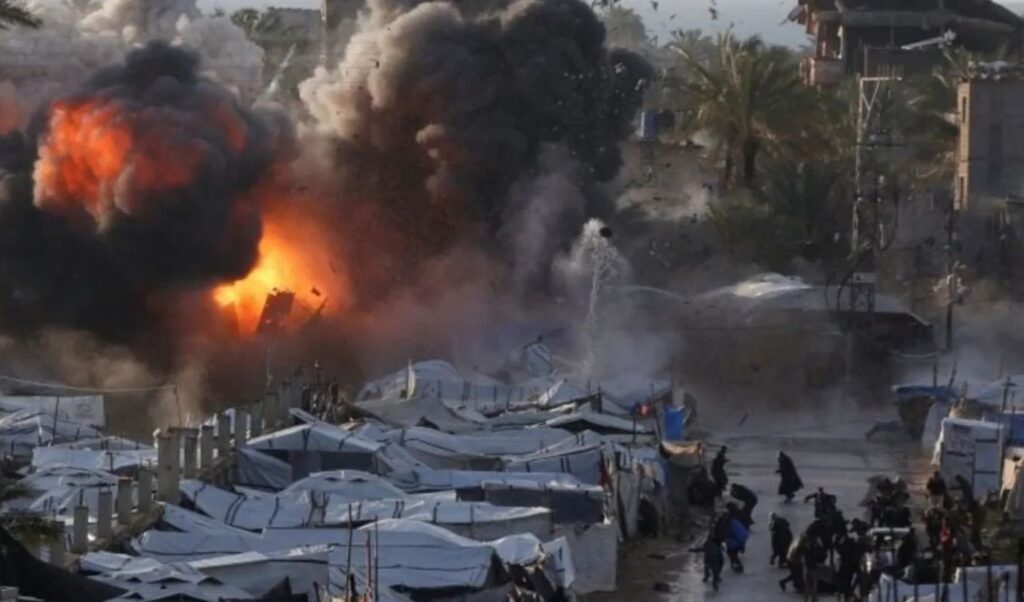
Since the ceasefire came into effect in October 2025, Israel has continued to carry out near-daily strikes on the Palestinian enclave, of which it controls 60%. Tens of thousands of people are living in tents as Gaza lies in ruins following two years of war, with the enclave’s population remaining mired in a humanitarian crisis.
At least 1,124 Palestinians have been killed since the ceasefire began, according to the Palestinian Ministry of Health. During the same period, Israel has announced the deaths of five of its soldiers, as well as one contractor.