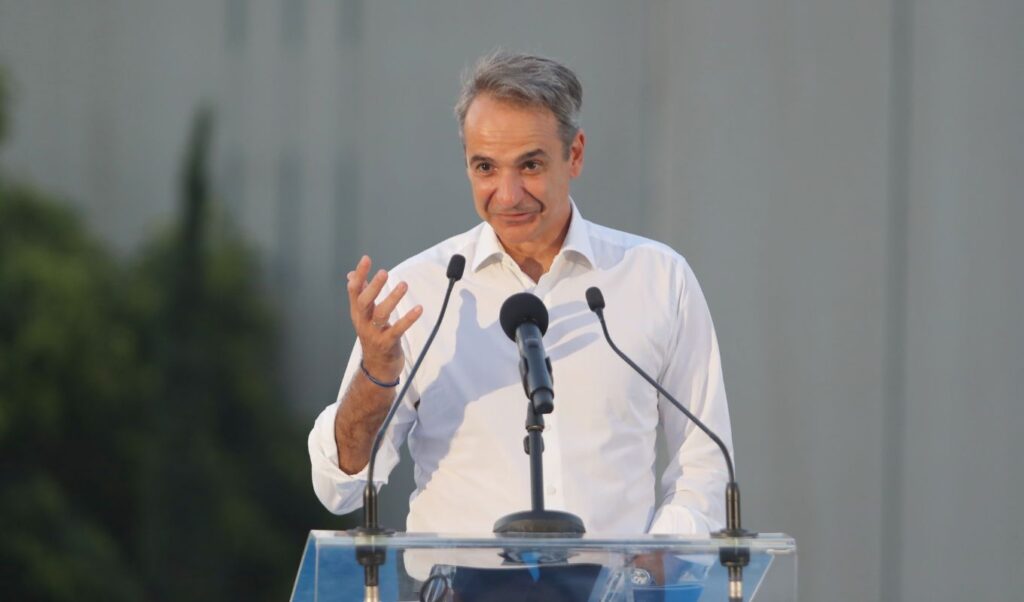
Prime Minister Kyriakos Mitsotakis is traveling to Grevena today following a regular meeting of the Government Council of Foreign Affairs and Defense (KYSEA), where at 7:00 p.m. the inauguration ceremony of the E65 motorway will take place — the latest in a string of landmark infrastructure ribbon-cuttings the government has been staging across the country this summer. In the presence of Kyriakos Mitsotakis, the northern section of the Central Greece Motorway (E65) will be officially opened to traffic. Spanning 46 kilometers, the section runs from the Kalambaka interchange to the Egnatia Odos interchange at Kipouri in Grevena.
Read also: E65 motorway: Toll prices and what this new road axis means for travel and commercial transport in mainland Greece
Mitsotakis delivers the E65 and accelerates Greece’s development agenda
The project is considered a landmark achievement for Western Macedonia and is funded with €450 million from the Recovery and Resilience Facility. It will directly connect Central Greece with Thessaly, Western Macedonia, and Epirus, ending decades of road isolation for large parts of these regions. With the delivery of the northern section, the E65 — the backbone of Central Greece’s transport infrastructure — is now complete. The motorway is expected to fundamentally transform travel patterns, whether departing from Athens or from northern Greece.
Notably, the project cuts travel times between all cities in Western Macedonia and Athens by approximately two hours. Specifically, the Athens–Grevena journey is now reduced to four hours, while the drive from Kozani and Kastoria to the capital comes in at around four and a half hours. In essence, this is a project of national significance that permanently ends the road isolation of Western Macedonia and Grevena, places Grevena at the heart of the country’s transport network, and creates a new development corridor directly linking Thessaly and Central Greece with the Egnatia Odos motorway. The inauguration of this flagship road project is part of a broader strategy from the Prime Minister’s office, which seeks to convey a clear message: during its first term, the government turned the country into one vast construction site, and now, in its second term, those projects are being delivered and are changing people’s lives — with the slogan “we said it, we’re doing it” remaining central to New Democracy’s strategy ahead of the next elections.
On the infrastructure front specifically, the E65 inauguration is to be followed by the opening of the Thessaloniki Metro extension featuring five new stations toward Kalamaria, the first kilometers of the long-awaited Northern Crete Road (VOAK), and the restoration of the railway network on the Athens–Thessaloniki corridor. Major projects already completed include the Patras–Pyrgos motorway and the main Thessaloniki Metro line, with the government continuing to highlight its infrastructure record as a key pillar of its governance. Against this backdrop, the administration is actively pushing the achievements made in both infrastructure delivery and the broader economic front.
The Thessaloniki International Fair: a key milestone
The upcoming Thessaloniki International Fair (TIF) is shaping up to be a critical milestone in the government’s political planning — and a “credibility test” for all political forces, as the Prime Minister himself described it, making clear he intends to steer well clear of reckless handout promises and commitments without fiscal backing. Mitsotakis has previewed specific measures to support the middle class, with particular emphasis on the self-employed — a group that has expressed growing dissatisfaction with the government’s handling of economic pressures, and one that the Prime Minister’s team is expected to actively court. “The difference between New Democracy and the other parties is that we first explain where the money will come from, and only then how we will distribute it fairly so it reaches citizens and helps them deal with this cost-of-living crisis — whereas the opposition announces the measures first and then scrambles with rough estimates to justify the cost,” government officials stressed, ahead of the Prime Minister’s September policy announcements.
Barbs aimed at the opposition
Kyriakos Mitsotakis took aim at the opposition and its culture of empty promises during a joint press conference with his Portuguese counterpart, Luís Montenegro. Mitsotakis noted that “we recognize and understand that citizens are facing hardships — we are always trying to do our best. But we know that only the policy we are pursuing is one that ultimately guarantees better days ahead.” In the same vein, he stressed that “if we were to return to eras we want to leave permanently behind us, the consequences for what we have achieved with so much effort would be dramatic.” The Prime Minister added, with his Portuguese counterpart standing beside him: “It would be very easy to be pleasant today and hand out money. I say this because Greece is again facing a prolonged pre-election period ahead of the spring 2027 elections, where unfortunately we are seeing forces that have learned nothing from Greece’s history — 2009, 2010, 2011, 2014, 2015. It’s very easy, when you’re in opposition, to promise everything to everyone. And they do so, of course, with the comfort of knowing — from a safe distance — that they probably won’t win the elections anyway. It costs them nothing. But right now, we must hold the wheel steady.”