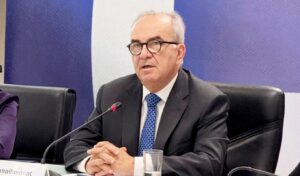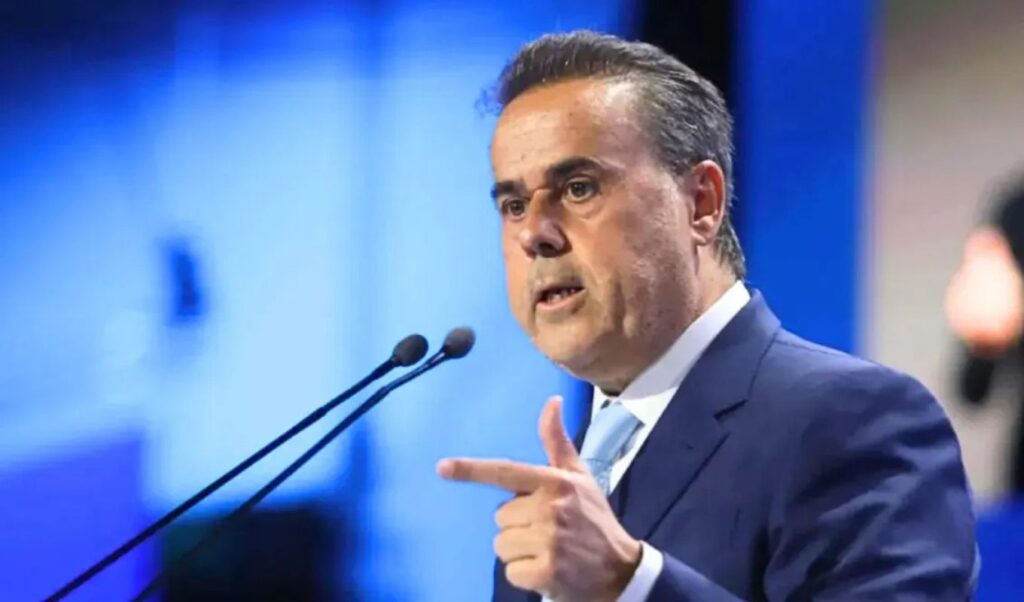
Greece’s Minister of Environment and Energy, Stavros Papastaurou, presented the government’s plan for energy corridors, infrastructure development, and the utilization of domestic energy resources during a roundtable at the Energy Corridors Summit 2026, held on Thursday (16/7) in Athens. The summit focuses on energy diplomacy, infrastructure security, and new energy transmission corridors.
Read also: Papastaurou at the Economist conference: Greece is shaping Europe’s energy architecture
What began as an economic necessity has taken on a geopolitical dimension
Minister Papastaurou stressed that “Europe realized it did not have a truly unified energy market,” noting that until recently, the EU essentially operated as 27 fragmented national energy markets, and that “what started as an economic necessity has now taken on a geopolitical dimension.” He added that the EU is taking significant steps forward, and that the implementation of new energy corridors will rely heavily on private sector investment rather than being “a process exclusively between states.”
On the Greece-Cyprus-Israel-US cooperation framework
Referring to the 3+1 cooperation framework between Greece, Cyprus, Israel, and the United States, Minister Papastaurou noted that this partnership provides a framework of stability that establishes clear rules within which business activity can grow and new investments can move forward in the region. He also made special mention of the post-war reconstruction of Ukraine, which he said will create significant opportunities for Greek businesses in the infrastructure and energy sectors.
On energy development and storage
Regarding hydrocarbon exploration and exploitation, the minister made clear that Greece is moving forward with sustainability as its guiding principle, rather than pursuing “development at any cost.” He noted that the drilling operation scheduled for 2027 will be carried out using one of the most environmentally advanced vessels in the world.
He further emphasized that Greece must develop all available forms of energy, with particular focus on storage investments. “Sustainable development and energy storage are a matter of national interest,” he stated emphatically.
Energy at the center of international developments
Opening the speaking sessions, Deputy Foreign Minister Tasos Chatzivasiliou underlined that energy is now at the heart of international affairs, noting that energy networks, interconnectivity, and source diversification have become top priorities for Europe.
According to Deputy Minister Chatzivasiliou, Greece — by leveraging its strategic partnerships — has the potential to become a co-architect of Europe’s energy future. He also referenced the Vertical Gas Corridor as a key goal for reducing dependence on Russian natural gas by 2027, as well as the prospect of an Israel-Greece pipeline. “We want to reverse the direction of energy flows, which previously ran from North to South,” he stated, adding that Greece, Cyprus, Israel, and the United States all stand to gain significantly from this new energy cooperation.
The pivotal role of the Greek shipping industry
Deputy Minister of Shipping and Island Policy Stefanos Gikas highlighted the pivotal role that Greek shipping — with approximately 5,800 vessels, representing 20% of global transport capacity, 23% of the world’s LNG fleet, and 61% of the European Union’s commercial shipping capacity — can play in securing global energy flows. He noted that developments in the Middle East and along critical maritime routes, such as the Strait of Hormuz, underscore the vital importance of maritime transport security.
Deputy Minister Gikas emphasized that shipping’s transition to cleaner energy sources — including alternative fuels such as LNG — must be underpinned by global regulatory frameworks that preserve the sector’s competitiveness.
Energy security as an indispensable pillar of economic stability
The Ambassador of the Republic of Cyprus to Greece, Stavros Avgoustidis, stressed that energy security — encompassing the strengthening of electricity and energy interconnections, infrastructure investment, protection of critical facilities, and the resilience of energy networks — is an indispensable component of economic stability and overall security across the Eastern Mediterranean and its energy corridors.
Greek expertise in Ukraine’s reconstruction
In the same vein, the Secretary General of the Hellenic-Ukrainian Chamber of Commerce, Nikolaos Kanellopoulos, highlighted that the chamber’s new leadership is placing particular emphasis on fostering cooperation in the energy, defense, and shipping sectors. He added that Greece is emerging as a key hub of the new energy era, thanks to its geographic position, LNG terminals, and maritime industry. He further noted that when Ukraine’s reconstruction begins in earnest, Greek expertise in energy, infrastructure, and shipping will have a meaningful role to play.
The continuously strengthening Greece-Israel relationship
Susana Francis, Director of the Hellenic-Israeli Chamber of Commerce and Technology, spoke about the continuously deepening relationship between Greece and Israel, emphasizing that energy is one of the most important sectors in which even closer business and investment partnerships can be developed.
A new era in EU energy diversification
In the summit’s keynote address, the Permanent Secretary of the Ministry of Energy, Commerce and Industry of the Republic of Cyprus, Kyriakos Iordanou, noted that following 2022, the European Union entered a new phase of energy diversification, moving away from its dependency on cheap Russian natural gas.
He stated that the Eastern Mediterranean is evolving into one of Europe’s most significant energy pillars, and that energy policy must strike a balance between security of supply, sustainable development, and energy affordability.