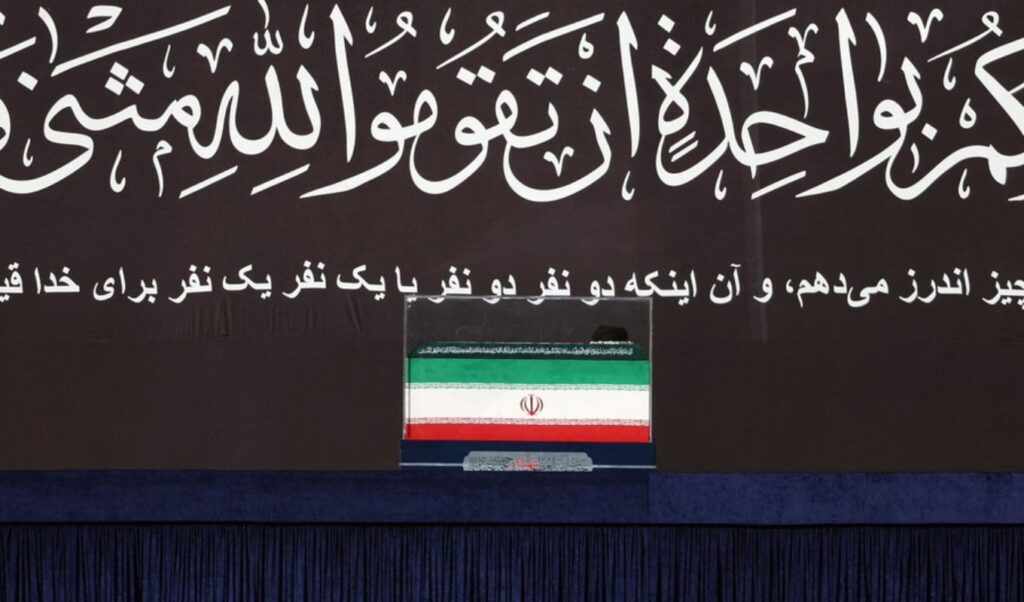
Religion has long been a core instrument of Iran’s foreign policy — hardly surprising for an “Islamic Republic” whose Supreme Leader simultaneously serves as the religious guide of Shia Islam. That same pattern was on full display at the funeral of Ayatollah Ali Khamenei, as Tehran appeared to send carefully crafted messages to its geopolitical neighbors and to the so-called “Axis of Resistance” — once again through the language of faith.
What has drawn particular attention from media analysts and observers is the fact that Iran deliberately matched specific Quranic verses and recitations to each foreign delegation paying their respects. And as the content of those recitations reveals, the choices appear anything but random — they seem to reflect Tehran’s assessment of each geopolitical player and their stance in the broader confrontation with the “Great Satan” and the “Little Satan,” i.e., the United States and Israel.
Read also: Ali Khamenei lying in state: Massive crowds flood the streets of Tehran (Live)
Starting with Saudi Arabia, the verse recited referenced a clash between two armies — one fighting for the sake of Allah and the other described as unbelievers — with God granting victory to whomever He wills. The allusion is to the Battle of Badr, fought on March 13, 624 AD, considered a pivotal moment in Islamic history when roughly 300 Muslims led by the Prophet Muhammad defeated approximately 1,000 Quraysh fighters. The symbolism could easily be read as Iran casting itself in the role of the faithful, while the Saudis are — or perhaps were — portrayed as the “unbelievers,” owing to Riyadh’s close ties with the United States. Also in the backdrop: the two countries’ support for opposing sides in Yemen, the gradual warming of relations through high-level diplomatic contacts in recent years, and Saudi Arabia’s push for a non-aggression pact between Iran and the Gulf states, modeled on the Helsinki Process — as reported by the Financial Times in May.
Next came Turkey, matched with a verse praising those who strive with both their wealth and their lives in the way of Allah, elevating them above those who “sit back” and do nothing. As for India, the chosen verse appeared to carry a note of disappointment regarding New Delhi’s position, referencing those who told the faithful to stand down because they had no allies — to which the believers responded: “Allah is sufficient for us.”
The verse assigned to the Lebanese government carried a distinctly negative tone, alluding to those called upon to make sacrifices but who refuse. The recitation for Hezbollah, by contrast, was the polar opposite — seemingly a message of moral encouragement: “Do not lose heart or grieve, for you will have the upper hand if you are true believers. If you have suffered wounds, so too have they. We alternate these days of victory and defeat among peoples, so that God may reveal the true believers, choose martyrs from among you — and God does not love the wrongdoers.”
A similarly uplifting verse was recited for the Hamas delegation: “Among the believers are men who have proven true to what they pledged to God. Some have fulfilled their pledge, others are still waiting. They have never wavered in the slightest.” The recitation for the Houthi delegation was equally affirmative in tone.
The verse recited for the Egyptian delegation also appeared to be one of praise, referencing the ultimate reward of the “Gardens of Eternity,” while both the Russian and Chinese delegations received positive recitations as well.
Finally, a notably favorable verse was recited for Qatar, referencing Allah’s “grace” and guidance “to the Straight Path,” along with the forgiveness of past and future transgressions: “So that God may forgive you your past and future sins, complete His favor upon you, and guide you to the Straight Path — and so that God may help you achieve a magnificent victory.”