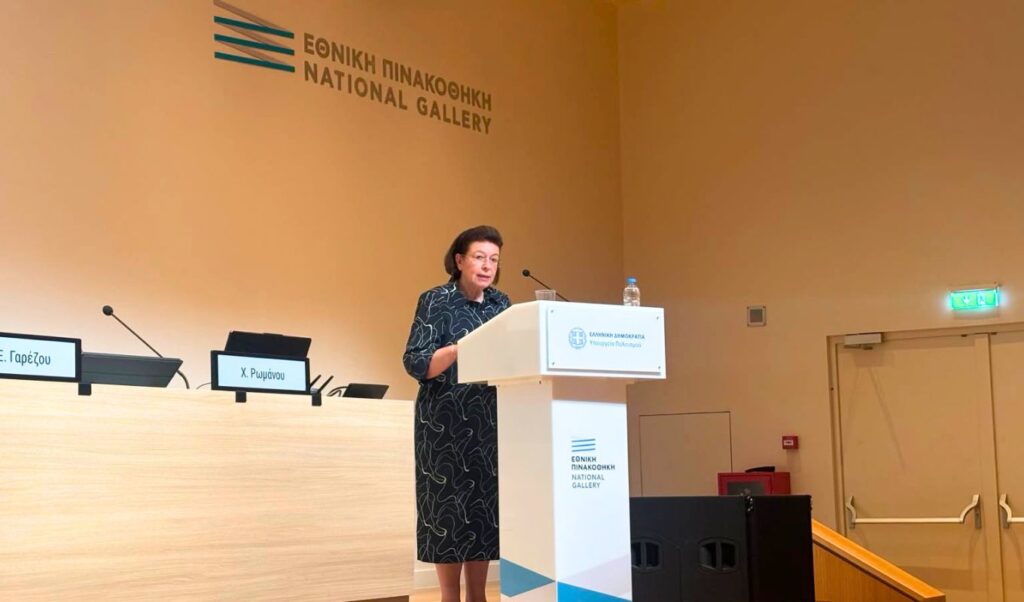
The National Gallery hosted the conference “National Monument Archive: Memory and future for cultural heritage,” opened by Minister of Culture Lina Mendoni. The event showcased the new, fully integrated digital ecosystem of the National Monument Archive — a project funded by the Recovery and Resilience Facility and implemented by the Directorate for the Management of the National Monument Archive (DDEAM) of the Ministry of Culture.
Mendoni: The National Monument Archive is a living reality and a national knowledge infrastructure
The Archaeological Land Registry now digitizes Greece’s cultural heritage, encompassing data on more than 17,000 immovable monuments, 3,160 archaeological sites, 404 historic places, 818 protection zones, and 237 museums. At the same time, the upgraded platform integrates new features and cultural routes, strengthening its role in scientific research, heritage protection, education, and the country’s tourism promotion.
In her opening address, the Minister highlighted the strategic significance of the National Monument Archive, connecting it to the Ministry of Culture’s overarching policy for the protection, management, and promotion of cultural heritage. “The National Monument Archive,” she emphasized, “concerns both the past and the future simultaneously. It constitutes the organized collective memory of our cultural heritage, as well as the foundational infrastructure upon which its future is being built — the future of research, protection, management, and utilization for the benefit of society. Cultural heritage is not merely a collection of material remnants from the past. It is a fundamental human right and a core social good. It is a vital element of historical continuity and our collective identity, and at the same time a precious asset with enormous developmental potential. Protecting it is not limited to the physical preservation of monuments. It equally encompasses preserving the knowledge and emotional weight that accompanies them: the history and symbolic content that frame their understanding and interpretation, keeping them relevant and meaningful in the present, and making them a legacy for the future by connecting them to the generations that follow.”

Reliable knowledge as the foundation of effective protection
Addressing the importance of knowledge and documentation in delivering effective heritage protection policy, Lina Mendoni stated that “systematic and detailed recording, documentation, and organization of cultural information are a fundamental prerequisite for any effective policy of protection and promotion. The more complete, accurate, and up-to-date our knowledge of monuments is, the more well-grounded, reliable, and effective their medium- and long-term management becomes.”
Digital transformation is the Ministry of Culture’s deliberate strategic choice. “The decisive step was taken,” said the Minister, “when we placed digital transformation at the heart of our strategy, making the integration of modern technologies central to all scientific and administrative processes across the Ministry’s departments. By leveraging the Ministry of Culture’s national resources and the funding opportunities offered by European structural funds, an extensive programme of digitization, documentation, and information systems development has been implemented and continues to evolve. This effort is not limited to developing individual applications — it aims to create permanent, interoperable infrastructures for 21st-century cultural heritage management.”
The outcome of this policy is that Greece now has the National Monument Archive fully operational. “Not as a theoretical concept or a fragmented set of databases,” Lina Mendoni noted, “but as a complex and integrated digital ecosystem that, as it becomes more embedded, enriched, and expanded in its infrastructure and functions, increasingly allows all of us to know, at any given moment, the identity, location, state of conservation, legal status, and management status of cultural heritage assets across the entire national territory.”
“At the same time, the ecosystem serves as a tool for scientific research, administrative management, developmental planning, and public access to knowledge. And I particularly stress developmental planning, an essential prerequisite of which is transparency and the rational use of time in licensing procedures.”
Mendoni also referred to the second pillar of the National Monument Archive — the Digital Collections of Movable Monuments information system — noting that within just a few years of entering full operation in 2021, the number of records has nearly doubled, approaching one million entries, making it one of the country’s most significant repositories of cultural information.
Turning to the Ministry’s next strategic objectives, Lina Mendoni underlined: “The next phase of strategic planning is set to be even more ambitious. The development of knowledge bases, the interconnection and interoperability of cultural datasets from diverse sources, the use of advanced search, analysis, and interpretation tools, and their integration with the infrastructure of the Greek Artificial Intelligence Factory ‘PHAROS’ are now opening new horizons for the study and management of cultural heritage.”
Artificial intelligence as an assistant, not a replacement
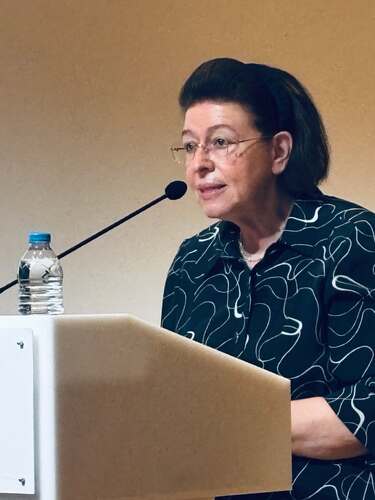
The National Monument Archive lays the groundwork for the next era of cultural heritage management: “Artificial Intelligence,” said the Minister, “does not replace the scientist. It does not replace the archaeologist, the historian, the conservator, the documentation specialist. But it dramatically enhances their capacity to process, correlate, and make use of vast amounts of information. For this to be possible, however, a foundation is required: reliable, documented, structured, and interoperable data. That is precisely what the National Monument Archive provides. It is the foundation upon which tomorrow’s applications will be built. It is the memory that makes innovation possible. It is the infrastructure that allows cultural heritage to enter the age of artificial intelligence with safety and confidence.”
During the conference, staff from the Directorate for the Management of the National Monument Archive presented the full upgrade of the Archaeological Land Registry, the applications developed around it, and the scientific collaborations that enriched its content. The system has now evolved into a central knowledge and information platform for monuments, archaeological sites, and historic places across the national territory. Also presented was the design of the new digital licensing service “Archeo-Adeies,” being implemented via gov.gr in collaboration with the Ministry of Digital Governance and the Technical Chamber of Greece. Through the Public Administration Information Systems Interoperability project, citizens and businesses can now digitally submit and track requests related to actions on monuments or their surrounding environments — modernizing and simplifying procedures with full transparency. Finally, the personalized mobile navigation application “PAUSANIAS” was presented, which draws on the uniquely rich and authoritative content of the Archaeological Land Registry.