One year from now, Greece will be preparing to take the helm of the European Union — and as Kyriakos Mitsotakis has recently emphasized, “Greek citizens will certainly choose in the 2027 elections which prime minister and which government can represent the country in this very important European commitment.” The prime minister is effectively laying the groundwork now, so that one of the dilemmas voters will face at the polls — though certainly not the most pressing one — will be who they choose to lead the country through this pivotal moment, and with what agenda, at a critical juncture: on July 1, 2027, Greece takes over from Lithuania and officially assumes the six-month rotating presidency of the Council of the European Union. This is a crucial presidency covering economic, energy, defense, and geopolitical matters — one that may even be called upon to handle the final stages of planning the EU’s next Multiannual Financial Framework (MFF) for the period 2028–2035.
Yesterday, for example, in his regular Sunday Facebook review, Mr. Mitsotakis highlighted “Greece’s official inclusion in the European defense funding instrument SAFE, securing €700 million for investments in critical defense capabilities, such as strategic surveillance, secure communications, and counter-drone technologies.” He also noted that “for the first time, Europe is taking such a meaningful step toward joint defense funding, and our country is at the forefront of this effort.”
On the question of EU competitiveness and global macroeconomic balances, Greece’s position is that the priority must be boosting the competitiveness of the European economy — which is the primary driver of the trade deficit with China. The Greek government also firmly supports the necessary investments and reforms in the European energy market, the deepening of the Single Market, and rapid progress toward completing the Savings and Investments Union.
Kyriakos Mitsotakis: Protecting Cohesion funds and the Common Agricultural Policy is Greece’s central goal
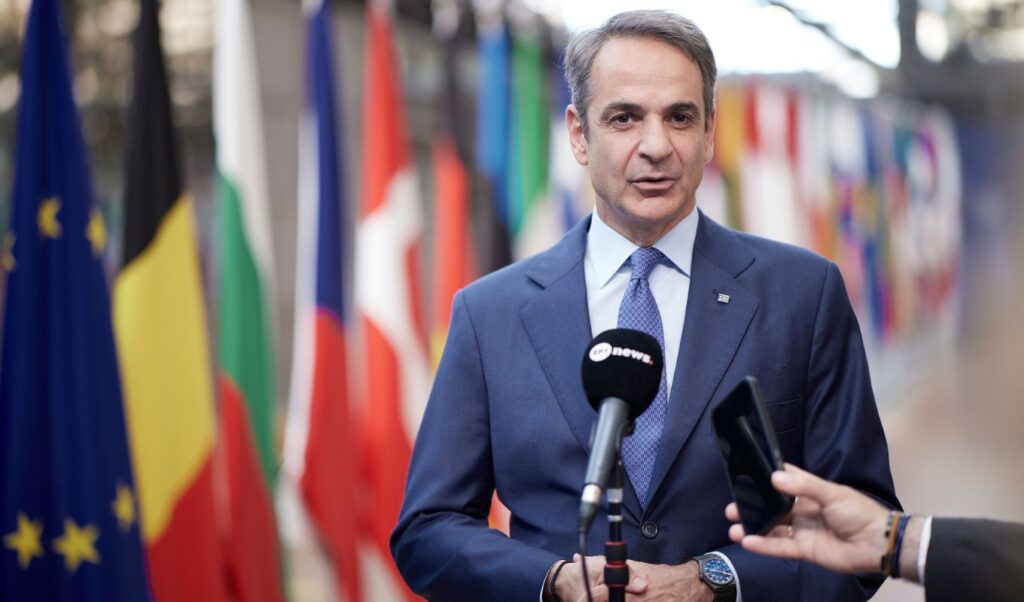
“This will be an extremely difficult negotiation,” Kyriakos Mitsotakis said on Friday in Brussels, following the conclusion of the European Council summit, referring to the next seven-year EU budget — the MFF. He acknowledged that there are “very significant divergences between those who stress the need for a more ambitious budget, given that we have ambitious goals, and those who view the budget through the — understandably, to a degree — lens of their own significant national contributions.” He set as Greece’s central objective the protection of Cohesion funds and the Common Agricultural Policy, which are now being integrated into a new national framework, as the structure of the budget has changed, he noted.
“Despite the significant fiscal pressures taking shape across Europe, I am optimistic that Greece can maintain strong resources for the primary sector. However, this requires serious preparation and active adaptation to the new funding architecture being formed within the European Union,” Minister of Rural Development Margartis Schinas had recently stated in a comment to the newspaper Parapolitika.
The six-month presidency is also an issue that could bring elections earlier — potentially in spring — rather than at the end of the government’s constitutional term in late June. This is because whichever government emerges from the polls must have been sworn in, received a vote of confidence from parliament, and have sufficient time ahead of it to carry out the necessary preparations and consultations with Brussels — as well as with the outgoing Lithuanian presidency — in order to adequately fulfill its heightened responsibilities.
Satisfaction at Maximos Mansion
On defense and security policy, there is satisfaction at Maximos Mansion over the fact that, once again, the European Council’s concluding text included the phrase “reducing strategic dependencies and addressing gaps in critical capabilities, with a 360-degree approach” — a formulation that directly covers Greece and Cyprus.
On migration, the country, as the prime minister pointed out, “expresses satisfaction that the budget allocated to migration has increased, but will continue to work to convince our partners that common funding instruments are needed to address the major challenges in defense” — yet another issue that the Greek presidency may be called upon to manage one year from now.