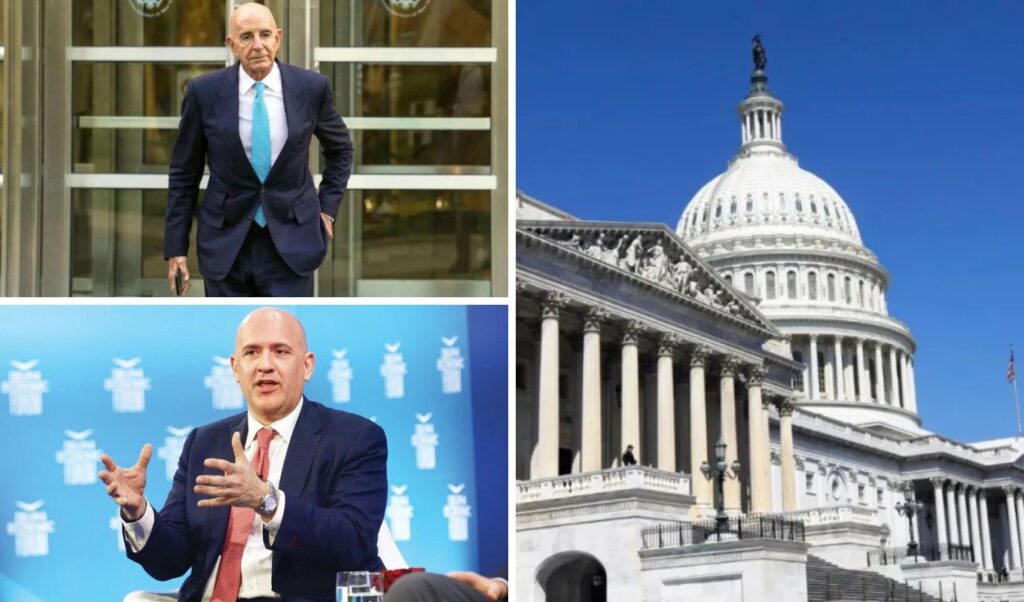
The responses of US Secretary of State Marco Rubio in Congress regarding Turkey’s exclusion from the F-35 program once again called into question Turkish-American relations and the role of the US Ambassador to Ankara, Tom Barrack.
According to Endy Zemenides, Executive Director of the Hellenic American Leadership Council (HALC), the message to Ankara was sent by Congress and not just by Marco Rubio, who was compelled to answer the question from Greek-American Congresswoman Dina Titus. As Mr. Zemenides tells parapolitika.gr, “the most significant aspect of this matter is that the message to Tom Barrack was sent by Congress, and importantly, it came one week after 12 congressmen sent a letter to Secretary of State Marco Rubio about the problem that the American ambassador in Ankara is causing for American foreign policy.”
The 3+1 format and Congress’s message to Turkey
Following this development, relations between the United States, Turkey, and Greece are entering a particularly complex and fragile phase, with the three countries attempting to find balance across all open issues in the Eastern Mediterranean. This is especially significant as on Thursday (June 11) in Houston, Texas, the Energy Ministers of the US, Greece, Cyprus, and Israel will meet within the 3+1 framework to implement the ambitious Eastern Mediterranean Gateway Act (EastMed Act). This is a US Congress initiative that focuses on strengthening American cooperation with key regional partners including Greece, Cyprus, Israel, Egypt, and India, in sectors such as energy, technology, innovation, and research. The plan includes integrating these countries’ infrastructure to implement the IMEC economic corridor. While the US demonstrates its commitment to strengthening stability in the region to enable multilateral cooperation in developing energy and commercial hubs, Turkey seeks to cancel the IMEC corridor and strengthen the “Middle Corridor” trade route that would connect China to Europe through Turkey.
According to Greek-American Endy Zemenides, the power of this endeavor lies in the fact that the plan is being implemented because it’s mandated by law passed in 2019. “The Turks should take the message that this is happening because certain bills were passed years ago. This is a major success because it officially implements the policy change. These institutional changes send a strong message and it’s being sent by Congress, which is the most powerful legislature in the world.”
Additionally, Israel’s participation in the EastMed Act program causes further concern in Turkey, following the strengthening of Greece and Cyprus’s defense capabilities. Nevertheless, the Turkish government’s decision to proceed with a tactical retreat regarding the “Blue Homeland” legislation shows a strategy of reducing tensions in the Aegean. It remains to be seen whether Ankara seeks “calm waters” in Greek-Turkish relations or simply doesn’t want a crisis in NATO’s southeastern flank ahead of the NATO Summit in Ankara in July.
Turkey “bets” on NATO summit – Ankara’s concern over Greece-Libya consultations
For Recep Tayyip Erdogan, this Summit represents an opportunity to upgrade his role as an international mediator and resolve open issues with US President Donald Trump, primarily the F-35 matter. The personal relationship between the two leaders and Tom Barrack’s role as the sole communication channel with the White House offer Turkey a strategic advantage. However, the Washington-Ankara approach has clear limits. Despite personal diplomacy, the American state—Congress and the Pentagon—remains deeply skeptical. It’s worth noting that the talks through technical committees, which Greece begins with Libya on Wednesday for EEZ delimitation, causes another concern in Ankara, as the prospect of these consultations is for both countries to appeal to the International Court of Justice in The Hague. This possibility deeply worries Ankara, as such a development could invalidate the Turkish-Libyan memorandum, given that the Court would not accept zero effect of islands.