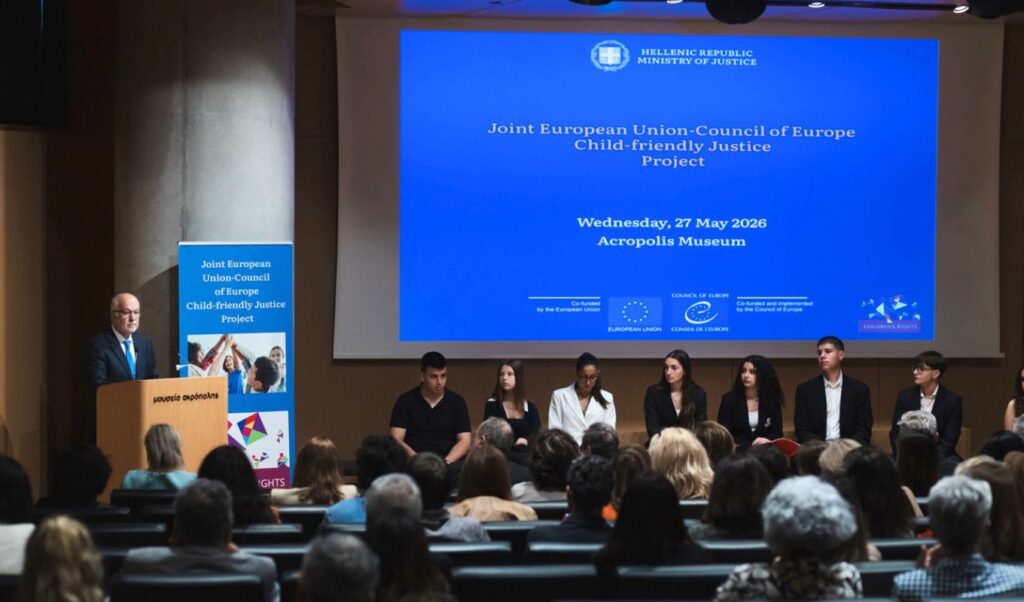
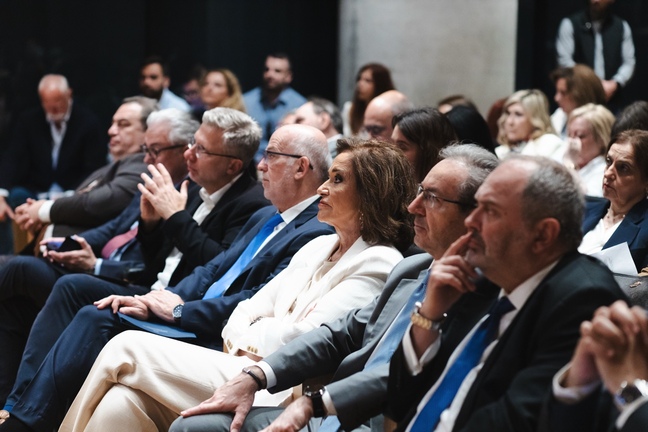
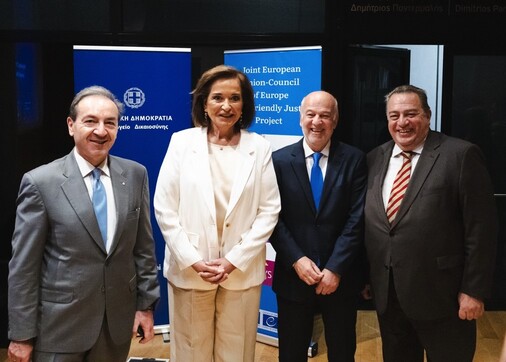
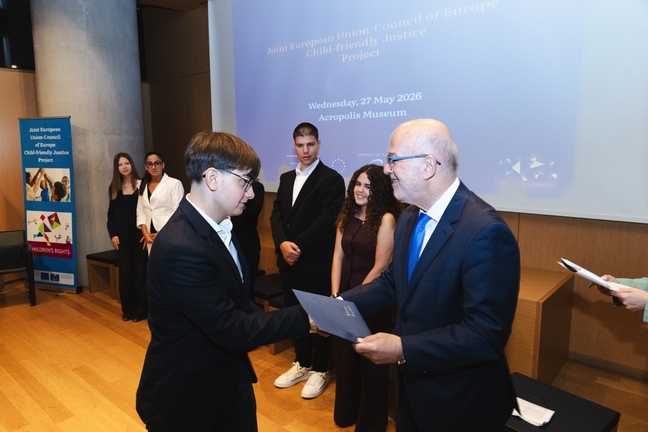
The concluding Conference of the Joint Project of the European Union and the Council of Europe for Child-Friendly Justice was held at the Acropolis Museum, a place of particular symbolism. The conference took place in the presence of Justice Minister George Floridis, Minister of State Akis Skertsos, Deputy Justice Minister Ioannis Bougas, Vice-President of the Parliamentary Assembly of the Council of Europe Dora Bakoyannis, former President of the Parliamentary Assembly of the Council of Europe Theodoros Roussopoulos, Director General of the Council of Europe for Democracy and Human Dignity Marja Ruotanen, European Commission representative Chrisoula Arkoudis, representatives from Belgium, France, Poland, Portugal, Slovenia and Hungary, Greek MPs, representatives of judicial authorities, representatives of the Chania Bar Association and children.
The two innovative educational tools promoted by the Ministry of Justice
Our country’s contribution through the Ministry of Justice to this sensitive sector proved substantial with the promotion of two innovative educational tools that were recognized as best practices with distinction and included in the Council of Europe Handbook titled “The state of child friendly justice in Europe”.
These are the pioneering educational program “Mock Trials for Minors” aimed at familiarizing children with the functioning of justice and the principles of fair trial, and the innovative interactive psychoeducational program for strengthening social skills of juvenile offenders “REMIND” through their contact with works of ancient Greek literature, world literature and philosophical texts.
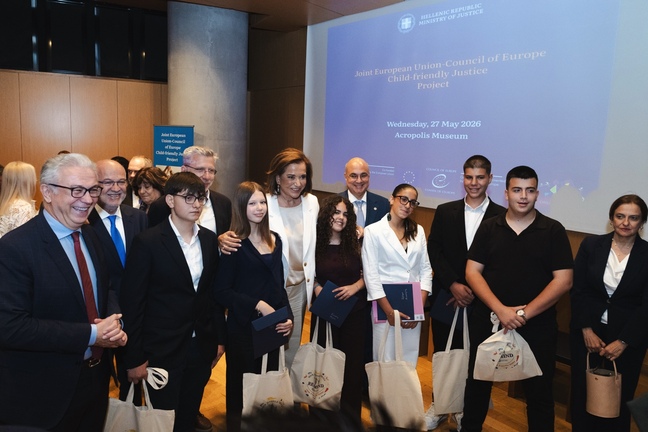
Nine third-grade students from the 6th Gymnasium of Chania, who participated in the mock trial held in Chania last November before members of the European Council and the Greek Government, spoke based on their experiential experience in the courtroom about the administration of justice, while also referring to ways the justice delivery process could become more accessible, fair and understandable to children. At the same time, they spoke about the criminal treatment children receive and how it could be improved to further help young people who have committed offenses.
Floridis: “When a child feels heard, protected, respected, we build a better democracy”
Justice Minister George Floridis in his greeting referred both to these educational actions that exceeded the pilot stage and were recognized as best practices, and to our country’s ability to serve as an example for other countries. Specifically, in his greeting the Justice Minister emphasized: “The fact that we are here today in this place has particular symbolism. Here fundamental concepts of democracy, justice and citizen participation in public life were born. Ancient Greek philosophy, from Aristotle to the Stoics, highlighted respect for human dignity, the pursuit of justice and the state’s obligation to serve the common good. Today, many centuries later, these principles acquire a new and substantial dimension: the common good cannot be conceived without protecting children and without full respect for their rights. The quality of a democracy is also judged by how it treats its most vulnerable citizens. Child-Friendly Justice is not simply an administrative or institutional choice. It is a deep value commitment. It is the recognition that every child who comes into contact with the justice system — as a victim, witness or defendant — remains primarily a child. This means justice must adapt to the child’s needs and not the child to the system’s rigidities. The basic principles of Child-Friendly Justice — the best interests of the child, their meaningful participation, access to information, non-discrimination, protection from any form of secondary victimization and respect for their age and maturity — constitute foundations of a system that places human dignity at the center. The Council of Europe played a leading role in transforming these principles into concrete policy standards and action. The 2010 Guidelines became a reference point and the Joint Project concluding today represents practical implementation of these principles. Greece actively participated in this collective effort, while proceeding with significant initiatives: modernizing the institutional framework, specialized training of professionals and developing innovative actions. I highlight the REMIND program, which utilizes digital psychoeducational tools and psychosocial empowerment of children in conflict with the law, as well as Mock Trials for Minors, an initiative of the Ministry of Justice that started in Chania and is gradually expanding throughout the country, with the contribution of judicial authorities, bar associations and the educational community. Through experiential learning, young people gain knowledge of their rights and cultivate a culture of respect for justice.”
Concluding his greeting, Mr. Floridis noted: “The stones of the Acropolis endured millennia because they were created and supported on strong foundations. The same applies to our societies. Their foundations are not only laws or institutions. They are our children. And when a child feels heard, protected, respected, then we are not simply building a better justice system; we are building a better democracy.”
“Protecting children’s rights is at the center of our common priorities”
European Commissioner for Democracy, Justice, Rule of Law and Consumer Protection Michael McGrath in his video message emphasized: “Protecting children’s rights is at the center of our common priorities. The Child Friendly Justice program is a perfect example of interinstitutional cooperation to address vital issues like children’s rights. Justice systems must serve everyone — and that includes children. Children deserve a system that supports them, listens to their voice and respects their rights. This work has shown how our common commitment to democracy, rule of law and respect for fundamental rights can translate into meaningful change for every child in Europe.”
Dora Bakoyannis: Child-friendly justice transcends legal or institutional obligations
Vice-President of the Parliamentary Assembly of the Council of Europe Dora Bakoyannis stated: “It is a great honor to participate today in Athens in this important Final Conference of the Joint Program of the European Union and the Council of Europe for ‘Child-friendly Justice’. Allow me first to thank George Floridis for organizing this final conference for the first phase of an emblematic program that addresses a critical issue that has reached pandemic dimensions throughout Europe. I would also like to welcome Director General Marja Ruotanen to Athens. Your presence here reflects our common European commitment to protecting the most precious treasure every society possesses: our children. Finally, allow me to express our sincere appreciation to European Commissioner Michael McGrath for his continued commitment to strengthening child-friendly justice in all member states. As head of the Greek delegation to the Parliamentary Assembly of the Council of Europe, I am particularly proud that Greece actively contributed to this important initiative. Child-friendly justice transcends legal or institutional obligations. It is a measure of our civilization, our democracy and our humanity. This work has proven that meaningful progress is possible when European institutions, national authorities, local communities, professionals and the children themselves collaborate. Greece’s participation in this collective effort is both important and a great honor for our country. The Council of Europe has long been at the forefront of defending human rights. Greece remains steadfastly committed to these principles and to strengthening a Europe where every child can grow up safely, with confidence and respect. In January, our Delegation to the Council of Europe invited Minister Floridis and his team to Strasbourg, where they presented before parliamentarians from 46 countries the two emblematic best practices for child-friendly justice. I am particularly moved because the Mock Trials were mainly conducted in Chania (the area I proudly represent in the Greek Parliament) and our children actively contributed to this process.”
Former President of the Parliamentary Assembly of the Council of Europe Theodoros Roussopoulos stated: “True justice always starts with something very simple: the ability to listen to the other. And especially the child. Our ancient ancestors used to say: ‘Whoever is wounded must also be healed.’ This, perhaps, is the deeper meaning of Child-Friendly Justice: that a child who has made a mistake, even a serious mistake, cannot be treated exclusively as a bearer of guilt, but also as a person who needs guidance, support, reintegration and a second and third chance. Real justice is not exhausted in punishment. Real justice seeks restoration. Healing. The child’s reintegration into a society where they will no longer feel the hatred of inequality, injustice and rejection. And that’s why Child-Friendly Justice is not simply a technical or legal detail. It is a deep indicator of democracy, humanity and civilization.
“REMIND utilizes philosophy and literature to strengthen social skills and moral development of minors”
For her part, head of the General Directorate of Special Legal Issues and Scientific Coordinator of the Action for Greece, Eftychia Katsigaraki emphasized in her speech: “Following the completion of the Joint Project of the European Union and the Council of Europe for child-friendly justice, Greece’s substantial contribution to promoting innovative practices in the juvenile justice system was highlighted. The country’s participation constituted an important opportunity for knowledge transfer and integration of modern educational tools and methods. Particular reference was made to mock trials for minors, which functioned as an innovative educational tool for familiarizing children with the functioning of justice and the principles of fair trial, as well as the ‘REMIND’ tool, which utilizes philosophy and literature to strengthen social skills and moral development of minors. These actions exceeded the pilot stage and were recognized as best practices, included in the relevant Council of Europe handbook, confirming the ability of the Greek experience to serve as an example for other countries.”
Director General of the Democracy and Human Dignity Department of the Council of Europe, Marja Ruotanen, emphasized: “Child-Friendly Justice is more than a list of obligations — it constitutes a conscious policy choice. A choice to place children’s rights above convenience, to transcend rigid traditions and to resist complacency.”
Head of Child Rights Policy at the Directorate-General JUST of the European Commission, Chrisoula Arkoudis stated: “Today’s conference is not the end of a project, but the beginning of a renewed commitment for Child-Friendly Justice in Europe. Through our cooperation with the Council of Europe, the active participation of member states and partner countries, civil society and the children themselves, the European Union will continue to work to ensure that every child is heard, protected and treated with dignity when they come into contact with justice systems. The progress achieved through this joint project proves that, working together, we can build justice systems that truly respond to the rights and needs of every child across Europe. The European Commission confirms its commitment through supporting Phase II of the joint project, promoting holistic child-friendly justice systems that protect children from all forms of harm and ensure coordinated, rights-based responses in all judicial, administrative and child protection systems.”