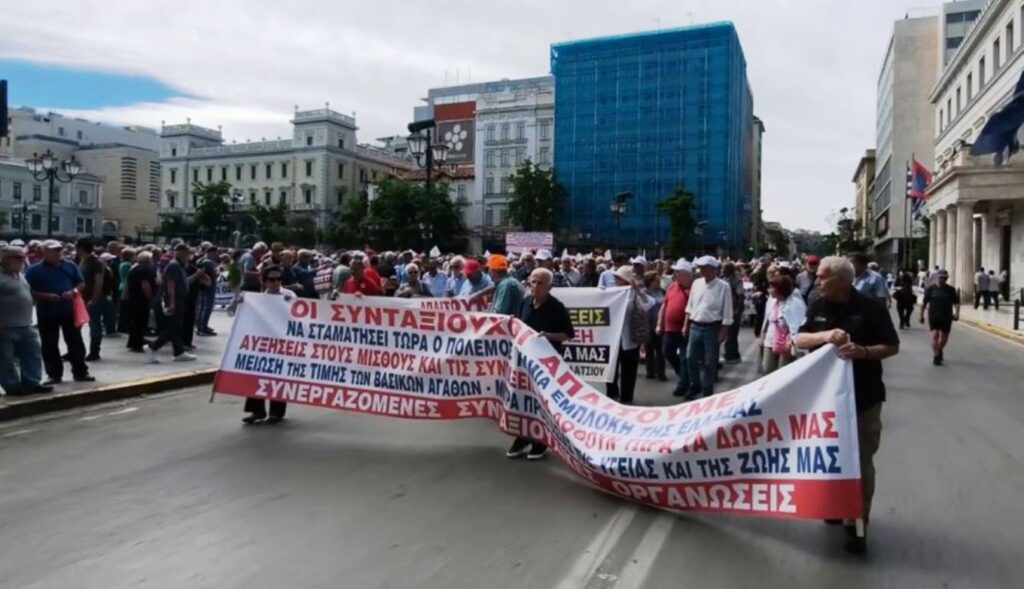
Retirees descended en masse on central Athens on Wednesday morning, staging a major pan-retirement protest at National Resistance Square, following a call from the Collaborating Pension Organizations of Attica. With slogans against high prices, low pensions and subsidy policies, thousands of demonstrators gave a dynamic “present” to the mobilization and then proceeded to march through the central streets of the capital, demanding substantial support measures and real increases. The retirees described in particularly harsh terms the financial situation they face daily, claiming that their pensions are no longer sufficient even for the first ten days of the month.
Read: Retirees back on the streets: Large rally in Athens – Their demands (Video)
At the same time, they accused all governments of anti-pensioner policies and brought back to the forefront the issue of cuts they suffered in previous years, talking about billions of euros lost from their incomes. The organizers of the mobilization argued that the state’s primary surpluses are created through the constant burden on citizens and especially retirees, while they categorically rejected the increase in November’s allowance from 250 to 300 euros, characterizing it as “subsidy mockery” that solves no substantial survival problem.
Retirees: “Pensions run out in ten days”
Representatives of pension organizations described an extremely difficult daily life for thousands of elderly citizens, arguing that the cost of living has increased to such a degree that pensions are exhausted within the first days of each month. According to what they reported, the increases presented by the government are insufficient to cover basic needs, while the high cost of food, energy and medicines has created conditions of financial suffocation. The demonstrators emphasized that their pensions now “don’t last even ten days,” denouncing that the subsidy policy being followed does not offer substantial relief. At the same time, they criticized the state’s invocation of fiscal difficulties, emphasizing that approximately 10.5 billion euros are saved annually from cuts in previous years. As they argued, primary surpluses are essentially based on reducing citizens’ incomes and particularly those of retirees, noting that last year they amounted to 11.5 billion euros and in the first quarter of this year to 4.4 billion euros.
Retirees react to allowances and support measures
Particularly intense was the demonstrators’ reaction regarding the announcement of increasing November’s allowance from 250 to 300 euros. The retirees characterized the measure as “beloved subsidy policy mockery,” arguing that strict income and age criteria leave out a large number of beneficiaries. According to them, this specific allowance cannot substantially improve citizens’ purchasing power nor address the real survival needs created due to high prices and continuous increases in the cost of living. Union representatives emphasized that retirees have regularly paid their insurance contributions throughout their working lives and will not accept the logic of temporary allowances instead of substantial interventions in pensions. At the same time, they underlined that the situation continuously worsens for thousands of people who are called to live with very low incomes in an environment of extreme high prices.
Key demands of the mobilization
At the forefront of retirees’ demands was the immediate legislation of real increases in both main and supplementary pensions. At the same time, they demanded the return of bonuses, namely the 13th and 14th pension, as well as the payment of 11-month retroactive payments. Additionally, retirees demanded the complete abolition of the solidarity contribution for all pensioners in the country, arguing that it is an additional burden that worsens their already difficult financial situation. Organization representatives made clear that mobilizations will continue with even greater intensity and mass participation throughout the country, emphasizing that they will not accept new measures that, as they claim, are taken in the name of the so-called “war economy.” According to them, these policies sacrifice social needs and citizens’ incomes in order to maintain the profits of major economic interests, leaving thousands of retirees in a state of financial suffocation and social insecurity.