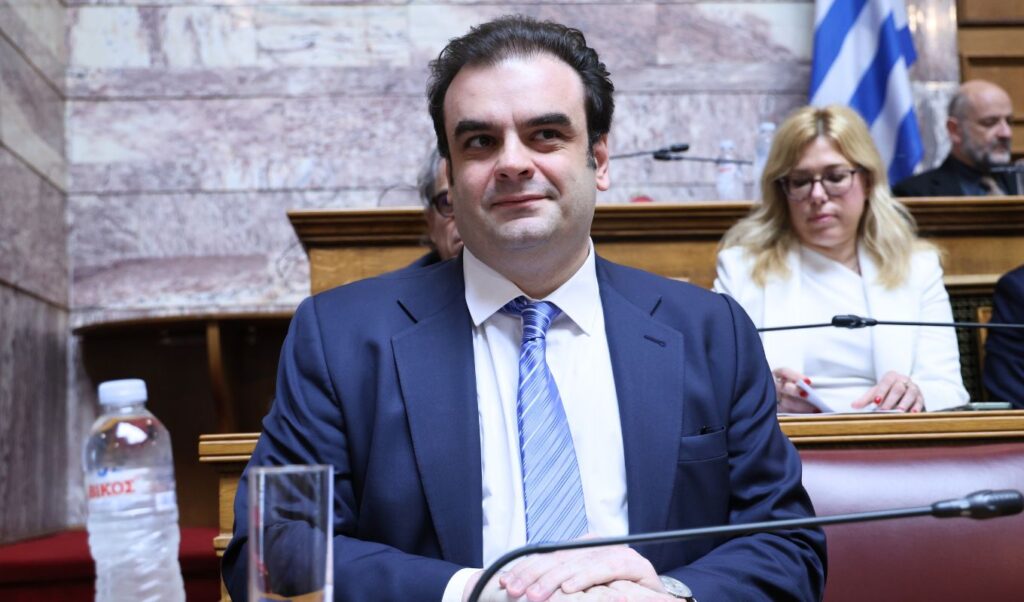
“For every early repayment of one billion euros, we save 30 million per year. We have repaid 26.5 billion euros. That’s approximately 800 million,” stated Finance Minister Kyriakos Pierrakakis during his remarks at the Public Enterprises, Banks, Public Utilities and Social Security Organizations Committee session.
Kyriakos Pierrakakis: “Europe has the expenditure rule”
Speaking in detail about the debt, he noted: In Europe, there is now the expenditure rule. We have mentioned this many times. Mr. Pappas is not here now, but it has been mentioned repeatedly that we could theoretically spend an additional portion of the surplus. The expenditure rule stipulates that the portion of the surplus you can spend is only that which:
a) either you have pre-agreed with the Commission over time, or
b) derives from active policy measures.
Therefore, from the extra 2.9 billion euros we had, going from 3.7 to 4.9 surplus, we could spend 1 billion euros and we have already spent 800 million euros supporting society. How does this relate to debt now.
For every early repayment of one billion euros, how much do we save? We save 30 million per year. How much have we repaid so far? We have repaid 26.5 billion euros. That’s approximately 800 million. So, from the 1.5 billion euros extra coming after 2032, we are already deducting 800 million.
The goal is to continue with early repayments from the remaining funds, approximately 19.5 billion euros, to have leveraged the cost of this amount so that no risk exists for the country,” he stated.
“We must not pass debt to the next generation”
He emphasized that debt must not be passed to the next generation. “I believe that regardless of party and political background, we can agree that one generation bore this burden and inherited it from previous ones. Well, this generation will not burden the next one again. It will do the job properly. This policy proves that,” he noted.
What he said about banks
“Your data, from the Bank of Greece, Governor, for 2025 shows that operating income increased by only 0.5%. Net interest income decreased by 15%. While operating expenses increased by 7.2%. What’s the result? Banks’ net operating results decreased by approximately 247 million euros.
Nevertheless, pre-tax profits increased. They rose from 5.44 billion euros to 5.82 billion euros. This didn’t happen because banks’ basic income increased significantly. It happened because we had a reduction in credit risk provisions of 438 million euros. Reduction of other losses by 158 million euros and smaller non-recurring positive effects. Basically, in simple terms,” he said.
“Banks need fewer provisions now because non-performing loans decreased and the economy’s situation improved. And see in what international environment this happened exactly. And that says something. Now, additional taxation would limit capital strengthening and reduce the ability to finance the economy… because what is our job now? To increase financing for the people watching us.
Both businesses and citizens, overall. So we want to achieve this. This is our goal. And I add that it would send a negative message to markets at a time when Greece has regained investment grade. What’s the worst mistake of all here?
It’s not so much the policy you’ll take but you not being consistent with the policy you’ll take. Don’t shake the playing field. If you shake it too much, it sends a very wrong message to markets and ultimately works against the people you want to help. And this is something we do not intend to do and should not do,” he added
“We want the system to work”
“We want the system to work,” he said regarding interventions. “If we judge that we need to intervene, we intervene, whatever is beneficial for the big picture. If we need to intervene again, we will intervene again,” he emphasized.
“We don’t start, however, from a premise that says we must politically instrumentalize banks to produce some political message. Because whenever this happened in Greek history, it wasn’t for the good. And it certainly wasn’t good for the most vulnerable,” he added.
Private debt and PASOK
Finally, he spoke about private debt and PASOK. “You mentioned deferred tax. Private debt as a percentage, let me say, regarding overdue private debt from 70% in 2018, Q4 of ’25, was 57%. We continuously take actions to manage it. Recently, you saw, we implemented the 72 installments.
We reduced from 10,000 euros to 5,000 euros the ability to be included in the out-of-court mechanism. We help businesses. We do what we can… first home support through out-of-court mechanisms to support citizens who need it most within the country’s capabilities.
And I close with one last political phrase, although we don’t have a PASOK representative in the room… to say that the “present” I heard from PASOK is not a reflection of the governor’s value. It’s a reflection of PASOK’s political helplessness in its overall politics.”