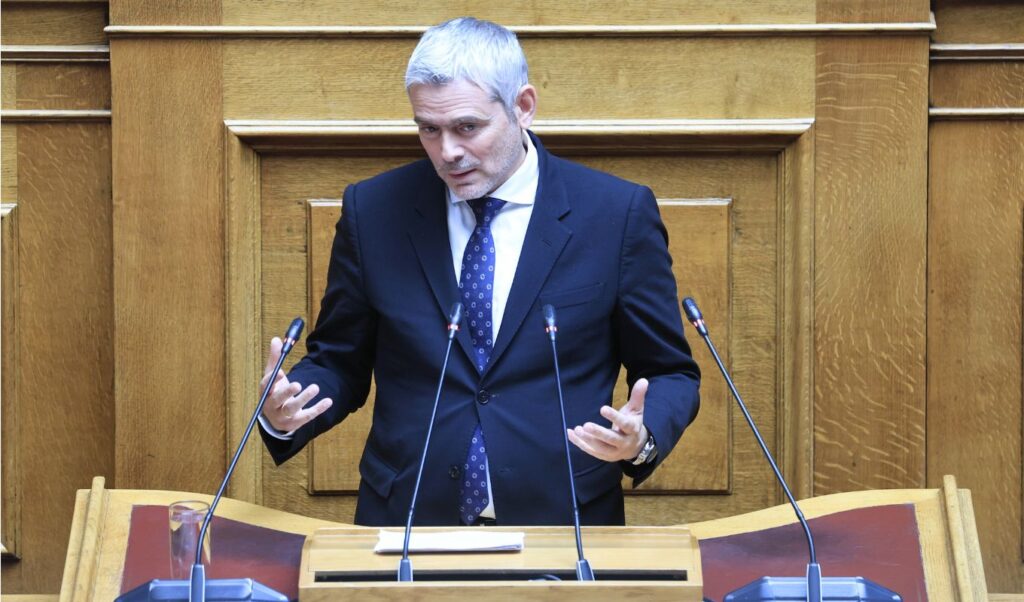
Deputy Labor Minister Kostas Karagounis stated there will be no cuts to widow pensions despite pending issues related to a Council of State decision and the current legislative framework, speaking on ERT news’ “Newsroom” program.
Specifically, referring to approximately 200,000 widow pension beneficiaries, he explained that there is a Council of State decision which, according to him, has not yet been finalized in writing, but generally confirms a regulation from the Katrougkalos law. As he mentioned, this particular regulation concerns the calculation method of the national pension for the surviving spouse, noting that the contributory part of the pension remains, while the issue concerns the national pension.
The deputy minister emphasized that, based on the ministry’s planning, there will be legislative intervention immediately after the decision is fully finalized, in order to prevent any reductions or repayments. He also stressed that, although only a summary of the decision exists so far, the government knows its general content and will proceed with regulation so that “there will be no cuts to widow pensions.”
Karagounis on retroactive payments
Responding to related concerns about possible retroactive repayments, he noted that no such issue arises for beneficiaries, insisting that the basic message to pensioners is that there will be no reduction, regardless of when the finalization is completed.
On hazardous and unhealthy occupations
Subsequently, Mr. Karagounis referred to the issue of hazardous and unhealthy occupations in the healthcare sector, noting that the government is proceeding with regulation concerning nurses, nursing assistants, ambulance drivers and assistants, as well as rescue workers from the National Health System and the National Emergency Medical Service. As he mentioned, these are six categories of workers in total, covering a large number of personnel working under particularly difficult conditions.
According to him, the regulation’s goal is to address inequalities that existed until today, as in some cases workers in the same specialty did not enjoy the same rights regarding hazardous and unhealthy work conditions. As he emphasized, the new provision will ensure uniform treatment for all workers under the same conditions.
The Deputy Minister announced that the regulation will be discussed at an upcoming Cabinet meeting and will be submitted legislatively in the coming period, with the goal of being implemented immediately after its publication.
Digitization of e-EFKA
Additionally, he referred to significant progress in the digitization of e-EFKA, noting that a dramatic reduction in pension processing times has been achieved. As he said, pensions are now issued in approximately 41 days on average, compared to about 500 days in the past, while complete digitization of archives, which include tens of millions of pages, is expected to be completed by 2027.
He noted that completing digitization will allow even faster pension processing, especially in cases of successive insurance, where significant delays are still observed today. In the same context, Mr. Karagounis referred to developments in the labor market, arguing that significant new job positions have been created since 2019 in sectors such as information technology, construction, pharmaceuticals, logistics, and healthcare. As he said, several of these sectors also record wage increases, particularly in highly specialized fields.
Finally, commenting on political developments and the possible establishment of new parties, the deputy minister characterized Alexis Tsipras’ return as “reheated food,” while regarding Maria Karystianou’s move, he noted it will be judged by her positions and political program. At the same time, he criticized PASOK and Nikos Androulakis, speaking of tension and toxicity in the public discourse of the main opposition.