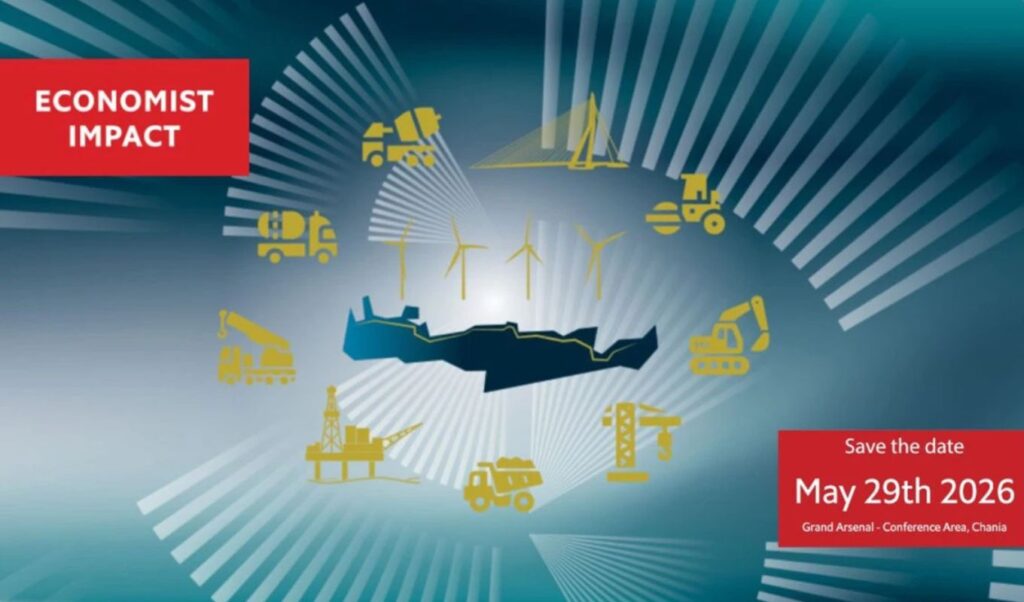
On May 29, the Grand Arsenal of Chania, a building that for centuries was part of the Mediterranean’s naval trade routes, will host an event that captures the new era opening for Greece’s largest island. Powergame.gr and the Economist are organizing the conference “Investing in Change: How Crete is Being Transformed,” with thematic pillars spanning from development and tourism to infrastructure, energy, telecommunications, road safety, circular economy, and culture.
Crete is at a turning point. The North Road Axis (BOAK), the new international airport in Kasteli, the electrical interconnection with mainland Greece, investments in renewable energy sources, plans for hydrocarbon exploration and exploitation, new major tourism investments, and the island’s emergence as a submarine telecommunications hub between three continents are radically changing its character. The conference brings together political leaders, European institutions, top business executives, bankers, and local government representatives to face this transformation.
The level of representation reflects the importance attributed to Crete’s transformation. The official opening of the conference will be made by the President of the Republic, Konstantinos Tasoulas. The keynote speech will be delivered by Prime Minister Kyriakos Mitsotakis, presenting the government’s plan for modernizing the country’s southernmost tip, spearheaded by BOAK and Kasteli airport. Alongside him as keynote speaker will be Mariana Mazzucato, Professor of Economics of Innovation and Public Value at University College London, one of the most influential economists internationally, known for her views on the state’s role as a strategic investor. At the other end of the program, the event will close with Deputy Prime Minister Kostis Hatzidakis.
Mr. Apostolos Tzitzikostas, Commissioner for Sustainable Transport and Tourism of the European Commission, will develop the importance of European connectivity for sustainable development. Kyriakos Pierrakakis, Minister of Economy and Finance and President of the Eurogroup, will examine Crete’s strategic role in the country’s development, how the island is evolving into a hub of energy, investments, tourism, education, and innovation. The Minister of Infrastructure and Transport, Christos Dimas, will present the planning and progress for the major infrastructure projects transforming Crete.
The conference will also discuss rapid geopolitical developments, particularly in the Middle East, that disrupt energy networks and supply chains, with direct impacts on regional economies. Giorgos Peristeris, Chairman and CEO of GEK TERNA Group, will address the impact of these developments on public policy and investment decisions. In the same vein, Alexandros Exarchou, Chairman and CEO of Aktor, will analyze how businesses can leverage Crete’s developing infrastructure to enhance competitiveness. The head of METKA, Dinos Benrouby, will analyze the challenge of major projects for an island in a separate section.
Two sections are dedicated to the financing issue. The first hosts Alpha Bank’s CEO, Vasileios Psaltis, on mobilizing capital for the island’s landmark projects. In the second, with participation from Deputy Minister of National Economy Nikos Papathanasis, representatives from development banks and domestic financial institutions will participate.
Tourism is addressed with two separate sessions. The first examines tourism investments as a lever for economic development on a national scale: Tourism Minister Olga Kefalogianni, Honorary Chairman of Sani/Ikos Group Andreas Andreadis, Aegean Airlines head Dimitris Gerogiannis, and Jet2.com CEO Steve Heapy will discuss the country’s transition to a high-value tourism model.
The energy section brings together Environment and Energy Minister Stavros Papastavrou, European Investment Bank (EIB) Vice President Giannis Tsakiris, and industry executives. The electrical interconnection between Crete and Attica, photovoltaic and wind farms, and the gradual independence from fuel oil compose an energy transition that profoundly reshapes the island. A separate section is dedicated to the circular economy and waste and water management — a critical issue for an island facing enormous pressures from tourism, urban development, and climate change.
One of the most interesting sections of the program concerns road safety. Crete chronically records high rates of traffic accidents, and the government has prioritized both BOAK and targeted measures to improve traffic flow. Deputy Infrastructure Minister Konstantinos Kyranakis, Executive Director of the European Transport Safety Council (ETSC) Antonio Avenoso, and President of the Panos Mylonas Road Safety Institute Vasiliki Danelli-Mylona will be accompanied by a recorded message from Jean Todt, the UN Secretary-General’s Special Envoy for Road Safety.
The contribution of Greek companies to infrastructure development is the subject of a separate panel, with Deputy Infrastructure Minister Nikos Tachiatos and industry representatives.
The telecommunications section holds a special position. Crete’s strategic location between Europe, Asia, and Africa makes it a gateway for international connectivity. ITE President Vasilis Charmandaras, OTE’s Chief Strategy, Transformation and Wholesale Officer Ioannis Konstantinidis, and a Vodafone representative will examine the prospects of this new role.
An interesting addition to the program is the “Culture Powering Crete’s Development” section, featuring Culture Minister Lina Mendoni. The inclusion of culture in an event agenda focused on infrastructure and investments signals recognition of cultural heritage as a development resource. In the penultimate panel, mayors of major Cretan cities will speak in a discussion about local leadership’s role in attracting investments.
The conference’s rich agenda conveys a clear message: Crete is not simply seeking development. It claims a new identity as a hub of energy, transport, technology, and strategic infrastructure at the crossroads of three continents.