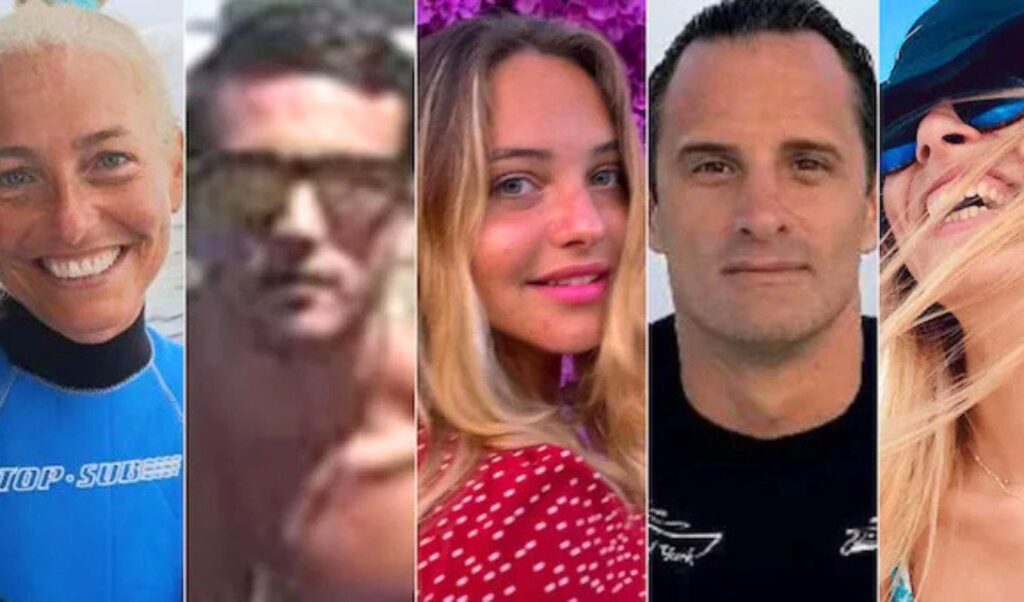
Italy remains shocked by the tragedy in the Maldives, where five people were lost during a diving expedition at Vaavu Atoll on Thursday, never returning to the surface. Among the missing are 51-year-old University of Genoa professor Monica Montefalcone, her 23-year-old daughter Giorgia Somacal, 30-year-old Federico Gualtieri, 31-year-old Muriel Oddenino, and diving instructor Gianluca Benedetti. The group conducted a dive to approximately 50 meters depth, aiming to approach an underwater cave stretching 260 meters. All were considered highly experienced divers, and nothing foreshadowed the tragic outcome.
According to Italian media reports, concern began when air bubbles stopped appearing on the water’s surface. It was then that expedition members aboard the Duke of York vessel sounded the alarm to authorities shortly before 2 PM on Thursday. So far, Sri Lankan authorities have managed to recover only one of the five bodies, with the operation being conducted with difficulty and considered extremely dangerous due to adverse weather conditions.
Three scenarios for the tragedy of the five Italians in the Maldives
Experts cited by Italian media such as Il Messaggero describe three most likely scenarios for the death of the five Italians.
The first scenario being investigated concerns the gas mixture supplied to the five members of the diving expedition by the Duke of York vessel. According to Repubblica, the yacht provided divers with nitrox, a combination of nitrogen and oxygen used in more demanding dives. At fifty meters depth, however, incorrect dosage can turn oxygen into a hazard: pressure makes it toxic to the body, straining all muscles, including the heart. To avoid this, at certain depths it would be necessary to reduce the oxygen percentage in the mixture and increase the helium percentage. If this balance wasn’t maintained, the five divers could have been affected almost simultaneously, explaining why none managed to surface.
The second scenario involves the cave the team of five attempted to approach. As described, the underwater Alimathaa cave is a coral canyon approximately 260 meters long at depths up to sixty meters with dim lighting, narrow spaces, and branching pathways. The combination with the “yellow” weather warning issued Wednesday evening with wind gusts and stormy seas, and thus reduced visibility, could have proven fatal. Under these conditions, even experienced divers may lose their orientation, and then panic sets in: movements multiply, air consumption accelerates, and time to find the exit runs out sooner than expected. The almost simultaneous loss of all five expedition members indicates something happened that worked quickly and affected everyone together.
The third scenario being considered – even though it’s thought to be least likely – is that one of the five became trapped somewhere in the underwater cave, resulting in oxygen and energy being exhausted in the rescue attempt. The strong currents of the Indian Ocean, which may have become even more unpredictable due to adverse weather conditions, could have prevented any safe return to the sea surface.
In any case, the position of the bodies inside the cave is believed to provide investigators with crucial evidence for understanding the sequence of events that led to the tragedy.
Who are the five victims
Monica Montefalcone was a professor of Ecology at the University of Genoa with several television appearances and specialization in marine environments. She was known for her love of the sea and scientific work focused on the impacts of human activity and climate change on marine ecosystems, with particular emphasis on conservation and underwater mapping.

Her daughter Giorgia would have turned 23 on June 1st and was studying biomedical engineering. She shared the same passion as her mother for the sea and diving and often accompanied her on expeditions.

31-year-old Muriel Oddenino had graduated from the University of Turin and was a researcher at the University of Genoa, having collaborated with Montefalcone. Her great love was diving.

30-year-old Federico Gualtieri had completed his thesis at the University of Genoa under Montefalcone regarding biodiversity and environment in the Maldives Atolls. He was a member of a scientific expedition led by the 51-year-old professor that began two weeks earlier. He had obtained diving certification in 2015.

Gianluca Benedetti from Padua had a career in banking and finance before deciding to turn his passion for diving into a full-time career. His first contact with the Maldives was in 2017, staying there for seven years with a brief break in Indonesia. His company profile described him as “active, extremely athletic, a lover of reading, classic cinema and chess, always ready to accompany you on a discovery of the wonders the Maldives offer.”