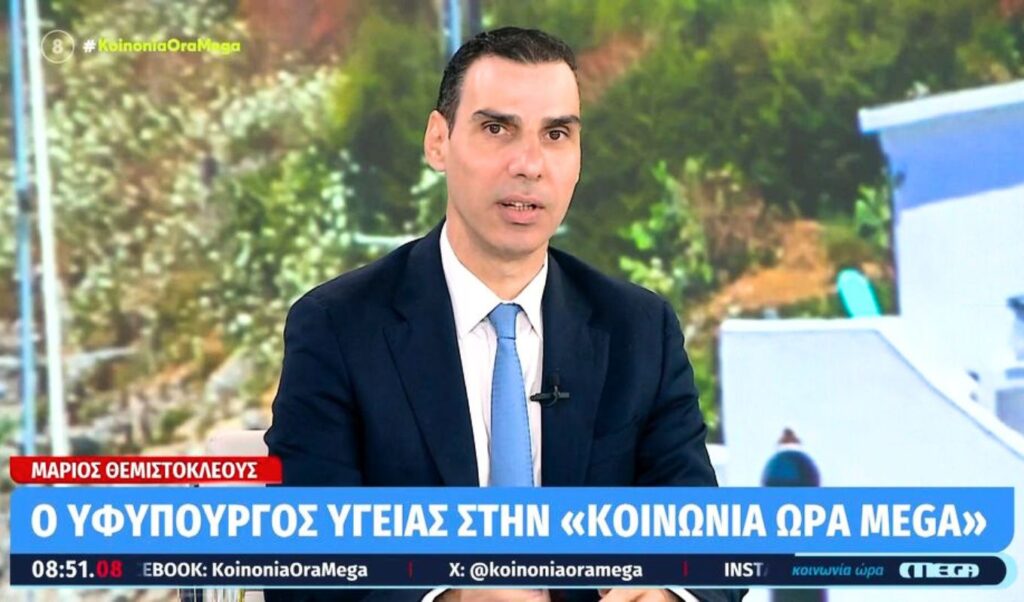
Deputy Health Minister Marios Themistokleou appeared on the MEGA TV show “Society Hour” and discussed among other topics the hantavirus and its difficult human-to-human transmission. “Our fellow citizen is in quarantine at Attikon Hospital. He is in very good health, has no symptoms, and we will wait for the 45-day period to pass. There is no concern whatsoever. Transmission is very difficult. It has no relation to coronavirus or other viruses. For human-to-human transmission to occur, very close contact is required for an extended period,” he said characteristically.
Read: Hantavirus: French woman on mechanical support, Briton in quarantine – WHO alerts for more cases
Marios Themistokleou: Hantavirus transmission from human to human requires close contact for extended periods
Deputy Health Minister Marios Themistokleou, beyond his statement on hantavirus, referenced the major announcement of 1,131 positions for doctors across the country, in hospitals and primary care, with shortened hiring procedures.
“Doctors have a different procedure, much shorter than ASEP. They have a two-week period, with possible extension to three weeks, for submitting applications. Evaluations are conducted by teams of other doctors. In approximately 4-6 months they will be in hospitals. Urgent positions proceed faster. They can reach as fast as three months, but the average is up to four months,” said the deputy health minister. “Incentives will be given in three categories: salary and insurance incentives, professional incentives, and family incentives.”
“Nurses constitute a fundamental pillar. Almost everything in hospitals and health centers depends on them. It’s a difficult profession. In all countries there’s a decline in young people wanting to choose the nursing profession. A package of measures will be provided to improve conditions and make it more attractive.”
Finally, Marios Themistokleou mentioned the creation of 40 new comprehensive mental health care units across the country, 21 for autism and 19 for dementia. These autonomous units aim for early diagnosis and prevention, collaborating with other structures like KDAP and KEDASY.
“They are autonomous units. They are primarily day centers with extended hours. There will be mobile units, teams of doctors and nurses who will also operate outside these units for early diagnosis and prevention, and they will be connected to KDAP and KEDASY for a holistic approach. This is an area where we lag as a country, which is why this effort is being made for two conditions that don’t only affect the individual but impact the entire family environment.”
The deputy health minister emphasized the increase in dementia cases due to population aging and the need for family support, as mental health, while previously marginalized, has begun to gain prominence in recent years, especially after the pandemic, stressing the need for further investment in this sector.