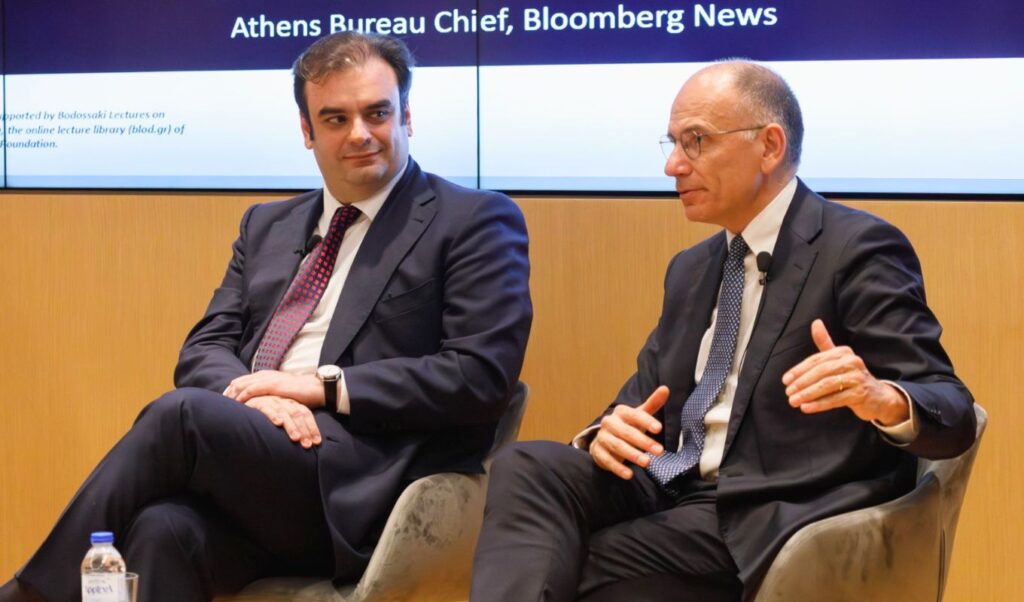
Greece’s Minister of National Economy and Finance and President of the Eurogroup, Kyriakos Pierrakakis discussed European competitiveness and its future evolution with former Italian Prime Minister and Dean of the School of Politics, Economics and Global Affairs at IE University Madrid, Enrico Letta.
The discussion took place at an event co-organized by ELIAMEP, IOBE and the IE Competitiveness Hub, marking 40 years since the signing of the Single European Act. Victoria Dendrinou, head of Bloomberg’s Athens bureau, moderated the discussion.
Kyriakos Pierrakakis: What he said with Enrico Letta about competitiveness in the European Union
Here follows the discussion:
– Mr. Pierrakakis, you have been at the helm of these discussions for some time, participating in these meetings for quite a while. Based on how you read the climate, do you believe Europe has what it takes to compete with the United States at this juncture? We have heard how great the past was, but the question is whether this can continue in the future, within this environment.
Kyriakos Pierrakakis: I wouldn’t necessarily frame it as “competing with the US.” What I would try to do is build capabilities, the ability to act. First, let me say it’s a great privilege to share the stage with Enrico Letta.
Addressing Letta, he said: “We were together in Brussels, as you said, last week and many times in the past. I really liked how you put it, because I think vocabulary dominates the discussion to a very large extent. What Enrico did with his report, and Mario Draghi with his own report, is essentially shape the vocabulary around what we, as 27 finance ministry administrations in ECOFIN and the Eurogroup, need to be able to achieve, and what our common interest should be. Common language is critical, because we need to do the same things when we describe them. We need to have a common north on our compass. And this may sound obvious, but it really isn’t. That’s exactly why, last week, because of your Italian heritage, I described you and Mario Draghi as the two ‘popes’ of European integration. But now that we have you in Athens preaching the gospel, I would say you are the ‘Saint Paul’ of European integration.”
Generally speaking, however, we are starting late. We have been very delayed in implementing changes. Explaining to citizens what the Savings and Investment Union, the SIU, is extremely difficult. It’s essentially a rebranding of the Capital Markets Union and Banking Union, which we failed to implement in time. A little over a month ago I visited The Hague and my Dutch colleague, Elko Heinen, told me that the Capital Markets Union was already a priority of the Dutch EU presidency in 2016. So this is both a delayed discussion and an obvious discussion, because we essentially need to build capabilities in all these areas.
Some things are obvious, and here I would say there are quite a few similarities with the Greek case when we took over governance in 2019. There is something in politics that I would describe as “the dividend of the obvious.” That is, the obvious thing you didn’t do, which is there waiting, and which, because it has accumulated over the years, can, if you do it, yield a growth dividend, beyond your ideal or non-ideal reaction to what you couldn’t predict, to unpredictable crises. So every policymaker in the world today must have this dual approach, both at national and European level. And Europe has a potential dividend if it implements the obvious: eliminating these hidden barriers.
The IMF calculated – and we refer to this study often – that these barriers correspond roughly to tariffs: 110% in services and 44% in manufacturing. Even if one considers this calculation method not entirely accurate, it highlights what we need to achieve. So the SIU has many elements. What are these? We need stock exchange consolidation. Chancellor Merz said there should be a single stock exchange in the EU. We need banking consolidation. We need bigger banks. We need more cross-border consolidation in Europe. Cross-border consolidation in Europe has declined since 2008, as we saw in a chart at a previous Eurogroup. If you compare the technology investments of European banks with those of American and Chinese banks, European ones are much lower. And this is also a sector that has been transformed by technology.
So, gaining common understanding of all these issues, and yes, communicating them properly, is a sine qua non condition for moving forward. The stars are aligning, because there are many exogenous events, from the Russian invasion of Ukraine to the total loss of geopolitical innocence regarding who should pay for the cost of our security.
If you add all this together, there is today a political current that favors implementing these plans. What we need to try to achieve as ministers is actual political implementation. Because we all theoretically agree with the Savings and Investment Union, but there’s always an asterisk that usually reflects a national interest. So, will you focus on the opportunity cost of non-implementation or will you focus on the asterisk? This is what will determine how fast we can move forward. It won’t be a “yes or no” issue. It won’t be “black or white.” It will be a matter of how much distance we cover on the field. And my sense is that in many of these areas, whether it’s the supplementary pension package to be discussed or the market supervision package, there will be progress. The question will be the magnitude of progress and the speed.
– So, Mr. Pierrakakis, no pressure not to lose this opportunity. I would like to talk a bit about national and European champions. Do you believe Europe can realistically compete globally if there isn’t greater concentration and if companies aren’t created large enough to function as European champions?
Kyriakos Pierrakakis: I think the question itself is, in a way, rhetorical. You can’t achieve the necessary scale if you continue to have 27 different versions of national champions. This discussion directly connects to both technology and cross-border integration. More business and banking consolidation is absolutely necessary.
On this front, we are particularly proud that Greece has shown a very positive stance, both regarding UniCredit’s increased participation in Alpha Bank and regarding Euronext’s cooperation with the Greek Stock Exchange. This is, more or less, what needs to happen in every market and every sector in Europe. We need greater scale and European champions that can compete internationally. However, the real battlefield is technology. And in technology, to be honest, we are already on “plan B,” because we delayed too much.
Europe needs a common strategy for what we call technological sovereignty. I wouldn’t characterize it exactly as doctrine, because realistically it’s not possible to develop European versions of all technologies. In some areas we are very far behind. In others, however, we already have European champions who are ready to grow and create strong ecosystems around them. The problem is that we don’t leverage them and don’t move fast enough in implementation.
A characteristic example is 5G infrastructure. During Donald Trump’s first term, American policies essentially targeted Chinese companies. Who were their main competitors? Not American companies, but two European ones: Ericsson and Nokia. The ideal European response would be to have a single telecommunications regulator, a single spectrum auction across Europe and leveraging part of the revenues, through the European Investment Bank, to finance 5G applications. This is a discussion that should have happened in 2010, not 2026.
In technology, the goal is not to become fully autonomous, with only certain exceptions. The goal is not to find ourselves in asymmetric dependency relationships. There are technologies where the United States leads, others where China leads and some where Europe can lead. These are exactly where we need to invest. We need to fund the winners and help European champions develop on a global scale.
There are, of course, areas where greater autonomy is required for national security reasons or where Europe can gain clear competitive advantage. Airbus is such an example. Galileo is another. In other sectors, Europe must function as a smart and technologically competent regulator. Overall, there are three directions, but the basic idea is one: we need a scale mentality and European champions mentality. This means, among other things, allowing national champions to evolve into European champions. Banking consolidation is an important part of this effort. The same applies to European startups. We can create startups in Europe and help them grow, with significant contribution from the European Investment Bank.
However, at some point, many of these cannot expand further due to European market fragmentation. And often, at a next stage, they become Delaware companies and depend almost necessarily on American financing. This isn’t necessarily negative. It should, however, be a choice and not a one-way street. The goal, therefore, is to create level playing fields, eliminating barriers that still exist. This is exactly what the Savings and Investment Union pursues. Start-ups must be able to evolve into scale-ups within Europe. And all European policymakers must change mentality. We need to think European when we talk about our champions. And we need to understand this quickly. Because, otherwise, we risk losing another extremely important opportunity – without there being an alternative plan.
– Some thoughts ahead of the next Eurogroup. One last question. We talked about large countries, or countries that don’t know they are small. Can smaller EU member states have a say and active role in shaping this agenda? Or does everything ultimately depend on what France and Germany want to do?
Kyriakos Pierrakakis: Absolutely. Not only can they, but they can play an even greater role. A significant part of this agenda concerns exactly the smaller countries. I mentioned, for example, the leading stance Greece seeks to demonstrate in cross-border integration and mergers and acquisitions. Many smaller countries, although often considered excluded from major developments, have managed to pioneer and bring tangible results. One need only see what the Baltic countries have achieved in digital transformation or what other countries have achieved in different sectors.
Generally, I remain optimistic. I wouldn’t want to comment on the political dimension, because part of my job is to deliver results and not simply describe how these might be achieved. Essentially, the critical question is to what extent we can align our short-term reactions to the multiple emerging crises with our long-term strategic priorities.
To be honest, last year we presented an analysis of the effectiveness of measures we took in 2022 in the energy sector, with mixed conclusions. However, one of the key findings was that the negative impact of today’s crisis is 12% smaller because of measures the European Union has taken meanwhile: investments in networks, infrastructure and diversification from Russian energy sources. This shows that, when short-term interventions align with long-term strategy, results are substantial. The Recovery and Resilience Facility was exactly such a case: an immediate reaction to a crisis, which incorporated long-term European priorities for green and digital transition.
Part of our job, therefore, is to deliver results. And a basic element of this mechanism is that we all agree on which direction the compass points, what our common north is. At the same time, we must take into account all national particularities and sensitivities that exist on many issues. At this moment, however, I see clear political will from European leaders. I had the opportunity to present Eurogroup priorities to all 27 leaders and it was evident at the Euro Summit that there is strong momentum, both from the European Council President and from all leaders, for Finance Ministers to deliver concrete results soon.
The digital euro, for example, is estimated to be reality by 2029, while many elements of the Savings and Investment Union will also begin to be implemented soon. The question, of course, is how quickly and to what degree. As Yogi Berra said, and it’s one of my favorite sayings: “It’s very difficult to make predictions, especially when they concern the future.” Politicians, by definition, are not the best at predictions. What I can say is that, as Enrico Letta also mentioned, at this moment the stars have aligned.
I very characteristically remember a theory of European integration, neo-functionalism, according to which Europe progressed to deeper integration through every crisis it faced. The usual criticism is that, as a rule, every crisis is accompanied by a response that is not optimal. This has worked in some cases, while less effectively in others. Overall, however, through every crisis we have faced, we have managed to strengthen our institutions and deepen European integration. Today we are at a critical crossroads. We face multiple emerging crises and many open issues, but at the same time we have leaders around the table who really want to see concrete progress. Because they understand that every delay has costs. And, mainly, that the opportunity cost of inaction has now become absolutely tangible and visible.
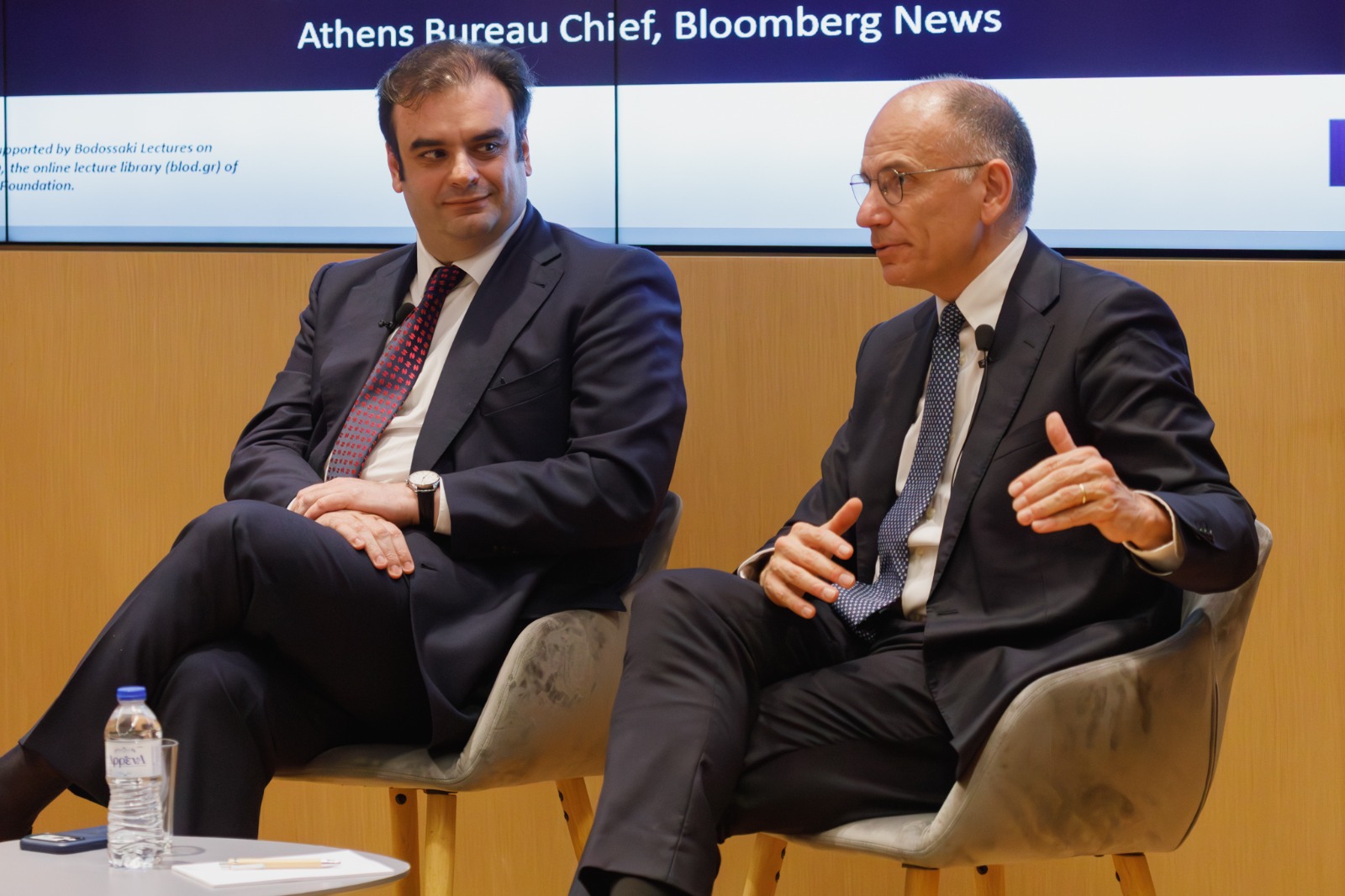
Key points from Enrico Letta’s responses on European integration and prospects
For his part, Enrico Letta, focusing on the need to complete the Savings and Investment Union (SIU), clarified that “the basic point is that, when we discuss these issues and try to promote the Savings and Investment Union, the sense of scale is not easy. The very simple problem we face is that the sense of this dimension today is completely different from the approach we have. Because in Europe we like small projects. We are small countries. We are full of small cities. We are the kingdom of small and medium enterprises. And I am very happy that my country is the kingdom of small and medium enterprises. And I always lived in small cities. And I like this small scale very much. This is the basic problem. The fact that the world has changed completely in terms of scale. And we, as Europeans, did not proceed with the integration of our financial markets”.
At another point, the former Italian Prime Minister emphasized: “Today we are retreating due to lack of scale. And this lack of scale is absolutely fundamental. We depend on American technology. We depend on American financing. We depended on Russian energy. We depend – and continue to depend – on Chinese manufacturing”. He added: “independence, in today’s world, means the ability to acquire the necessary size. It means uniting the small with the large. If we manage to do this, we can succeed. And we must start from financing”. “If you had asked me three months ago, I might have been less optimistic. Today, however, I clearly see the path. I spoke with the Irish presidency. The Irish presidency for the next semester is absolutely determined to continue and accelerate in this direction. There is, therefore, a sense that momentum is being created. And this exact momentum we already see in practice. Of course, we can waste this momentum. We must not, however, lose this moment.
“There is no alternative plan. If we lose this opportunity, I believe we might be able to recover lost ground later. However, at this moment we have a great opportunity before us”, Enrico Letta also emphasized.
Enrico Letta made special mention of Eurogroup President Kyriakos Pierrakakis, speaking with very positive characterizations about his assumption of duties. As he characteristically said: “I am very happy to be here with Kyriakos, because I feel I am next to someone who is writing European history. By trying to call things by their names, he manages to make a difference”.