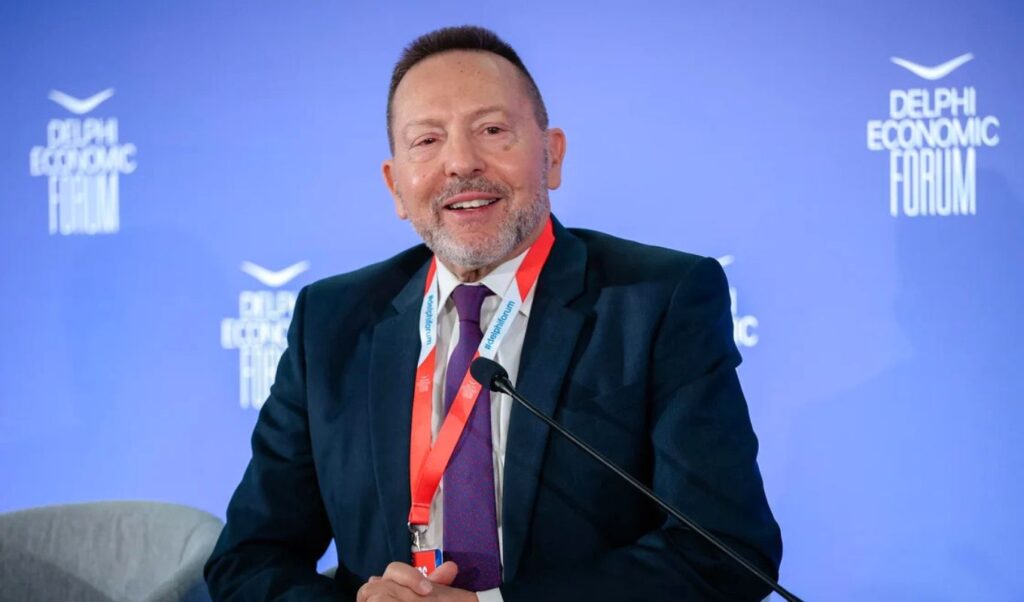
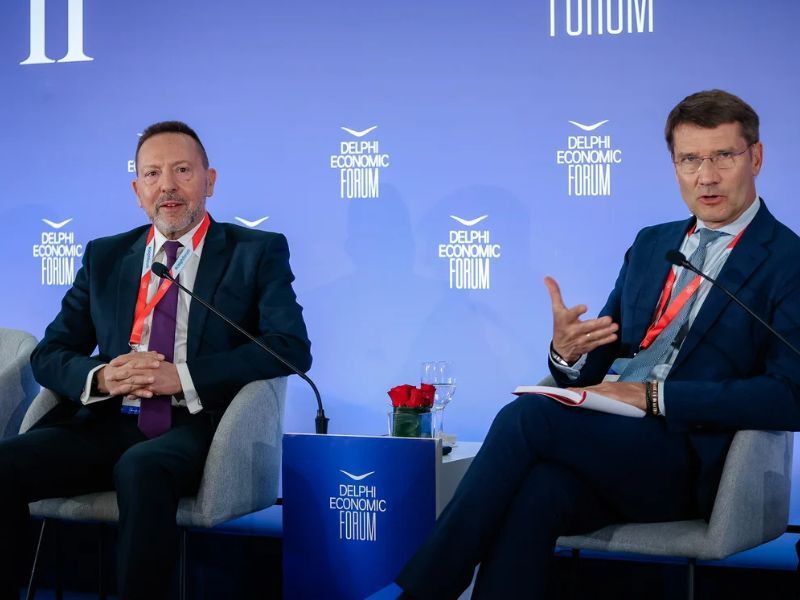
The Governor of the Bank of Greece, Yannis Stournaras, addressed the environment of heightened geopolitical uncertainty and energy pressures during a discussion at the 11th Delphi Economic Forum taking place in Delphi from April 22-25.
Read: Bank of Greece: Proposes Yannis Stournaras’ reappointment to the Cabinet
Stournaras: “Monetary policy will adapt according to developments”
Mr. Stournaras emphasized that international markets appear “resilient and optimistic,” estimating that the baseline scenario remains a relatively swift de-escalation of the conflict in the Middle East. “I’m among the optimists that the war will end soon,” he noted, pointing out that “it wasn’t a war of necessity, but of decision.”
However, he warned that uncertainty remains high and made clear that monetary policy will adapt according to developments. “If necessary, we will do whatever is required,” he stated, emphasizing that central banks now have greater experience compared to previous crises.
Referring to developments in the energy market and specifically to the possibility of escalating tensions in the Strait of Hormuz, he noted that an agreement could lead to rapid improvement of the situation, while reminding that Europe has already gained significant experience.
He placed particular emphasis on the independence of the European Central Bank, which he characterized as “the greatest achievement” of the European economic architecture. “No one in Europe could or would dare to reduce the ECB’s independence,” he stated, adding that the role of central banks is not to maximize profits, but to ensure stability for the benefit of society as a whole.
As he explained, the main challenge for monetary policy remains returning inflation to target “without the risk of recession,” noting that decisions require delicate balances, especially in an environment of external shocks.
At the European level, Mr. Stournaras emphasized the need for further deepening of integration. “We need more Europe, not less,” he declared, stressing the need for capital markets union and closer cooperation between member states. As he noted, convergence is now observed, with southern Europe developing faster than the north.
Regarding Greece, he mentioned that the economy has covered significant ground since the crisis period. “Let’s not forget where Greece was 15 years ago,” he noted, highlighting the improvement in investments and the overall economic picture.
When asked about the OPEKEPE case, he stressed that “we must wait,” emphasizing that institutions are functioning and that the case was revealed by the Greek government itself.
Finally, he focused on the importance of digital transition, noting that the digital euro represents a critical step so that “Europe doesn’t fall behind in the field of digital money.”
The discussion was moderated by Christian Schubert, Economic and Business Correspondent of Frankfurter Allgemeine Zeitung (FAZ), Italy.
To watch the Delphi Economic Forum proceedings live, click HERE