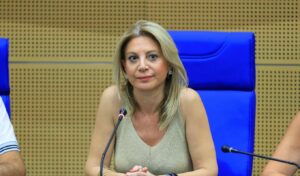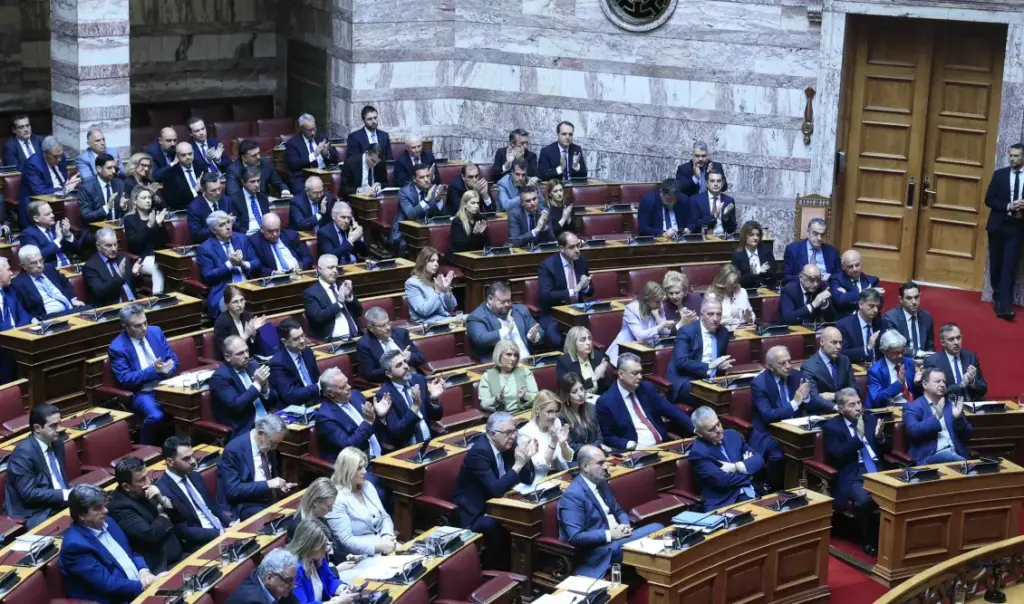
The Greek Parliament’s Plenary Session decided to lift the immunity of the “13 blue” MPs mentioned in the OPEKEPE case file. Among the 13 ruling party members, the immunity lift for Trikala MP Katerina Papakosta received the most votes with 287 MPs voting in favor, while the immunity lifts for both Kostas Tsiaras and Charalampos Athanassiou were approved by 285 MPs each, with two voting against and one abstention in Athanassiou’s case.
Parliament: Voting results for immunity lifts in OPEKEPE case
Specifically, 287 MPs voted in favor of lifting Katerina Papakosta’s immunity with one against, while 286 MPs voted to lift Kostas Ach. Karamanlis’s immunity with two against. Additionally, 286 MPs voted in favor of lifting immunity for Notis Mitarachi, Kostas Skrekas, Dimitris Vartzopoulos, Maximos Senetakis, Vassilis Vassiliadis, Theofilos Leontaridis, Christos Boukoros, and Tasos Chatzivassiliou, with two voting against in each case.
Who abstained
Ruling party MPs Notis Mitarachi, Stelios Petsas (as he had pre-announced), and Miltos Chrysomallis abstained from the vote. Katerina Papakosta only voted in favor of her own case. Independent MPs Antonis Samaras, Marios Salmas, G. Aspiotis, and Pavlos Sarakis abstained, as did SYRIZA MP Katerina Notopoulou.
Detailed results
Katerina Papakosta 287 in favor, one against
Kostas Karamanlis 286 in favor, two against
Giannis Kefalogianniss 286 in favor, two against
Notis Mitarachi 286 in favor, two against
Kostas Tsiaras 285 in favor, two against
Kostas Skrekas 286 in favor, two against
Dimitris Vartzopoulos 286 in favor, two against
Maximos Senetakis 286 in favor, two against
Lakis Vassiliadis 286 in favor, two against
Kostas Boukoros 286 in favor, two against
Theofilos Leontaridis 286 in favor, two against
Charalampos Athanassiou 285 in favor, two against, one present
Tasos Chatzivassiliou 286 in favor, two against
What the ruling party MPs said in their speeches
Earlier, the 13 ruling party MPs took the parliamentary podium, requesting their immunity be lifted. Kostas Tsiaras raised questions about the role of MPs, wondering whether they should be limited to passive observation or intervene on citizens’ issues. He referenced a specific farmer’s case, arguing there was no irregularity while characterizing the amounts in the case file as excessive. He clarified his support for the European Prosecutor’s Office operations.
Notis Mitarachi emphasized that MPs function as “primary citizen advocates,” noting that in this specific case he merely forwarded a citizen’s request to the competent authority. He stated that while he considers the immunity lift legally unfounded, he welcomes it for transparency reasons to ensure no shadow falls on his name. Katerina Papakosta explained that her intervention caused no damage, simply conveying a livestock farmer’s request to OPEKEPE without applying pressure or interfering with administrative work. She emphasized that ultimately no subsidy was paid, which she said proves no illegal result occurred.
Kostas Karamanlis noted that the case file contains no conversations involving him or his associates, sarcastically commenting on “how strong the disputed evidence is.” He declared he doesn’t wish to participate in a “toxic environment” and announced he won’t seek re-election while requesting immunity lift to prove his innocence. Giannis Kefalogianniss argued there’s no evidence of his involvement in illegal activities, emphasizing he neither encouraged anyone to break laws nor caused damage. He noted that even the case file dialogues show him not engaging in favoritism, also requesting immunity lift.
Similarly, Kostas Skrekas stressed he requested nothing illegal, attributing the case to pricing errors by an agricultural engineer. As he said, there was no data falsification and the procedure followed was legal. Dimitris Vartzopoulos spoke of a “logical leap,” arguing that MP intervention to advance citizens’ legitimate requests is proper. He questioned whether MPs shouldn’t deal with citizens’ real problems, especially those arising from bureaucratic dysfunctions.
“I haven’t committed any illegal act; I consider it my duty to make myself available to any authority,” said Maximos Senetakis from the podium, adding that in the recorded conversation, he simply conveyed the producer’s request without asking for anything illegal. “Nothing suggests that the OPEKEPE president himself took any action,” he emphasized.
“My name’s involvement causes me sadness. I must show and prove there’s nothing reprehensible in my behavior,” stressed Lakis Vassiliadis, emphasizing he would protect his relationship with Pella’s society. He clarified that no conversations he participated in are included, adding that the dialogue participants had no contact with his associates.
Christos Boukoros appeared absolutely convinced he committed no illegal act. He pointed out that public opinion was influenced by selectively and fragmentarily publicized dialogues that created distorted impressions. At his speech’s end, he made pointed remarks: “I don’t expect someone who orders filet or veal at a nice Athens restaurant and has the distorted impression that this is produced digitally to understand the case’s essence.”
Theofilos Leontaridis spoke of actions that constitute neither illegality nor punishable acts but fall within institutional communication frameworks. He argued his intervention concerned exclusively expediting legal payment to a female farmer, not disbursing any irregular amount.
From Parliament’s podium, Charalampos Athanassiou argued that his alleged case doesn’t connect to the OPEKEPE investigation. He stressed seeking immunity lift so no doubt exists about his actions and to stand beside colleagues accused of acts within their political activity scope. He also expressed intention to contribute to changes he considers necessary through his name’s mention.
Tasos Chatzivassiliou emphasized that according to the European Prosecutor’s Office referral, no crime is attributed to him. Nevertheless, he declared seeking immunity lift not because he considers himself liable but to definitively end the matter. He noted the case concerns a request for agricultural rights transfer between spouses, which he characterizes as legal and humane, submitted for force majeure reasons due to pregnancy. He stressed full compliance with prescribed procedures, though competent services rejected the request. “I’m accused of an act that never occurred,” he concluded.