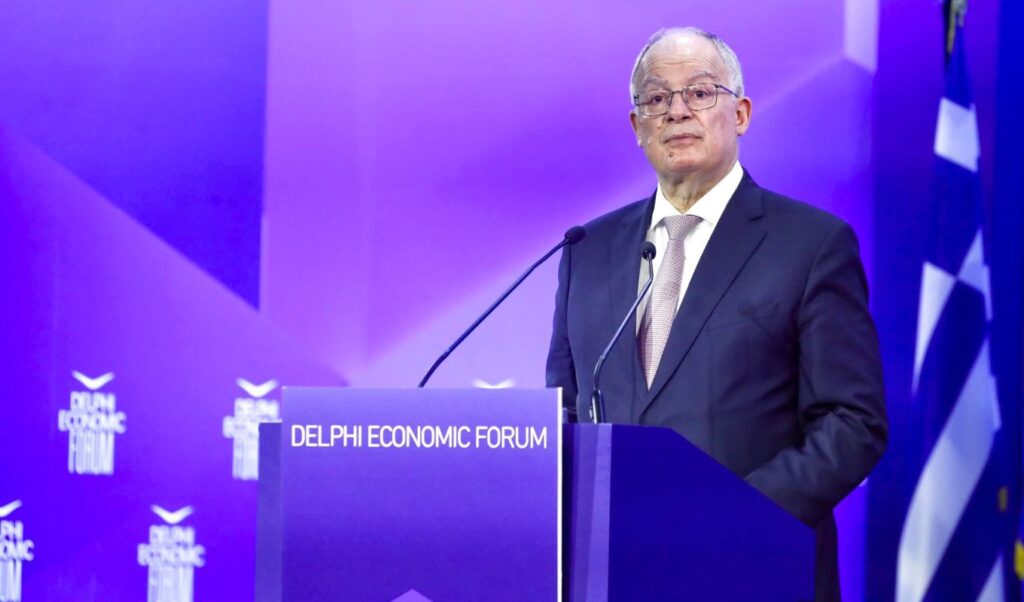
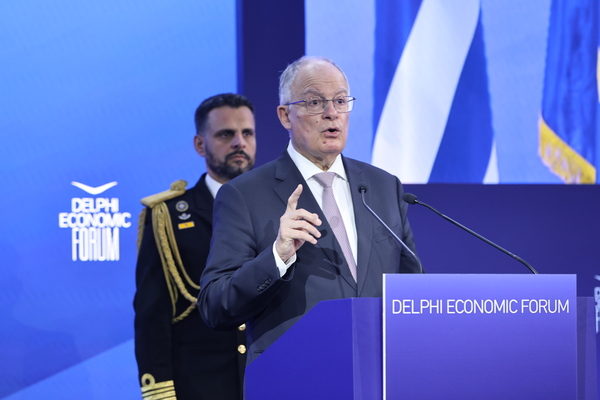
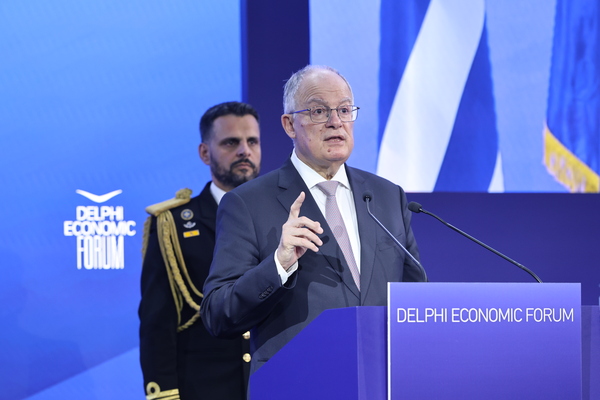
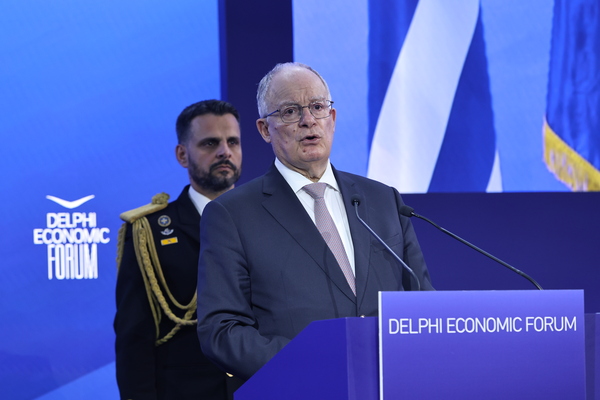
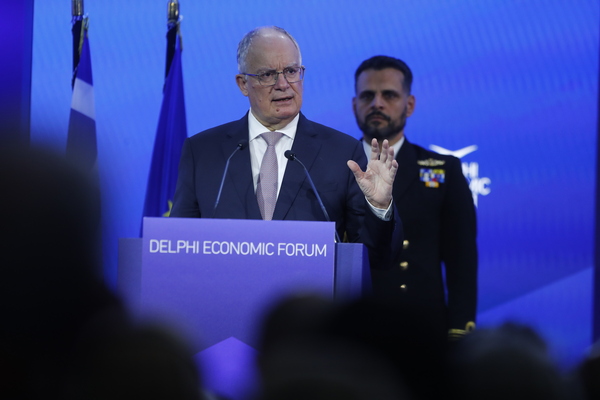
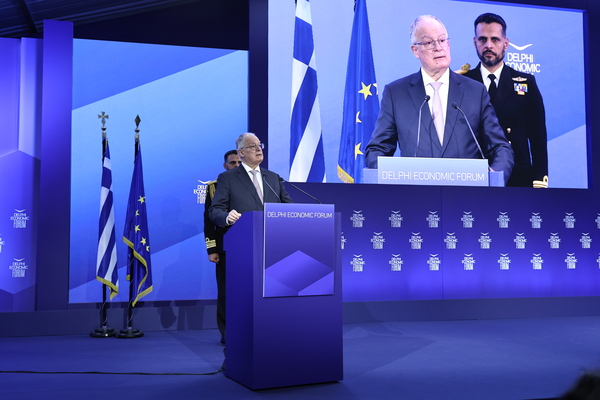
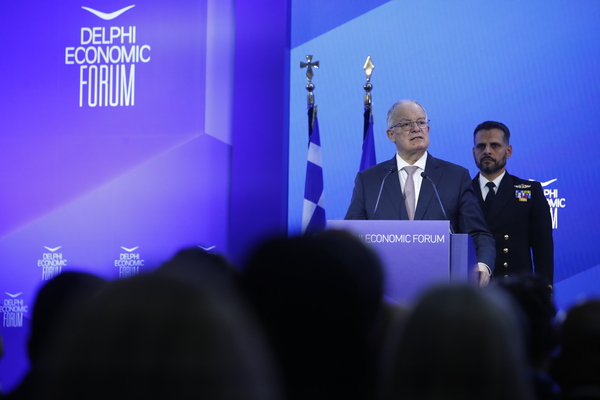
“The risk of Western fragmentation must be avoided by all means. Unity, determination, and adherence to our liberal values and human rights are sine qua non prerequisites for defending our political, economic, and social achievements from the end of World War II to today,” emphasized the President of the Hellenic Republic, Konstantinos Tasoulas, during his opening speech at the 11th Delphi Economic Forum.
Read: Laura Kövesi comes to Greece – Will speak at the 11th Delphi Economic Forum
Tasoulas at 11th Delphi Economic Forum: “Europe needs America”
“Europe needs America as much as America needs Europe. Any disconnection of these two poles of the Western world, under the weight of transactional approaches and nationalist and populist currents, will have very serious consequences for the security and prosperity of all of us, both in Europe and America,” he added.
The speech by Konstantinos Tasoulas
The complete speech by Konstantinos Tasoulas: “It is with particular joy that I welcome you to Delphi, a place with strong symbolism, which since antiquity has been connected with the search for truth, the need for self-knowledge, and the synthesis of different perceptions with the ultimate goal of deeper understanding of the world. In this historic place, where for eleven consecutive years the internationally renowned Delphi Economic Forum has been organized with absolute success, we are called today to pick up the thread from where we left it last year and discuss the challenge of adapting to the new, emerging international conditions. Or, as the organizers have eloquently titled this year’s Summit, the “Shock of the New”.
Our world is going through a period of rapid and profound transformations. Developments and crises in geopolitics, economics, energy, technology, and climate no longer evolve linearly, but interact dynamically, accelerating and often overturning established perceptions and certainties. Mr. President of the friendly country of Estonia, Within this constantly changing environment, critical questions arise:
Are we at the end of the international order and international security architecture, as built after World War II and shaped after the Cold War? And if so, what will be the form of the next day? What do these changes signify for Europe and the West in general? What is Greece’s position in this new landscape?
In the geopolitical sphere, we observe the reorganization of power distribution, the emergence of revisionist tendencies, and the reappearance of competitive theories and policies of military power that we believed belonged to the past. The monopolar international system of the post-Cold War period is in a process of transition towards a multipolar balance of power system, where the West seeks not only a modus vivendi with revisionist powers, but also a new distribution of rights and obligations among its members.
Your Serene Highness Prince of Monaco,
In this context, the risk of Western fragmentation must be avoided by all means. Unity, determination, and adherence to our liberal values and human rights constitute sine qua non prerequisites for defending our political, economic, and social achievements from the end of World War II to today. Let us be clear: Europe needs America as much as America needs Europe. Any disconnection of these two poles of the Western world, under the weight of transactional approaches and nationalist and populist currents, will have very serious consequences for the security and prosperity of all of us, both in Europe and America.
For Europe, the challenge is twofold: on the one hand, to ensure its strategic autonomy by strengthening its economic competitiveness, as well as its defensive capabilities and power, energy connectivity, and an innovative technological sector, and on the other hand, to remain consistent with its alliance obligations while staying true to the fundamental values that constitute its identity, such as democracy, human rights, and the rule of law. At the same time, armed conflicts, such as those in Ukraine and the Middle East, remind us dramatically that peace and stability are not given.
Gross violations of fundamental principles of international legal order, even by permanent members of the UN Security Council, may not formally change the rules of international law, making for example the use or threat of force or violent border changes legal, but they dangerously weaken the foundations upon which the international order of things rests, built after the most catastrophic war in human history.
This trend must be reversed immediately, and for this purpose, among other things, the reform – not abolition – of the United Nations is necessary so that it not only reflects the international balances of the 21st century and not those of 1945, but can also respond to its high mission of maintaining international peace and security. At the same time, we must work to strengthen multilateral international institutions and international cooperation, as well as renew our commitment to the fundamental principles of the UN Charter, including those of respect for territorial integrity and national sovereignty, peaceful resolution of disputes, and human rights.
In a period when these principles are being tested and violated, their defense is not a choice but a necessity. For this reason, we have a duty to continue our unwavering support for the struggle of the Ukrainian people for peace and defense of Ukraine’s sovereignty and territorial integrity.
In the Middle East, where conflicts rage on various fronts, Greece supports efforts for peace and believes that ceasefires in both Iran and Lebanon constitute a first step toward de-escalation that creates space for diplomacy and negotiations. Equally important is the peaceful resolution of the Palestinian problem based on the two-state solution, as determined by relevant UN resolutions.
In this context, Greece supports the implementation of the second phase of the American Comprehensive Plan for ending the conflict in Gaza. Although a bit further from our neighborhood, equally urgent is peace in Sudan, where one of the world’s largest, somewhat unseen but existing humanitarian crises rages. Simultaneously, in the economic field, globalization is being redefined, with new forms of interdependence but also with increased fragmentation tendencies.
Protectionism and extreme competition for securing critical raw materials, energy sources, and new markets cannot but pose long-term risks not only to the economic stability and prosperity of all of us but also to international peace and security itself. Similarly, in the field of technology, the rapid progress of artificial intelligence creates new possibilities but also new challenges for the economy and the democratic functioning of modern societies.
For the digital transition to be peaceful, democratic, and socially just, it must be carried out with human beings and their needs as the focus, with respect for work and care for the most vulnerable. For Greece, the geopolitical rearrangements and new international conditions that are forming daily acquire particular significance due to its geographical and geopolitical position.
Our country is located in a region of increased strategic importance, where energy flows, trade routes, and competitive strategic interests intersect. In the Eastern Mediterranean, worrying international and regional developments highlight the imperative need for stability and cooperation, with respect for international law and particularly international maritime law. In this context, Greece remains steadfastly committed to the peaceful resolution of disputes, based on international law, and to promoting good neighborly relations through good-faith dialogue.
This, of course, presupposes the strong political will of all interested parties, including Turkey, as well as Turkey’s abandonment of revisionist and hegemonic narratives. At the same time, the Cyprus issue continues to constitute a major international problem of illegal invasion and occupation for 52 years now. Its resolution, based on relevant UN resolutions and European acquis, remains at the top of Greek foreign policy as a prerequisite for the full restoration of peace and stability in the region. Simultaneously, Greece systematically strengthens its defensive armor, not as a choice of conflict or confrontation, but as a security prerequisite and deterrent in an unstable and sometimes threatening international environment.
This strengthening is combined with our country’s active participation in international, regional, and bilateral cooperation schemes that promote peace, security, and development, without being directed against anyone. As shown by the recent unprecedented mobilization of European defense assets, with our country as the protagonist, for the protection of Cyprus from the consequences of the war in the Middle East, our national but also European collective security requires speed, determination, and coordinated action.
In the energy sector, Greece is emerging as a hub for connecting and diversifying sources and routes, contributing mainly through the Vertical Corridor to the energy security of Southeastern Europe. The role and geopolitical value of our country is constantly highlighted due to developments in the broader region and is recognized by all interested parties.
In this reality, Greece does not approach as a country helpless or fearful of the future. It approaches having achieved, especially in recent years, a new level of power in the economy and state organization that allows it to respond better than ever to the complex challenges of our time. With planning, with work, with faith in its capabilities, our country can turn difficulties into opportunities, opening new paths in all fields. After all, history has shown that the peoples who progress are those who shape their future with confidence, persistence, and collective effort.
Ladies and gentlemen,
The “Shock of the New” is not simply a vivid description of reality. It is an invitation for action. It calls us to reexamine our certainties, strengthen our institutions, and invest in multilateralism and cooperation.
The goal is not to eliminate uncertainty or possibly even fear in the face of changes – such a thing would be, after all, unattainable. The goal is to manage these changes in a way that will enhance our security, stability, resilience, and prospects for the future.
Our era requires sobriety, insight, and adherence to stable principles and values that transcend each unfavorable circumstance. It requires what is happening here these days, dialogue, cooperation, both at international and regional levels. And it requires, above all, confidence in our ability to shape a future that is more secure, more just, and more sustainable. With these thoughts, I declare the opening of the work of this year’s Delphi Economic Forum and wish that the discussions that will take place here in the coming days will illuminate the various aspects of a rapidly changing world. Thank you warmly.”