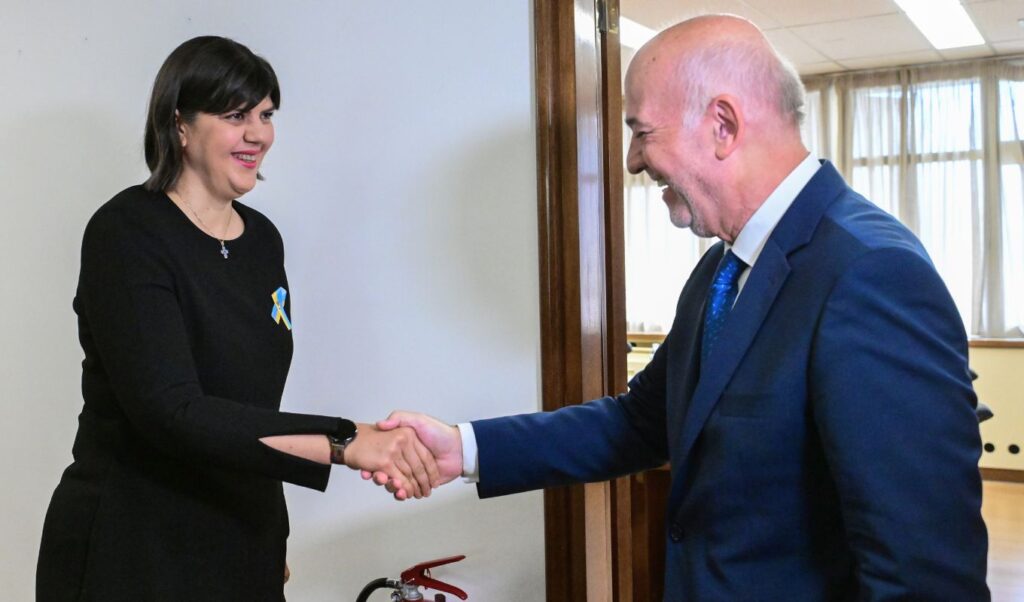
Today’s meeting between the head of the European Public Prosecutor’s Office, Laura Codruța Kövesi, and Justice Minister George Floridis at the ministry building on Mesogeion Avenue is being awaited with exceptional interest. Ms. Kövesi’s presence in Greece coincides with the parliamentary plenary debate on whether to lift the immunity of 13 New Democracy MPs involved in the OPEKEPE case.
The meeting was requested by Ms. Kövesi and is expected to discuss issues related to the operation of the European Public Prosecutor’s Office in Greece. During her previous meeting several months ago with the political leadership of the Justice Ministry, the head of the European Public Prosecutor’s Office had raised issues regarding the strengthening of the Greek team with prosecutors and staff, something that was promoted by the Justice Ministry, as the number of delegated European prosecutors increased from 10 to 13, due to the workload that the European Public Prosecutor’s Office has in our country.
What is also awaited with interest is whether the issue of renewing or not the term of the three delegated Greek prosecutors, Popi Papandreou, Dionysis Mouzakis and Chariklia Thanou, will be discussed, an issue that is to be brought before the Supreme Judicial Council in mid-May. Already since last November, the College of European Prosecutors had decided on their continuation, without however being preceded by a decision of the Supreme Judicial Council, a fact that had annoyed Supreme Court circles at the time, resulting in procedures being initiated so that a decision of the Supreme Judicial Council that had initially appointed them to their positions would be taken.
Ms. Kövesi’s visit to Greece will continue with her presence at the 11th Economic Forum of Delphi. Specifically, Ms. Kövesi will travel to Delphi on Thursday, where she will have a discussion with journalist Pavlos Tsimas as part of the forum. Ms. Kövesi’s previous visit had taken place last October.
At that time, she had held a round of important meetings with government officials and the Supreme Court prosecutor, Konstantinos Tzavellas. During her meeting then with the political leadership of the Justice Ministry, the minister, George Floridis, and the deputy minister, Ioannis Bougas, the European Prosecutor, Laura Codruța Kövesi, had raised issues concerning the strengthening of the European Public Prosecutor’s Office, while she had also shown interest in the revision of article 86 of the Constitution regarding the criminal liability of ministers.
Meanwhile, on Tuesday, the Coordinating Committee of the Plenary of Presidents of the Bar Associations of Greece extended an “institutional protection shield” to the European Public Prosecutor’s Office. “Any attempt, direct or indirect, to interfere with or influence their work, as well as to depreciate or downgrade their institutional role is absolutely condemnable regardless of where it comes from. In a law-governed state, behaviors that damage the prestige of justice, undermine its independence and shake citizens’ trust in it, especially when they come from members of the executive power, cannot go unnoticed and be tolerated by any citizen and especially by justice collaborators. Justice constitutes a pillar of democratic functioning and its independence is the foundation of the rule of law and the separation of powers, which we all must defend,” the bar associations stated in their announcement.