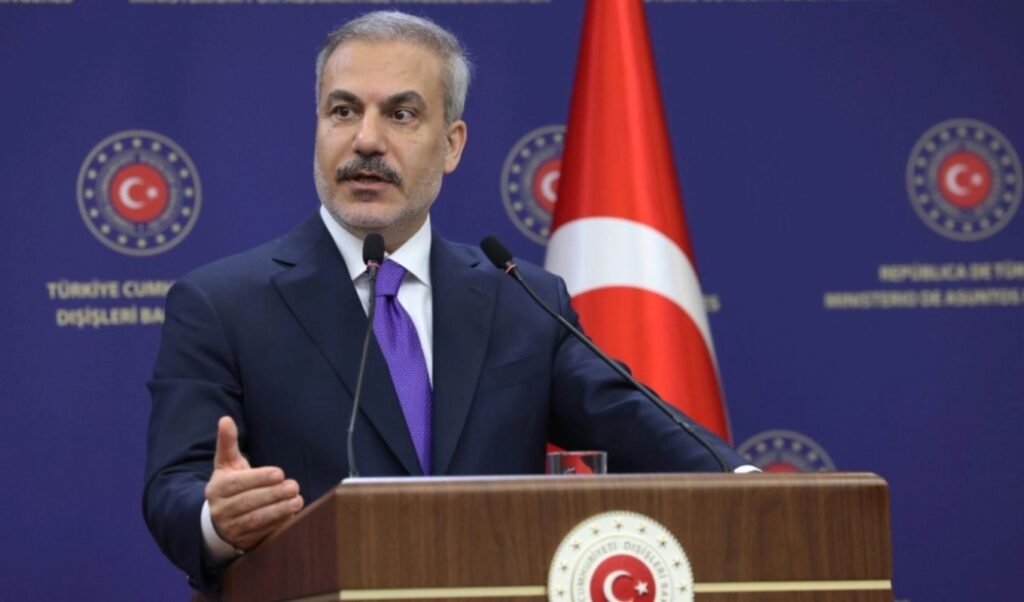
Israel as a threat to Turkey is regularly brought up in public discourse by the head of Turkish diplomacy, Hakan Fidan. Recently, however, he has also involved Greece and Cyprus, as he did at the Antalya Diplomacy Forum. Nevertheless, his rhetoric is clearly targeted at Tel Aviv. This is proven by the culmination of his statements on Sunday from southern Turkey, when he said that “Israel does not seek to armor its own security. Israel wants more territory. Security is being used by the Netanyahu government as a pretext to seize more territory.”
Fierce attacks against Israel and personally against Prime Minister Benjamin Netanyahu are frequently launched by Turkey’s President Recep Tayyip Erdogan, either over the Gaza Strip (genocide) or regarding Syria and Lebanon. The escalation of tensions between Turkey and Israel fuels scenarios of military confrontation in articles and analyses across all international media. In one such piece, former US Defense Department official Michael Rubin does not rule out even the extreme scenario of military conflict between the two states.
Sotiris Roussos: “Both in Israel and Turkey, hostility between them is developing”
Professor of International Relations Sotiris Roussos rules out such a possibility in the immediate future. According to his assessment, Israel is currently in a very difficult situation – amid ongoing conflicts – and does not have the ability to open another front. However, he points out that Hakan Fidan’s claims that Israel is developing a narrative saying “Turkey constitutes one of the main threats” are indeed accurate. “In a recent threat assessment conducted in Israel, mainly among the elites – military, political, and economic classes – Iran emerged as the first threat, the Islamist danger as second, Turkey as third, and the international peace movement as fourth. These are the four basic threats that exist for Israel at this moment. So you understand that Turkey is among the primary threats, the basic threats to Israel, as assessed by the country’s elite. On the other hand, over the last two to three decades, all measurements conducted in public opinion and among elites in Turkey have always placed Israel among the top three threats to Turkey. So hostility is developing in both countries. It’s not just in Israel, as Fidan says, a narrative of threat. A narrative of Israeli threat against Ankara is also developing in Turkey.”
The conflict of interests developing between Turkey and Israel in the Middle East, particularly in Syria, seems to be mitigated by the United States’ presence in the region and the approval it provides for Turkey’s moves there. Additionally, Turkey as a NATO member country and as a candidate member of the European Union enjoys Western support against any threat from Israel.
“Despite mutual rhetoric, we will not have a frontal confrontation between Turkey and Israel”
As Mr. Roussos argues, “it is completely different – and we must not confuse them – competition of interests versus the probability of conflict. Competition of interests does not necessarily lead to conflict. We have had competition of interests with Turkey for 40 years, it has not led to conflict. I don’t think that at this moment, nor in the near future, we will have a confrontational situation between Turkey and Israel. Despite the mutual rhetoric and the mutual sense of threat that exists, we will not have a frontal confrontation between Turkey and Israel.”
The Trump factor
Another possible scenario mentioned is the possibility of a reconciliation initiative between the two countries by the American President, who maintains friendly relations with both leaders. At this moment, however, this scenario is postponed for the future, as Donald Trump appears to have fallen into quicksand in the Middle East while trying to get out of the war with Iran by any means. Furthermore, the American President’s diplomatic skill appears to be burning day by day, and the hopes placed on him are diminishing.