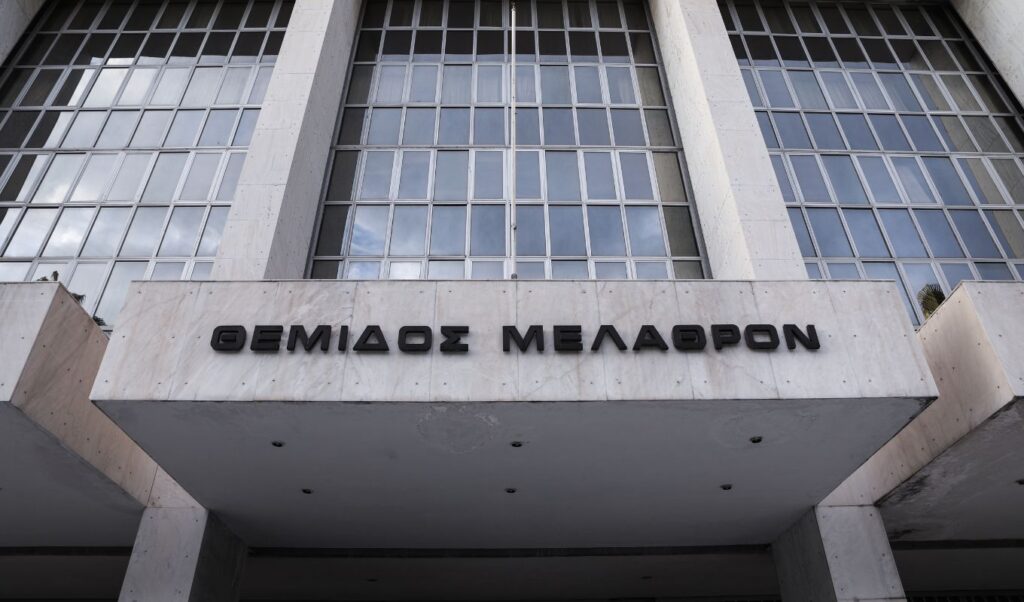
The Supreme Court issued a denial of reports regarding a Supreme Court judge’s resignation for reasons related to a judicial officer’s abstention from the trial concerning videos from Tempe, through a personal statement from the senior judicial officer. The judge in question is Supreme Court Justice Fotios Mouzakis, who emphasizes that he did not resign for reasons related to the judicial officer’s abstention but for reasons that have been reported to the Supreme Court.
Supreme Court: The judge’s statement
Specifically, in his statement he notes: “Regarding today’s newspaper publication and for the purpose of safeguarding the prestige of the Supreme Court and Justice in general, as well as protecting my honor and reputation, I bring to your attention the following: Regarding the part that concerns me, first of all, I have no connection whatsoever with this publication, since I have never maintained relationships with journalists directly or through third parties.
Regarding its content: The reasons for my resignation from service are stated in the relevant official document that was properly submitted on 3-4-2026 and my replacement by my legal deputy regarding inspection matters took place late in the afternoon of 7-4-2026 and after I had settled certain urgent service matters that I had pending.
None of the recommendations mentioned in the publication, which refer to the abstention declaration of the trial president for the videotapes in Larissa and to the legality of the decision of the competent judicial council, were made to me, either by the President of the Supreme Court or by any other person, and I would ask for particular attention from those who circulate such “information,” because, ultimately, what is always affected by inaccurate publications is not mainly the persons they concern, but the prestige of the institution of Justice. Fotios Mouzakis, Supreme Court Justice.”
The detailed announcement
Regarding today’s (unsigned) publication in the ESTIA newspaper, concerning the reasons for a Supreme Court Justice’s resignation, we note the following: It is completely inaccurate that checking the legality of decisions by supervised judicial officers falls within the duties of an Inspector Supreme Court Justice. Judicial decisions are not administrative acts to be subject to legality control, nor are judicial officers employees subject to hierarchical control, because the Constitution and the Organization of Courts and Status of Judicial Officers provide for (and protect) the personal and functional independence of judicial officers from external or internal interference. Furthermore, decisions issued on requests for exclusion and abstention declarations by judicial officers are not subject to legal remedies and no one can approve or reject them.
Therefore, any involvement of an Inspector Supreme Court Justice’s duties regarding the legality or illegality of a judicial decision is outside legal and constitutional reality and any reference to the contrary lacks foundation in legal science. Furthermore, on the substance, Supreme Court Justice Mr. Fotios Mouzakis, who is mentioned by name in the publication, proceeded by sending an electronic message to the Supreme Court Secretariat with the following statement which we convey verbatim: “Regarding today’s publication in the ESTIA newspaper and for the purpose of safeguarding the prestige of the Supreme Court and Justice in general, as well as protecting my honor and reputation, I bring to your attention the following: Regarding the part that concerns me, first of all, I have no connection whatsoever with this publication, since I have never maintained relationships with journalists directly or through third parties.
Regarding its content: The reasons for my resignation from service are stated in the relevant official document that was properly submitted on 3-4-2026 and my replacement by my legal deputy regarding inspection matters took place late in the afternoon of 7-4-2026 and after I had settled certain urgent service matters that I had pending.
None of the recommendations mentioned in the publication, which refer to the abstention declaration of the trial president for the videotapes in Larissa and to the legality of the decision of the competent judicial council, were made to me, either by the President of the Supreme Court or by any other person, and I would ask for particular attention from those who circulate such “information,” because, ultimately, what is always affected by inaccurate publications is not mainly the persons they concern, but the prestige of the institution of Justice. Fotios Mouzakis, Supreme Court Justice.”
Finally, the publication’s reference that “other Supreme Court Justices who typically dissent when issuing decisions are being pushed to leave,” apart from constituting a self-contradictory complaint due to its semantic inconsistency, is contrary to the logic of our legal civilization and obviously raises concerns about its purpose.
The scattered insinuations about the reasons for any judicial officer’s departure from service overlook that this is purely a matter of personal choices, not communicable for personal data protection reasons and falls under the strict framework of the judicial officer’s personal and functional independence. In view of the above, it becomes clear that this particular publication lacks any trace of truth, moving outside legal reality and is perceived as an attempt to undermine the Institution of Justice.