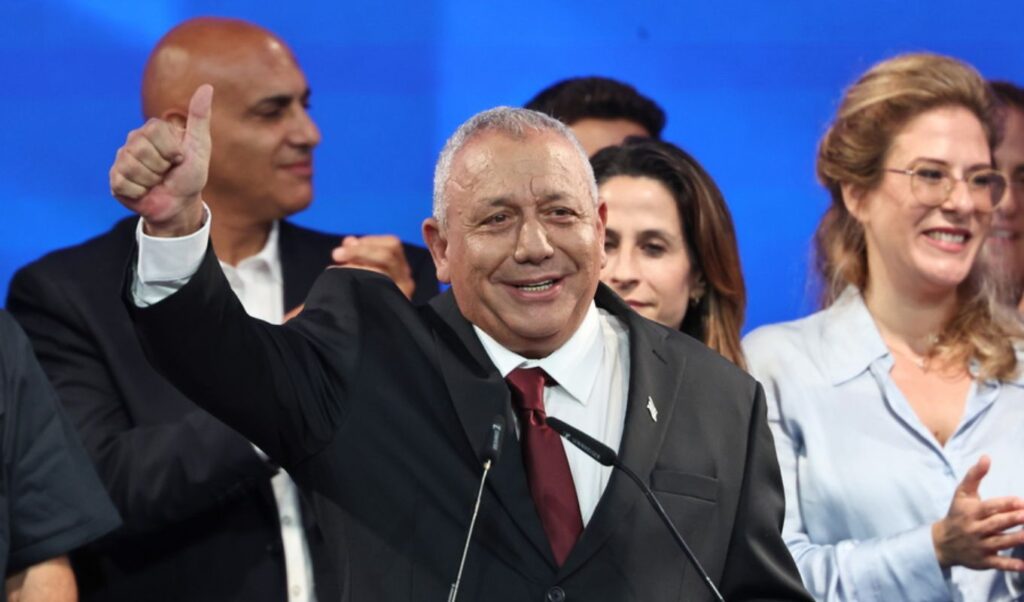
Israel’s president Isaac Herzog is expected to formally task Gadi Eisenkot with forming the country’s next government, potentially setting the stage for a historic political shift and the removal of Benjamin Netanyahu from power.
Despite securing the backing of a parliamentary majority, the leader of the centrist Yashar party faces significant hurdles in his bid to assemble a coalition, primarily due to deep divisions within the opposition camp.
According to CNN, Herzog is expected to officially hand Eisenkot the mandate at 5:00 PM today, following consultations with the parties represented in the Knesset.
67 lawmakers’ support and a 28-day window
Eisenkot has secured the backing of 67 lawmakers, including 19 from the two Arab parties. By contrast, Benjamin Netanyahu managed to gather only 46 recommendations in his favor.
Notably absent from Netanyahu’s supporters is United Torah Judaism, a party that has traditionally been one of his closest allies but chose not to recommend him for the mandate.
Once Eisenkot receives the mandate, he will have 28 days to form a government, with the possibility of a two-week extension granted by the president. Should he fail, the mandate would pass to Netanyahu.
Four conditions for a national emergency government
The Yashar leader is seeking to form a “national emergency government,” initially built around the four Jewish opposition parties, which collectively hold 48 seats in the Knesset.
These parties are Yashar, the Together party of Naftali Bennett and Yair Lapid, Yisrael Beiteinu led by Avigdor Lieberman, and the Democrats under Yair Golan.
To join such a governing coalition, Eisenkot has laid out four core conditions. These include recognizing Israel as a Jewish, democratic, and liberal state, upholding the principles of the Declaration of Independence, and establishing a universal obligation for military or national service.
He also demands that Hamas be recognized as a terrorist organization. This particular condition effectively bars Arab parties from joining the cabinet, though it does not prevent them from providing external parliamentary support.
The Lieberman obstacle and the ultra-Orthodox dispute
The biggest stumbling block to forming a government, according to CNN, is Avigdor Lieberman, who flatly rejects the idea of a government that depends on Arab party support.
Instead, he is pushing for a 61-seat coalition that would include the ultra-Orthodox parties Shas and United Torah Judaism.
This proposal, however, runs directly counter to one of the opposition’s core commitments: ending the sweeping exemption that allows ultra-Orthodox men to avoid mandatory military service. Furthermore, one of the two ultra-Orthodox parties continues to back Netanyahu.
Netanyahu’s push against Arab-Jewish political cooperation
Meanwhile, Benjamin Netanyahu is actively working to prevent any form of political cooperation between Jewish and Arab parties.
In a public statement, he warned that Israel “will not survive” if a minority government is formed with Arab party support, calling instead for a national unity government that includes his entire political bloc.
As things stand, despite the parliamentary support he has amassed, Eisenkot must now navigate the internal divisions of the opposition and forge a viable governing coalition if he is to deliver the political change Israel’s opposition has been seeking.