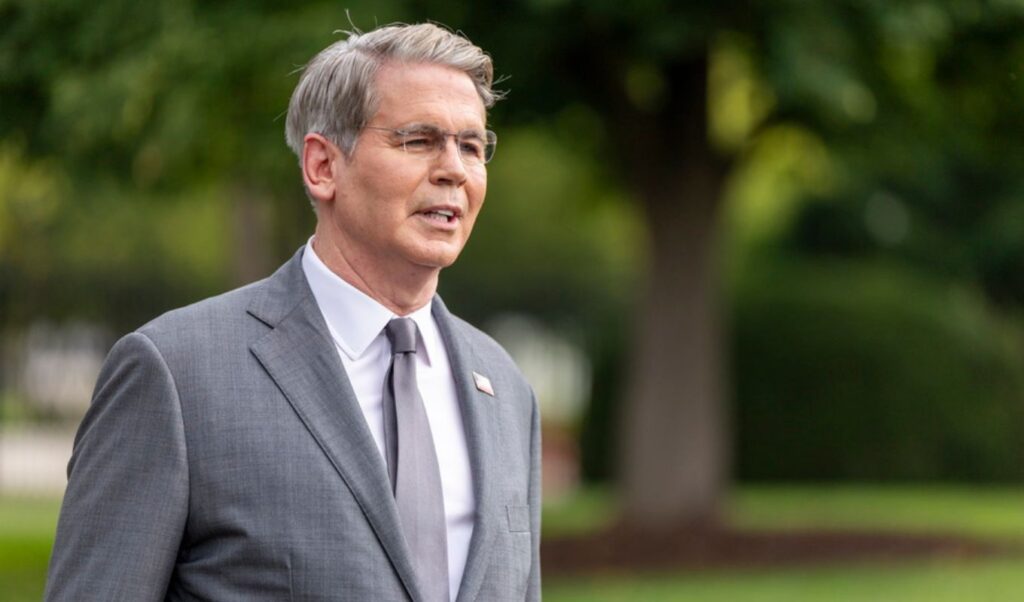
An unprecedented economic offensive against Iran, aimed at the complete financial and commercial isolation of Tehran, is being heralded by US Treasury Secretary Scott Bessent, who is simultaneously sending a clear warning to countries that continue to buy Iranian oil, trade with the regime, or facilitate its financial flows.
In an op-ed published in the Financial Times titled “An economic D-Day is coming for Iran,” Bessent — who was set to announce Washington’s measures at a press conference Monday evening — invokes the symbolic reference to the Normandy landings to describe the scale of economic pressure that the Donald Trump administration is preparing to unleash.
“At dawn, an economic D-Day begins — the largest financial offensive ever launched against an adversary,” he writes, arguing that following the military strikes that have curtailed Iran’s capabilities and weakened its nuclear program, the confrontation is now entering its final phase.
Washington’s message to countries trading with Tehran
Bessent directs much of his warning not only at Iran itself, but also at the countries that continue to serve as economic lifelines for Tehran.
As he outlines, these countries are purchasing and transporting Iranian oil, facilitating financial transactions through exchange offices and free trade zones, permitting Iranian flights, and maintaining ship registries on Tehran’s behalf. At the same time, he says, they are turning a blind eye to fuel transshipments at sea and to the illicit use of banking systems.
Washington’s message is unambiguous: this tolerance is over. The US Treasury Secretary argues that those who view appeasing Iran as the safer option need to reconsider their position, as they now risk facing the consequences of economic isolation themselves.
Bessent also invokes the famous “Pascal’s wager” to describe the dilemma that, according to Washington, Tehran’s trading partners face: continue to prop up Iran economically and jeopardize their relationship with the United States, or sever ties with the regime.
Bessent: “Anyone who becomes Iran’s economic lifeline will share in its isolation”
The warning becomes even more explicit. According to Bessent, countries that sever their economic ties with Iran will strengthen their access to international capital markets and enhance the credibility of their economies.
Conversely, “every country that acts as a financial artery for a collapsing regime should expect to share in its isolation,” he writes. He further warns that any country that transforms itself into a haven for terrorism will be treated by the United States as a “pariah” of the international community.
The Treasury Secretary also underscores that the Trump administration is prepared to deploy “every agency, every authority, and every measure” at its disposal. He cautions that any remaining ties to Tehran could accelerate the economic exclusion of countries and businesses alike — whether through deliberate cooperation or through activities to which governments choose to look the other way.
He also leaves open the possibility of a fresh military response should Tehran attack US forces or Gulf states. In such a scenario, he states, Trump would act “swiftly and decisively.”
Which countries are in the crosshairs
The pressing question now is which countries could be hit by the economic offensive Washington is signaling. Iran has made clear it is prepared to weather economic warfare, pointing to the network of allies and trading partners it has maintained.
China: By far the largest buyer of Iranian oil, China stands as one of the countries most likely to face the greatest pressure. More than 80% of Iran’s oil exports are directed to China, and Kpler estimates that Beijing purchased an average of 1.38 million barrels per day in 2025. The US has already imposed sanctions on an independent Chinese refinery for purchasing Iranian oil and has warned Chinese banks about the prospect of secondary sanctions.
Turkey: Ankara and Tehran maintain significant economic ties, with Turkey importing Iranian natural gas and exporting industrial goods to Iran. Bilateral trade amounts to approximately $5–6 billion annually, while Iran accounts for around 13% of Turkey’s total natural gas imports.
Iraq: Trade with Iran surpassed $10 billion in 2025. Even more critical is Baghdad’s energy dependency: Iraq pays Tehran $4–5 billion per year for natural gas used in electricity generation. New US sanctions could therefore cause serious difficulties for Baghdad.
Oman: Muscat has maintained friendly relations with Tehran for decades and frequently serves as a mediator between Iran and other governments, including Washington. Bilateral trade reached $1.5 billion in 2025 and $345 million in the first four months of 2026.
Pakistan: The two countries have long traded oil, wheat, rice, livestock, and pharmaceuticals through both official and informal channels. Despite previous sanctions, unofficial trade is estimated to have pushed total imports and exports to around $4 billion, while Islamabad and Tehran have set a bilateral trade target of $10 billion.
India: Trade ties have already been dramatically curtailed due to US sanctions. From a peak of around $17 billion, bilateral trade had fallen to $4.8 billion in the 2019–2020 fiscal year and reached just $1.63 billion in 2025–2026. Of that figure, approximately $1.3 billion consists of Indian exports, primarily cereals, tea, coffee, and spices.
Armenia: Trade with Iran reached $768 million in 2025, with around 20% of Armenia’s foreign trade passing through Iran. The two countries also maintain a “natural gas for electricity” swap agreement.
Azerbaijan: Bilateral trade grew by 4.5% in the first half of 2026, reaching $312.6 million. Azerbaijan’s imports from Iran totaled $297 million, while exports to Tehran more than doubled to $15.6 million.
The dilemma Washington is posing
The strategy Bessent outlines is clear: Washington seeks to sever every economic lifeline still sustaining Tehran, effectively shifting pressure away from Iran itself and onto its trading and economic partners.
“The world must understand that our goal is to cut every economic lifeline sustaining the tyrannical regime, until Tehran stands alone,” Bessent writes, closing with a pointed question directed at those who continue to do business with Iran: are they willing to “bet their future” against the resolve of the United States?