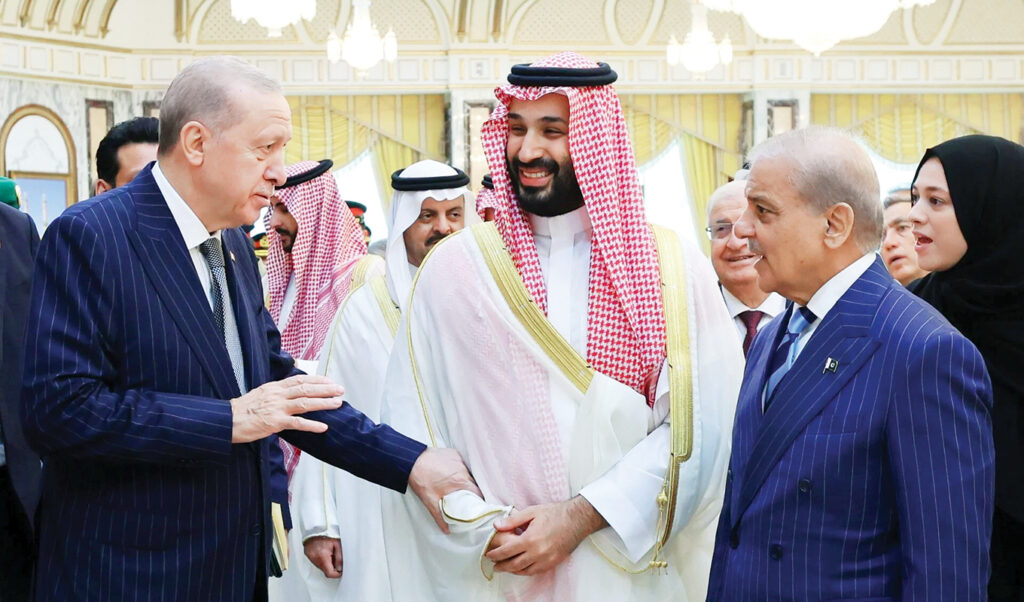
The Mecca Agreement — the defense pact between Turkey, Saudi Arabia, and Pakistan signed last Friday (August 7) — appears to be a deliberate attempt to redraw the rules of engagement across the Middle Eastern chessboard. Ankara, Riyadh, and Islamabad are drawing closer together (and the choice of Mecca as a reference point seems anything but coincidental), with analysts already branding the pact an “Islamic NATO,” as it includes a collective security clause modeled on Article 5 — meaning an armed attack against one is considered an attack against all.
Almost immediately, Ankara — partly through statements by Foreign Minister Hakan Fidan — signaled that it would welcome Egypt’s accession to the agreement (notably, the Turkish FM has scheduled a two-day visit to Cairo on August 13 and 14), echoing a structure similar to the R4 format, of which Egypt is already a participant alongside the signatories of the Mecca Agreement. For now, however, this appears unlikely, given Saudi Arabia’s reservations and Egypt’s own potential hesitations. Cairo may be eyeing Turkey’s defense industry with interest, but it simultaneously relies on continued US support — underpinned by its 1979 Peace Treaty with Israel.
Mecca Agreement: institutionalizing defense cooperation among partners
Breaking down the individual elements of the agreement — which appears designed to institutionalize defense cooperation among its partners, creating a NATO-like structure beyond the Article 5 provision mentioned above — analysts first focus on the potential formation of a formidable force in numerical terms: a leading oil-exporting nation (Saudi Arabia), NATO’s second-largest army (Turkey), and the world’s only Muslim nuclear power (Pakistan) are now aligning.
Combined, they field 1.4 million active military personnel, 3,400 aircraft, 6,000 battle tanks, and more than 340 naval assets, according to the 2026 Global Firepower Index — which ranks the defense capabilities of 145 countries — as reported by Al Jazeera. “The three countries complement each other unusually well,” Andreas Krieg, a security lecturer at King’s College London, told Agence France-Presse last week. “Turkey has technology and production capacity but needs markets and investment. Pakistan has manpower, military institutions, and nuclear deterrence but needs funding and industrial capacity,” Krieg noted, with both countries looking to Saudi Arabia for access to the required capital. For its part, Saudi Arabia can leverage Ankara’s defense industry and Islamabad’s nuclear capability to bolster its own regional gravitas — beyond the American security umbrella — particularly against threats to vital maritime corridors such as the Bab el-Mandeb and Strait of Hormuz.
An attempt to “connect” regional players
This development clearly represents an attempt to forge deeper links among regional players, driven by Washington’s growing ambivalence about maintaining a leading role in the area. Beyond that, the Mecca Agreement appears to position itself against both Israel and Iran, with the three Sunni powers seeking to curtail the geopolitical ambitions of Tel Aviv and Tehran alike. While Iran appears relatively unconcerned — at least publicly (as reflected in statements by Iranian Foreign Ministry spokesman Esmail Baghaei, who pointed to his country’s existing ties with Pakistan and Turkey) — the same cannot be said for Israel.
Senior Israeli officials speaking to domestic media described it as “an alliance directed against Israel,” warning that in place of the now-weakened Shia axis, a “Sunni axis” is taking shape, with Turkey moving to the forefront. Against this backdrop, Israel is being called upon to develop counterweights — with Greece, Cyprus, India, and the United Arab Emirates in the frame. A similar line of analysis appeared in the Jerusalem Post, which focused more heavily on the deepening Israel–India relationship (India, for its part, is equally alarmed by the prospect of a stronger Pakistan) as a direct consequence of the Mecca Agreement.
Athens sends a clear message to Riyadh
Greece is watching the shifting dynamics across the Middle East with particular attention — and has already taken a first concrete step in response. Until recently, the deployment of Greece’s Patriot missile battery in Riyadh was reviewed on an annual basis, within a framework of mutual trust and strategic coordination. However, the new geopolitical realities have prompted an immediate reassessment of this approach. Athens has hardened its stance and is now sending a clear message to Riyadh: the annual review mechanism is being replaced by a monthly reassessment of the Patriot battery’s presence in Saudi Arabia.
In doing so, Athens is making it unambiguously clear to Riyadh that Greek support for Saudi Arabia’s security cannot be taken for granted — nor can it be treated as independent of the broader alliances the Kingdom chooses to forge, especially when those alliances involve powers that threaten or contest Greek sovereign rights. Turkey’s participation in the new trilateral framework understandably raises serious concerns, as Greece has no desire to provide strategic cover in environments where Turkish influence is growing in decisive ways.
Published in Parapolitika