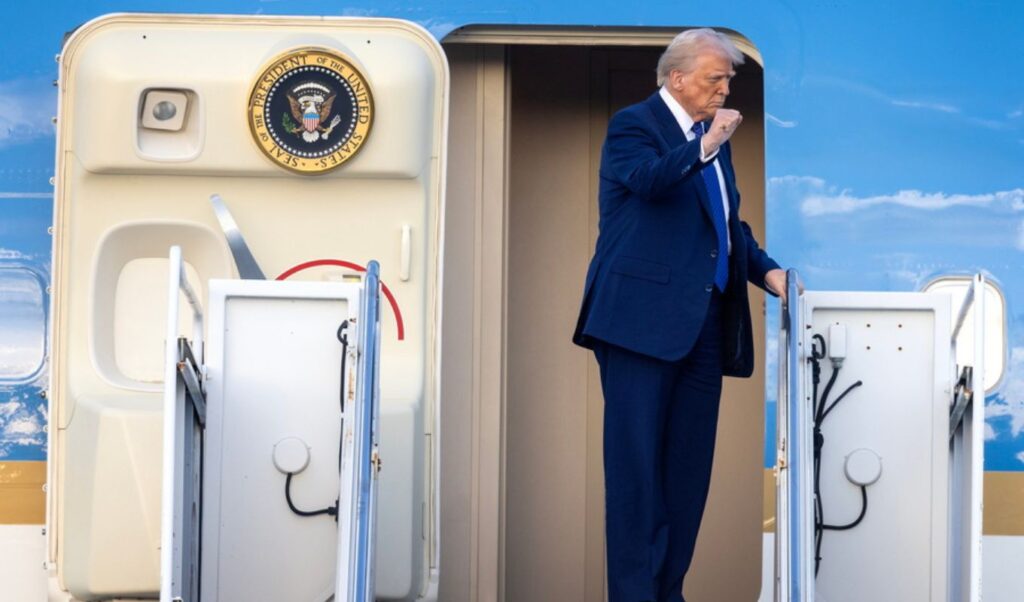
More details are coming to light regarding the covert “exfiltration” of Donald Trump and the secret aircraft swap during his departure from the NATO Summit in Turkey. American media outlets are now providing new details about who alerted the U.S. side to the Iranian threat — deemed credible enough to use the original Air Force One as a “decoy” — while Trump quietly slipped away from Ankara aboard a smaller military aircraft, a C-32A, a modified Boeing 757 frequently used by the Vice President, via a catering truck exit.
A U.S. official cited by the Wall Street Journal revealed that Israel informed the Trump administration of intelligence indicating a threat involving the use of portable surface-to-air missiles against Air Force One. The threat was apparently deemed credible enough for U.S. intelligence agencies to devise and execute such an elaborate contingency plan.
No missiles were fired at either aircraft, the U.S. official stated, adding that this was the first time during Trump’s presidency that such a deception tactic had been employed. The exact credibility level of the threat against the president could not be determined. At the time, Secret Service officials concluded that extraordinary measures were necessary to protect the president, the official said.
“It really depends entirely on the Secret Service,” Trump told reporters after returning from an event in Ohio on Tuesday evening, in his first public comments on the incident. “I just follow whatever they want to do. That’s why I follow the Secret Service and the military. They wanted me to travel on a different flight, a different plane, for security reasons.” When asked why the Secret Service wanted him on the other aircraft, Trump replied: “I receive a lot of threats.”
The previously undisclosed effort to secretly transfer Trump to another aircraft — first reported by the Washington Post — took place amid an escalating conflict with Iran. Iran has openly declared for years its intention to retaliate against Trump for the assassination of Qasem Soleimani, the top commander of the Islamic Revolutionary Guard Corps.
Secretary of Defense Pete Hegseth separately boarded the C-32A using external stairs in a deliberate effort to project an appearance of normalcy, according to the newspaper.
Read also: CNN: Questions over Trump’s secret aircraft change due to Iran threat — White House contradictions and the “decoys”
“I do what I’m told,” Trump said
“I follow the instructions of the Secret Service and the military. They wanted me to travel on a different flight, a different aircraft,” Trump told reporters on the matter. “I have no choice but to do what they tell me,” he noted, as the U.S. president confirmed the aircraft switch for his departure from the Turkish capital.
Trump had previously stated that he was Iran’s “number one target” during the Summit in Ankara. “I suppose there was some kind of threat,” the president said during a flight aboard Air Force One to an event in Ohio on Tuesday. “I didn’t ask too many questions about it. I receive a lot of threats.” He added that he “receives many threats that the public doesn’t know about.”
Rubio, Bessent stayed aboard the “decoy” aircraft — It remains unclear who knew about Trump’s secret exfiltration operation
The operation was known, according to New York Times reporting, to a small number of senior U.S. government and military officials, including Chairman of the Joint Chiefs of Staff Dan Caine and Pete Hegseth. With the clear aim of preventing any leaks, the original aircraft — the older Air Force One, chosen, as Trump had suggested, for the sake of “old times’ sake” — carried passengers including Secretary of State Marco Rubio, according to two officials who spoke to the newspaper on condition of anonymity to discuss sensitive information. Also aboard that aircraft were Treasury Secretary Scott Bessent, along with Stephen Miller, the president’s top domestic policy adviser, and Steven Cheung, the White House communications director.
Rubio had been briefed on the threat, though it was unclear how many of the others had been informed, the same outlet reports. At least some of the White House staff traveling on the aircraft had not been briefed, the officials said — nor had the journalists on board.
José Zamora, regional director for the Americas at the Committee to Protect Journalists, said in a statement that the Trump administration “has a responsibility to ensure that journalists covering the president are not needlessly exposed to danger.”
“Journalists must be informed of credible threats to their safety so they can make informed decisions about their own security,” he added.