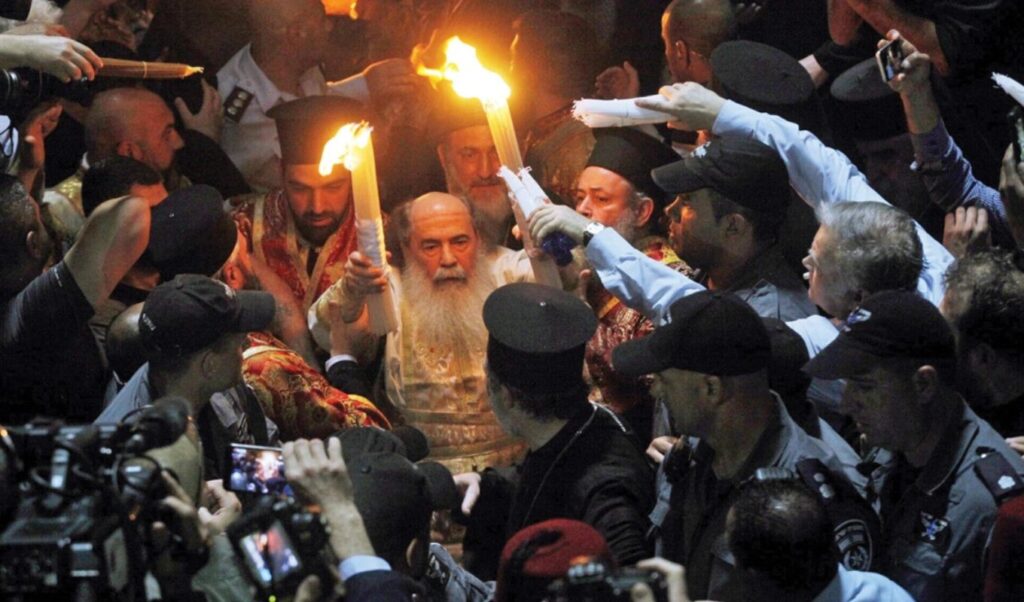
The celebration of Easter will not fill the Holy City of Jerusalem with crowds as in previous years, due to the volatile situation in the Middle East. Although the Brotherhood of the Holy Sepulchre conducts daily Holy Services at all the Holy Shrines and at the Holy Church of Saints Constantine and Helen located within the Patriarchate courtyard, the Holy Sepulchre and the Holy Church of the Resurrection – the reference point of the Holy Shrines for millions of believers – will remain closed by order of the police commander of Jerusalem’s Old City. After information reaching the ears of the Brotherhood members about the celebration arrangements, it was officially confirmed by Jerusalem police that there is no intention from the Israeli government to grant permission for the Holy Light ceremony, not even with 60 people as initially hinted.
Moreover, Israeli police placed particular emphasis on prohibiting even the television broadcast of the Holy Light ceremony that takes place every year, being completely negative about allowing it – a fact that has raised questions.
The authorities’ positions created even greater uncertainty among Christian Churches regarding Easter celebrations, resulting in an emergency meeting yesterday morning of the Council of Church Leaders under Jerusalem Patriarch Theophilos to decide how to address the ceremony ban. Immediately after, just before noon the same day, they sent a letter to Israeli Prime Minister Benjamin Netanyahu and Foreign Minister Gideon Saar, requesting a clear answer regarding the upcoming celebrations and services, as there is already great concern in the Christian world about what will happen with the Holy Fire ceremony.
Holy Fire ceremony will proceed normally despite potential ban – the process to be followed
The letter already sent to Israeli officials requests that the ceremonies proceed normally on Holy Saturday during the Holy Light ceremony. Anxiety is widespread in the Brotherhood of the Holy Sepulchre and other Christian denominations awaiting the government’s official position and official guidelines from state authorities so the Fathers can proceed with the precise determination of the Holy Services.
The Brotherhood of the Holy Sepulchre appears fully prepared to respond to any negative response from the Israeli government and address the Holy Light ceremony ban, given that even if the Great Gate to the Holy Court remains closed, the entrance connecting the Brotherhood cells to the Holy Edicule, the fearsome Golgotha, and the Church of the Resurrection is internal and always accessible to the Fathers.
Information suggests that the Brotherhood and other Christian denominations will request as a last resort that at least six people be allowed to attend, exactly as happened during the coronavirus period in 2020. Meanwhile, it will be interesting to see if during Jewish Passover on April 3rd, access to the Wailing Wall will be permitted, as the Jerusalem mosque for the Muslim Eid celebration remained closed and they seem to want to ban the Holy Light ceremony.
Regarding the transport of the Holy Light to Greece, it has not yet been clarified by the Greek government whether it intends to send a military aircraft or charter a civilian one.
However, if the ceremony will not be held with Israel’s blessings and is officially banned, then any desire by Greece to carry out the transport will evaporate, since Israel cannot protect the landing and takeoff of an aircraft carrying something it has already prohibited.
The Brotherhood experiences the horror of war – Statements to “Apogeumatini” about prevailing conditions by Metropolitan Kyriakos of Nazareth, Abbot Ignatios of “Shepherds’ Field” monastery, and Abbot Eirinarchos of Capernaum
At the same time, while bombings continue in the Holy Land, Brotherhood members serving at shrines outside central Jerusalem experience the horror of war, yet continue the Holy Services of Great Lent. In Nazareth, located in Northern Israel at the epicenter of the war, Metropolitan Kyriakos of Nazareth shepherds the area of 30,000 Orthodox Christians where the Annunciation to the Theotokos took place, giving courage to his flock despite human weaknesses.
Speaking to “A” from Christ’s birthplace, he states:
“To be honest, we were all afraid. And we’re still afraid. Every day throughout Israel, throughout Palestine, sirens are heard. We pray to our Holy Mother, to our God, to enlighten these powerful ones of the Earth, to enlighten them so peace may come. That’s what we want. Here at night, midnight, dawn, noon, evening, afternoon – sirens sound continuously. Although I’m the only Greek in Nazareth, while the others are Arab Orthodox, we serve the Holy Places even if we’re alone. On Mount Tabor one monk alone. In Tiberias alone, in Capernaum the same, in Haifa the same. We have telephone communication so we can support each other. And our Most Blessed Patriarch cares for us all – this is the truth – he calls and supports us like all the Holy Fathers. We’re in the middle of warring countries and hear everything happening. May God put His hand here. Fortunately it’s now Great Lent and people gather. If they strike now, they struck. God will protect us again. The only thing we can do about the current situation is prayer.”
Difficulties
Meanwhile, from Shepherds’ Field in the West Bank, where extremists always attack Christians, monastery abbot Father Ignatios told “A” about daily difficulties since the war began: “This year’s Great Lent differs from previous ones, as the prevailing situation is more difficult. However, in all Churches and Monasteries the pastoral and liturgical work remains the same. The shrines are now empty, but there’s an intense presence of grace, ‘as if the Holy Land itself is praying.’ The Holy Land always had problems, but here the grace of the place sustains us, making us unafraid – the Lord encourages us and we don’t realize it. We live the mystery of the Cross, but also of the Resurrection. There are monasteries we can no longer communicate with and we’re forced to travel there at whatever risk to see if our brothers are well.”
Bombings
Father Eirinarchos, abbot of Capernaum located about an hour from Tel Aviv which is being mercilessly hammered, tells us about a constant state of sirens and bombings. “With the war, pilgrim flows stopped. Our ears buzz 24 hours from the strikes – whatever is destined for Tel Aviv passes over us, whatever leaves Israel for Iran or Lebanon passes over us again. In the most difficult times like a war, it’s best to seek refuge in God’s House. So we too hide and pray. We all seek the Resurrection, but without Golgotha there will be no Resurrection.” The Jerusalem Patriarchate, while preparing to face Israel’s decisions about whether to ultimately allow the Holy Fire ceremony, remains vigilant and in communication with Brotherhood members on the front lines to address any problems and losses it may have.
*Published in Apogeumatini*