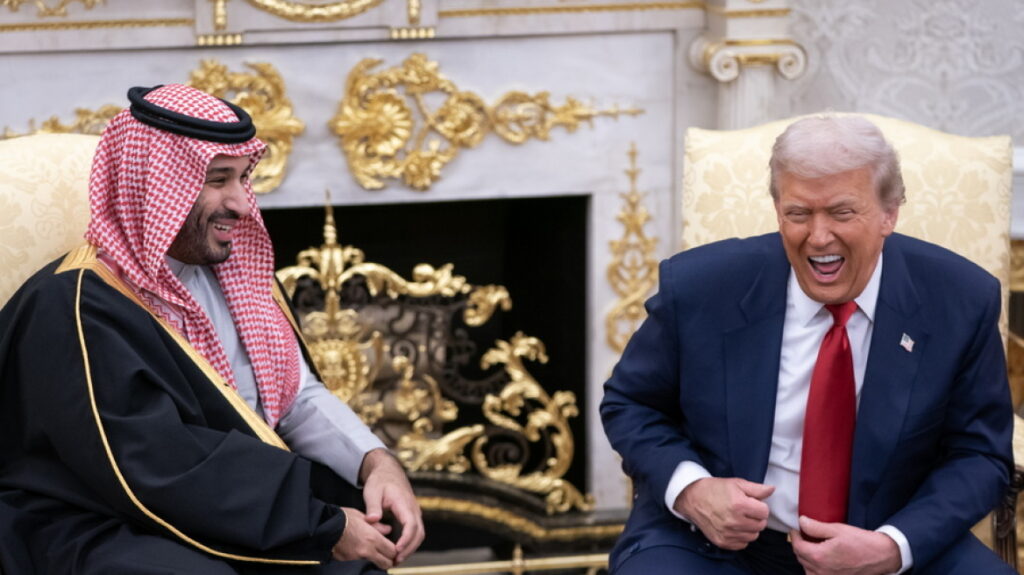
According to a New York Times report, Saudi Arabia’s Crown Prince Mohammed bin Salman is allegedly pressuring US President Donald Trump to continue the war against Iran. Specifically, he argues that the US-Israel military campaign represents a “historic opportunity” to reshape the Middle East, according to sources briefed by American officials on the conversations. In a series of contacts over the past week, Prince Mohammed reportedly conveyed to Trump that he should persist in efforts to weaken Iran’s government. He believes Iran poses a long-term threat to Gulf countries that can only be eliminated through regime change in Tehran.
Israeli Prime Minister Benjamin Netanyahu also views Iran as a long-term threat. However, analysts believe Israel would likely consider a weakened Iranian state preoccupied with internal turmoil a success. On the other hand, Saudi Arabia estimates that a destabilized Iran would pose a serious and immediate threat to its security.
Saudi Arabia’s concerns about larger attacks
Meanwhile, high-ranking officials in both Saudi Arabia and the US express concerns that, should the conflict be prolonged, Iran might launch even more powerful attacks on Saudi oil facilities, while the US could become embroiled in an endless war.
Publicly, Donald Trump has made contradictory statements, either suggesting the war could end soon or implying there will be escalation. On Monday, in a social media post, he mentioned there had been “productive talks for complete resolution of hostilities,” although Iran denied that negotiations were underway.
The war’s consequences for Saudi Arabia’s economy and national security are particularly significant. Drone and missile attacks from Iran, in response to the US-Israeli offensive, have already caused serious disruptions in the oil market.
What Riyadh says
Saudi authorities have rejected claims that the prince is pushing for war continuation. As they maintain, the kingdom supports a peaceful resolution of the conflict and maintains close communication with the American government.
“Our primary concern is protecting our population and civil infrastructure from daily attacks,” the Saudi government stated, accusing Iran of choosing dangerous escalation instead of serious diplomatic solutions.
Mohammed bin Salman, with strong influence over Trump, reportedly even supported the possibility of troop deployment in Iran to seize energy infrastructure and weaken the government.
According to the same sources, Trump is considering a military operation to capture Kharg Island, a key hub of Iran’s oil infrastructure, an operation that would be considered extremely dangerous.
Serious problems from the Strait of Hormuz
Saudi Arabia’s stance is influenced by both political and economic factors. Since the war’s outbreak, Iranian attacks have seriously affected the functioning of the Strait of Hormuz, through which the majority of oil exports from Saudi Arabia, UAE, and Kuwait pass.
Although these countries have alternative pipelines, these infrastructures have also come under attack.
Analysts believe that Prince Mohammed, while initially wanting to avoid military conflict, worries that premature US withdrawal would leave Saudi Arabia and the broader region facing a strengthened Iran. In this scenario, an incomplete military operation could lead to frequent Iranian attacks. Meanwhile, Tehran would retain the ability to periodically disrupt ship passage through the Strait of Hormuz.
“Saudi authorities want the war to end, but how it ends also matters,” said analyst Yasmin Farouk from the International Crisis Group.
Saudi Arabia has a significant number of Patriot anti-aircraft systems to intercept attacks against oil facilities and cities, but available interceptor missiles are limited globally.
Since the conflict’s beginning, strikes have occurred on refineries and diplomatic facilities, while fragments from intercepted missiles have caused casualties among foreign workers.
Analysts believe the crown prince may view the war as an opportunity to strengthen Saudi Arabia’s influence in the Middle East, considering his country can be protected even in case of prolonged conflict.
Meanwhile, Trump has expressed concerns about high oil prices’ impact on the economy, with the Saudi leader estimating that disruptions will be temporary.
Fear for economic plans
Economists, however, appear skeptical about rapid oil market recovery, as Saudi Arabia cannot fully cover losses caused by restricted navigation in the Strait of Hormuz.
The prolonged war might also jeopardize Prince Mohammed’s ambitious economic plans to transform Saudi Arabia into a global business hub by 2030, as a stable environment is required to attract investment and tourism.
Saudi Foreign Minister Faisal bin Farhan stated that the country’s basic priority is stopping attacks against Saudi Arabia and neighboring countries.
“We will use every available means—political, economic, and diplomatic—to end these attacks,” he said.