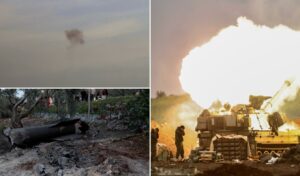
The fear of Europe’s involvement in war became evident across all decision-making fields, following the strike on the American-British base on Diego Garcia island in the Indian Ocean. Despite analysts not ruling out the possibility of provocation, the visible probability that ballistic missiles recorded a range of nearly 4 kilometers is causing concern across Europe.
Diplomatic sources do not rule out the possibility of provocation to parapolitika.gr from forces seeking to pressure European countries, which until now refuse to ultimately succumb and enter the war themselves. Moreover, the Israeli army, with a post on X, makes the concern more intense: “We said it: the Iranian terrorist regime is a threat. Now with missiles that can reach London, Paris or Berlin,” it notes.
However, Britain ruled out this possibility, with Minister Steve Reed stating that there is no evidence to support such a scenario. Greece, as the European country along with Cyprus that is closer than any other to the inflamed region, has every reason to reconsider its defensive stance against all possibilities. According to the prime minister, Europe “must be ready – we must have a clear and implementable roadmap in case European territory comes under attack.”
Is a strike from Iran likely? What the experts say
But how likely is it that Europe, and specifically Greece or Cyprus, could receive a strike from Iran?
Retired Air Vice Marshal Konstantinos Iatridis argues that theoretically Iranians can target our country, but practically it is very difficult. As he says, “the missiles can reach Cyprus and Greece or Crete which is 2,000 kilometers away. The issue is whether they can manage to get here, and this is because there are four levels of air defense that will counter them. Therefore, theoretically they can, but practically it is very difficult. It’s difficult because they will be intercepted.” Furthermore, according to defense analyst Mr. Iatridis, Iran’s goal is to hit energy infrastructure and create a cost problem for citizens. “If it hits Greece or Europe now, what cost will it have? The game for me will be played in the Strait of Hormuz,” he says characteristically.
And the executive director of the Hellenic American Leadership Council (HALC) Eddie Zemenides argues that currently there is no danger of Greece or Cyprus receiving a missile strike from Iran, because Iran’s goal focuses on energy centers. As he says, “even if there is a strike on Souda, it will not affect President Trump’s decisions. What affects Trump is what is starting to happen now in America, where people are shouting about gas prices.”
The possibility of a strike in retaliation for the presence of American military forces at bases in Greece and Cyprus, as has been noted at Akrotiri and Turkey, does not appear to be a priority for Iran at this time.
Moreover, well-informed sources express to Parapolitika.gr the possibility of provocation for these strikes. The same view is expressed by Mr. Zemenides, who expresses the same doubt about whether these strikes came from Iran, as the target of Iranian missile attacks is energy resources.
Mr. Iatridis also speaks of provocation, questioning that the missile strikes in Turkey came from Iran. Given this, the probability that all means are being used to finally involve Europe (as Benjamin Netanyahu requested), as well as other countries in the war, is high. According to Mr. Iatridis, for this to happen there must be tough negotiations and things must have become very difficult regarding oil prices.
Everything indicates that the week ahead will be the most critical for the war’s development.