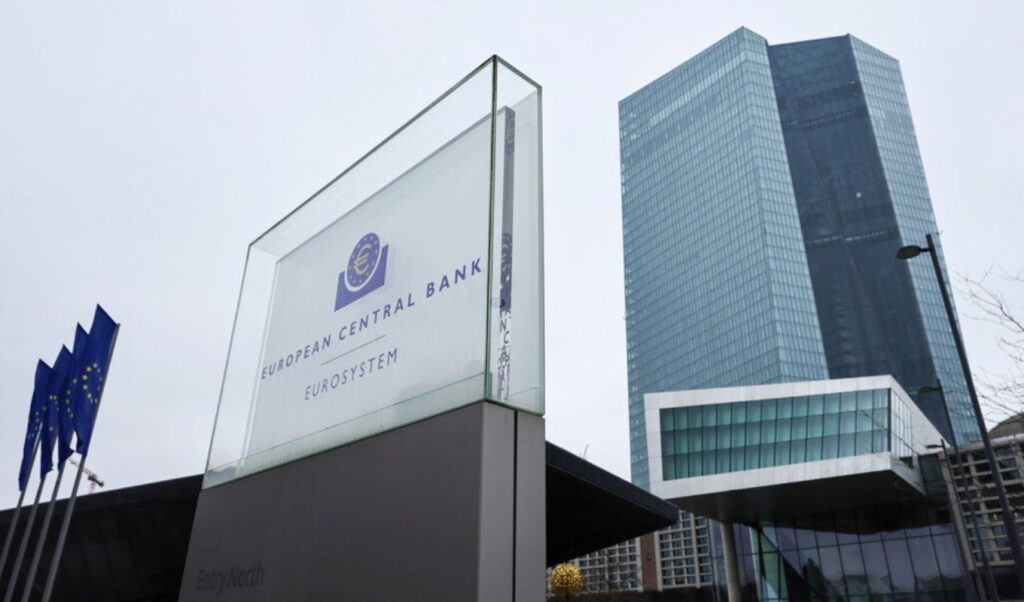
Against the backdrop of military conflicts in the Middle East, the European Central Bank announced today that it is maintaining its key interest rates unchanged, keeping the deposit rate at 2%, the level where it has been since June 2025. The decision was taken with strong consideration of developments in the Middle East and increased risks of inflationary pressures. The Frankfurt move, like that of other major central banks this week, reflects the effort to assess geopolitical risks before making decisions on monetary policy changes.
ECB officials remain on alert
Analysts note that the conflict in Iran, which has dramatically increased oil and natural gas prices, intensifies concerns about inflation resurgence, despite indications that the consumer price index in the eurozone is moving close to the 2% target.
Despite the decision to keep interest rates steady, markets are now pricing in probabilities for at least one or more increases later in 2026, if inflationary pressures persist. ECB officials remain on standby and ready to adjust their stance, monitoring growth and inflation data amid uncertainty.
Full ECB announcement
The Governing Council decided today to keep the three ECB key interest rates unchanged. It is determined to ensure that inflation stabilizes at the 2% target over the medium term. The war in the Middle East has significantly increased the uncertainty surrounding the outlook, creating upside risks to inflation and downside risks to economic growth. It will have a significant impact on near-term inflation through higher energy prices. Its medium-term implications will depend both on the intensity and duration of the conflict and on how energy prices will affect consumer prices and the economy.
The Governing Council is positioned to manage this uncertainty. Inflation has been around the 2% target, longer-term inflation expectations are stabilized, and the economy has shown resilience in recent quarters. Incoming information over the coming period will help the Governing Council assess how the war will affect inflation prospects and the risks surrounding them. The Governing Council is carefully monitoring the situation and its data-dependent approach will help it determine appropriate monetary policy.
The new ECB staff projections exceptionally incorporate information up to March 11, a later data cut-off date than usual. According to the baseline scenario, headline inflation is projected to average 2.6% in 2026, 2.0% in 2027 and 2.1% in 2028. Inflation has been revised upward compared to December projections, particularly for 2026. This is because energy prices will be higher due to the war in the Middle East.
How inflation is affected
Regarding inflation excluding energy and food, experts project it will average 2.3% in 2026, 2.2% in 2027 and 2.1% in 2028. These rates are also higher compared to the path projected in December forecasts, mainly due to the transmission of higher energy prices to core inflation. Experts expect economic growth to average 0.9% in 2026, 1.3% in 2027 and 1.4% in 2028. This implies a downward revision, particularly for 2026, reflecting the global impact of the war on commodity markets, real incomes and confidence. At the same time, low unemployment, robust private sector balance sheets and public spending on defense and infrastructure are expected to continue supporting growth.
In line with the Governing Council’s monetary policy strategy commitment to incorporate risks and uncertainty in its decision-making, staff also assessed how the Middle East war could affect economic growth and inflation under certain alternative illustrative scenarios. These scenarios will be published alongside the staff projections on the ECB website. The scenario analysis suggests that a prolonged disruption to oil and natural gas supply would result in inflation being higher, and growth lower, than assumed in the baseline projections. The implications for medium-term inflation depend critically on the size of indirect and second-round effects of a stronger and more persistent energy shock.
The Governing Council will follow a data-dependent approach and make decisions meeting by meeting to determine the appropriate stance of monetary policy. In particular, its interest rate decisions will be based on its assessment of the inflation outlook and the risks around it, in light of incoming economic and financial data, as well as underlying inflation dynamics and the strength of monetary policy transmission. The Governing Council does not pre-commit to a particular rate path.
ECB key interest rates
The interest rates on the deposit facility, the main refinancing operations and the marginal lending facility will remain unchanged at 2.00%, 2.15% and 2.40% respectively.
Asset purchase programme (APP) and pandemic emergency purchase programme (PEPP)
The APP and PEPP portfolios are declining at a measured and predictable pace, as the Eurosystem no longer reinvests principal payments from maturing securities.
The Governing Council stands ready to adjust all of its instruments within its mandate to ensure that inflation returns to its 2% target over the medium term and to preserve the smooth functioning of the monetary policy transmission mechanism. In addition, the Transmission Protection Instrument (TPI) is available to counter unwarranted, disorderly market dynamics that pose a serious threat to the transmission of monetary policy across all euro area countries, thus allowing the Governing Council to more effectively deliver on its price stability mandate.