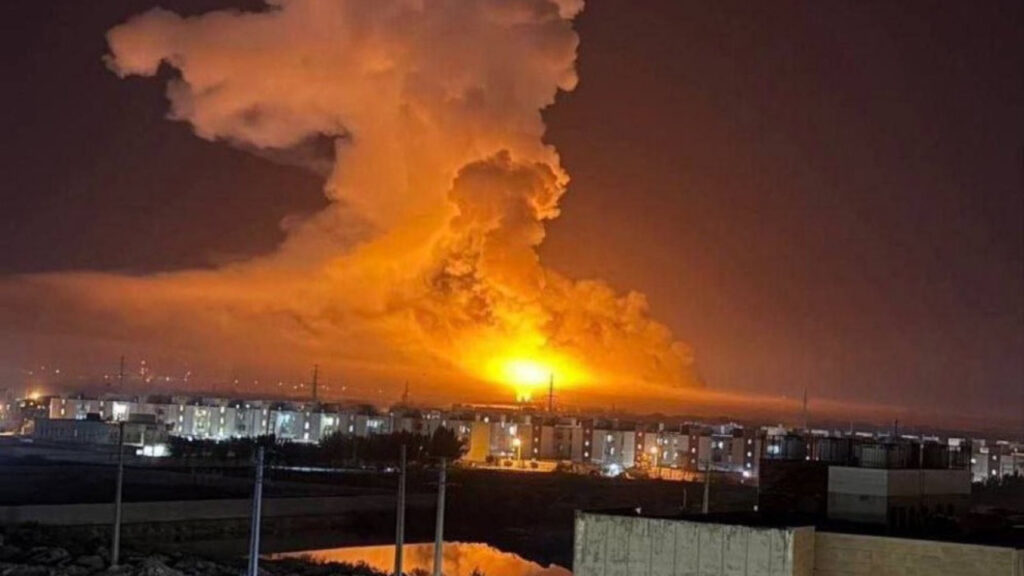
The American-Israeli operation against Iran advances with pivotal strikes on nuclear facilities and natural gas units. In recent hours, analysts are focusing on the significance of strikes on the joint field with Qatar and the Bushehr nuclear plant in southern Iran. Meanwhile, the escalation of attacks on Iran’s critical energy infrastructure, including the South Pars natural gas field, is triggering new price surges.
Iran: Israel’s strikes on natural gas field and nuclear facility
Starting with South Pars, which constitutes a joint field with Qatar and serves as a primary natural gas supply source to Turkey, it was significantly affected, with several production phases taken offline.
Simultaneously, the strike on Asaluyeh may limit the supply of condensate, a particularly light type of oil widely used in the petrochemical industry.
The South Pars natural gas field and other oil and petrochemical facilities in southern Iran were hit by Israeli airstrikes, with Tehran warning of retaliation against Gulf countries.
According to the Axios website, Israel carried out these strikes in coordination with the US. The US specifically confirms that Israel’s attack on Iran’s South Pars natural gas field was coordinated and approved by the Trump administration, Axios reports, citing an American official.
The attack marked the first time Israel attacked natural gas facilities in Iran during the ongoing US-Israeli military operation against Iran’s regime.
For its part, the International Atomic Energy Agency announced that the Bushehr nuclear plant in southern Iran was hit yesterday by a “projectile” that caused no damage to infrastructure and no injuries. The UN agency, based in Vienna, “was informed by Iran that a projectile struck the Bushehr nuclear plant facilities last night. There was no damage to the plant or injuries among staff,” according to an IAEA post on X.
Director General Rafael Grossi “reiterates the call for restraint during the war to avoid any risk of nuclear accident.” Russia, for its part, condemned the “irresponsible and completely unacceptable strike against the plant’s inner perimeter (…) just meters away from the operating unit.”
The Bushehr plant is of Russian design and construction, with Russian specialists working there. “We have warned Israel and the United States countless times (…) that it is categorically unacceptable to endanger the lives and health of a large number of Russian citizens at the plant,” said Russian Foreign Ministry spokesperson Maria Zakharova. She called on both countries to avoid attacks that could cause regional radiological or ecological disaster.
The Bushehr plant, Iran’s only operational nuclear facility, has a generating capacity of 1,000 megawatts, representing a small portion of the country’s electricity needs.
Rising oil prices
The European energy market reacted immediately to developments with the strike on Iran’s South Pars natural gas facility and retaliation threats, with natural gas and oil prices making new leaps.
Brent crude, the primary benchmark for crude oil, strengthened by more than 5.9% at 16:45 Greek time, approaching $109.5 per barrel, reflecting widespread market concerns about energy security.
Meanwhile, the European natural gas benchmark price TTF in Amsterdam recorded gains above 8% at 16:45 Greek time, approaching 55 euros per megawatt-hour.
Iran’s announcement that the South Pars natural gas field – one of the world’s largest – was targeted for attack intensifies the climate of uncertainty.
Iranian state television reported that US and Israeli airstrikes hit South Pars and neighboring petrochemical facilities in Asaluyeh.
South Pars had recorded a daily production record of 730 million cubic meters in 2025.
Analysts note that Tehran has multiple retaliation options, which may include attacks on energy infrastructure in the Persian Gulf. Such a scenario could significantly affect oil and natural gas flows from the region, further increasing tension in international markets.
Approximately 20% of global LNG flows pass under normal conditions through the Strait of Hormuz, which remains largely closed due to last month’s attacks.