If one characteristic can be attributed to Turkish President Recep Tayyip Erdogan by both friendly and unfriendly circles, it is undoubtedly his diplomatic talent for balancing while standing on two boats. However, the ongoing war in the Middle East has put the Turkish president in an extremely difficult position. If the conflict had two players, Israel and Iran, choosing sides would have been easy for Ankara, whose relations with Jerusalem are at their nadir, while with Tehran they are chronically good. However, the fact that Israelis are attacking Iranians jointly with Americans forced T. Erdogan to handle the issue carefully, not only because of NATO, but (mainly) because of the good personal relationship he has – and wants to have – with Donald Trump.
The myth of Turkey’s much-publicized capability collapsed
The “emperor,” however, proved naked operationally as well. The myth of Turkey’s much-publicized ability to defend its territory and airspace collapsed like a house of cards. While Greece was sending frigates and fighter jets to Cyprus for the defensive fortification of the Great Island and transferring Patriot batteries to Karpathos and Evros, Turkey was receiving attacks from ballistic missiles. Although Iran denied that it was the one targeting Turkey, the Turkish defense ministry spoke openly of Iranian origin. In any case, the interception was credited to NATO anti-aircraft systems.
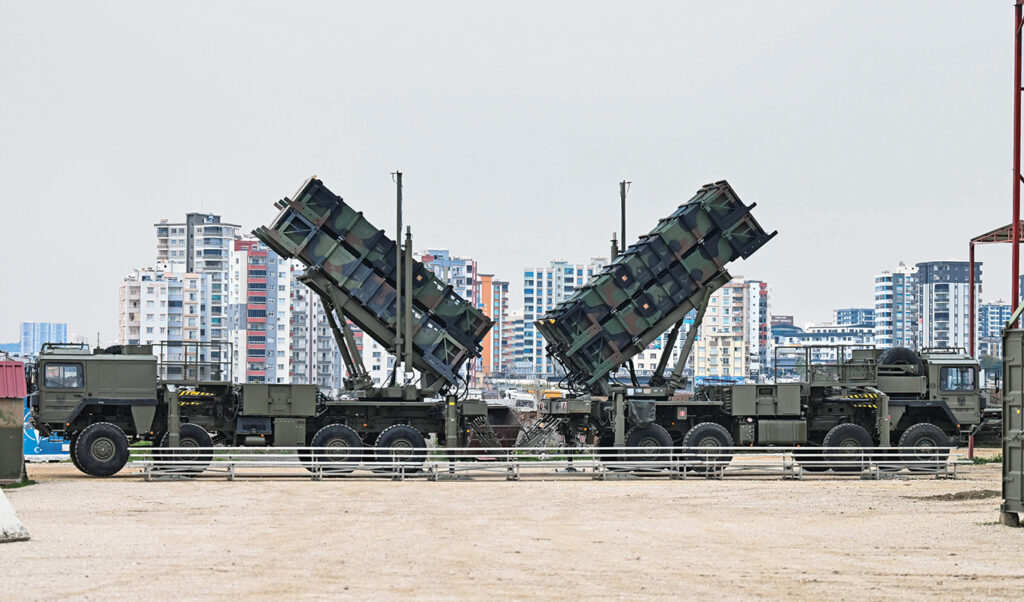
The neighbor, in other words, showed that it relies on NATO forces to do what it cannot do itself. That is, to be fortified. In this context, NATO proceeded to deploy Patriots in Turkey. Specifically, the systems transferred to Kürecik came from the NATO base in Ramstein, Germany. According to information from the East, Spanish Patriots have been at the Incirlik base since 2015, while the first deployment of such systems in the area was made in 1991, during the Gulf War, by the Netherlands. After the end of the Dutch mission, the systems were replaced with Spanish ones.
Now, with the installation of Patriot systems from Germany at Kürecik, it is estimated that a broader air defense “umbrella” will be created, which will cover not only the radar itself, but also the wider Incirlik – Kürecik line, i.e., a large part of Southeastern Turkey.
Turkey has had Russian S-400s in storage for almost seven years
Turkey has had Russian S-400s in storage for almost seven years. The relevant Ankara – Moscow agreement was signed in 2017, with the batteries arriving in Turkey in 2019. However, due to NATO and American pressure, Turkey does not use the Russian system. After all, this was also the reason for the imposition of sanctions under the American CAATSA law and its exclusion from the F-35 program. So now that anti-aircraft defense was needed, it was left exposed.
The fact that Israelis are attacking Iranians jointly with Americans forced T. Erdogan to handle the issue carefully, not only because of NATO
Nevertheless, with excessive audacity and utopian approach, Turkish Defense Minister Yasar Güler stated that Turkey seeks both to maintain the Russian S-400 systems with autonomous use and its reintegration into the F-35 program. In contrast, the Turkish opposition “hammered” T. Erdogan, characterizing the acquisition of S-400s as a “strategic mistake,” and spoke directly of operational inadequacy. “We have no anti-aircraft defense,” said the leader of the main opposition, Özgür Özel. Turkish pro-government channels rushed, of course, to let leak scenarios about secret activation of Russian S-400s, without, however, the information being officially confirmed.
Externalizing the crisis
When Turkey is “cornered,” it tends to externalize the crisis. It did this once again. To satisfy its audience, it sent additional military force to the Occupied Areas, while also issuing a provocative announcement about the transfer of Greek Patriots to Karpathos.
Regarding the deployment of Turkish F-16s and anti-missile air defense systems to the Occupied Areas, Greece – which was not surprised – responded through the Foreign Ministry spokesperson, Lana Zochios, who emphasized: “Illegal invasion and occupation does not legitimize any presence of Turkish military force.” This was preceded by the statement of Cypriot President Nikos Christodoulides, who had made clear that Turkey, whatever it sends to the pseudo-state, will remain an occupying force.
Also, on the occasion of the deployment of Patriot batteries in Karpathos and the dispatch of F-16s to Lemnos, the Turkish defense ministry in its announcement claimed that “Lemnos and Karpathos are islands that should have demilitarized status,” stating in parallel: “We do not accept Greece’s efforts, which do not serve the real purpose and aim to exploit the crises in our region. We take all necessary measures in this direction.” According to diplomatic circles who spoke to the author, Turkey indirectly threatened Greece, fearing that our country will permanently leave these weapon systems on the islands.
Athens makes clear that the country’s defensive arrangement is non-negotiable, rejecting unilateral and unfounded Turkish claims and clarifying that the regime of the Eastern Aegean islands is governed by the Treaty of Lausanne of 1923, the Montreux Convention of 1936 and the Treaty of Paris of 1947, in which, moreover, Turkey is not even a contracting party.
Published in Parapolitika