On the thirteenth day of war, Ankara appears to be trying to balance its role as a leading power among Middle Eastern Muslim countries and as a strategic partner of Western nations (EU and USA). At the same time, Turkey is called upon to plan for the post-war era, as it will need to manage the consequences arising from strained relations and mistrust with former partners, refugee flows, destroyed energy infrastructure, and participate in the strategic upgrading of the Eastern Mediterranean by engaging with the powers that will now be present there.
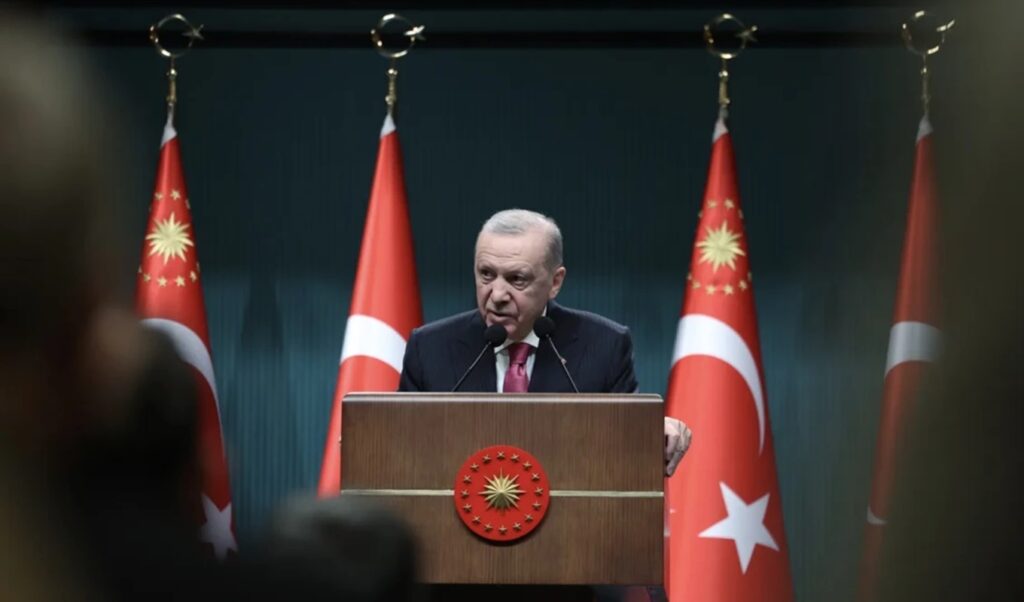
Moving within this fluid landscape, Recep Tayyip Erdogan appears to be gripped by panic with his latest moves. “Whoever extends a hand against Turkey will burn their hand. Whoever speaks against Turkey will burn their tongue,” he declared on Wednesday before AKP deputies in the Turkish National Assembly, feeling that his country has found itself surrounded amid the war.
Indeed, the strong presence of Greek and French defense systems from the first day of the crisis in Cyprus, together with the presence of Greek Prime Minister Kyriakos Mitsotakis and French President Emmanuel Macron, as well as the subsequent formation of a powerful European “umbrella” of protection on the island with the participation of Italy, Spain, the Netherlands, and Germany, provoked opposition reactions that led the Turkish government to an unnecessary show of force.
However, reliable information from Nicosia shows the Cypriot government stoically confronting the Turkish leader’s posturing. “Either way, Turkey is an occupying power in Cyprus. Whether it has 40,000 troops or 40,000 troops and six F-16s makes no difference,” authoritative sources tell parapolitika.gr.
Under these conditions, diplomatic processes continued in Cyprus. According to reliable diplomatic sources, the issue of Turkish military presence on the island was raised in meetings the Cypriot government had with European officials who visited Nicosia in recent days. The matter also occupied the Monday meeting between Cypriot Foreign Minister Konstantinos Kombos and his German counterpart Johann Wadephul, in the presence of the UAE Foreign Minister. In fact, Germany’s Foreign Minister, who visits Ankara today, publicly committed that “if Cyprus really needs us, we will be present,” aligning with the unified stance of European Union countries.
Eftychidis to parapolitika.gr on Turkish forces in Cyprus: “No one mentioned the presence of occupation troops, which are actually being reinforced with new occupying forces”
However, international relations expert Thrasyvulos Eftychidis, speaking to parapolitika.gr, highlights the lack of condemnation from our European allies regarding the Turkish presence in Northern Cyprus. As he says, “what bothers me is that, despite the declarations of support made to Cyprus, no one, not even President Macron, referred to the Turkish presence on the island, which is an occupation army presence that is actually being strengthened with new occupying forces. It’s good to recognize Europe’s southeastern borders – but Europe’s southeastern borders are Cyprus in its entirety, without occupation troops.”
The reinforcement of Turkey’s military presence in the occupied areas with F-16s raises questions about the intention of their permanent stay. Mr. Eftychidis argues that their remaining in Cyprus is very likely: “In a display of intransigence and within the framework of the Blue Homeland narrative, Turkey may keep all six F-16s in the region. I believe, however, that there will be a reaction. Both from our allies in Europe and from the UN Security Council.”
Nevertheless, Turkey’s ambitions in the region are declared, stable, and unquestionable. For this reason, it doesn’t miss an opportunity to seek to strengthen its role in the Middle East and establish its Blue Homeland claims.