A complex power game is unfolding against the backdrop of rapid developments and the war waged by the US and Israel against Iran, which has intensified in the Middle East, evolving into a regional conflict that is reshuffling balances in an unknown direction. Certainly, a post-theocratic Iran could build a new axis in full alignment with Israel (if, for example, the last shah’s son assumed a leading role, favoring a framework like the “Cyrus Accords,” which have been extensively discussed months ago in “P”), however the mosaic, especially within Iran’s interior, is complex and predictions are risky for the day after.
Benjamin Netanyahu referred to this mosaic in his address that launched the attack. As he stated, “the time has come for all parts of Iran’s people – Persians, Kurds, Azeris, Baloch – to shake off the yoke of tyranny and bring forth a free and peaceful Iran.” The Israeli prime minister “reminded” that Iran is certainly not ethnically-racially homogeneous, with its 92 million inhabitants having their own origins and cultural references, something common for the broader region, which consists of states characterized by such “diversity” (e.g., Syria, Iraq, Afghanistan, etc.). The reference to the Kurds doesn’t come only from the Israeli side (both at reporting level and beyond official declarations), but is also found on the other side of the Atlantic, with American media reporting both Trump’s communication with Kurdish leaders in Iraq on Sunday, against the backdrop of the ongoing war against Iran, and a possible CIA plan to arm Kurds within Iran to facilitate an uprising plan against Tehran’s central authority.
Meanwhile, on February 22, five Iranian Kurdish parties, led by the Democratic Party of Iranian Kurdistan (KDPI), formed a joint coalition with the declared goal of overthrowing the Islamic regime. The coalition fields Peshmerga fighters, who have been trained in Iraq and are well familiar with the mountainous terrain along the border between the two countries. Perhaps it wasn’t coincidental that Trump himself posted, twice, on social media an opinion article from the “Washington Post” about the “Trump Doctrine.” “There is no need for American invasion force,” wrote columnist Marc Thiessen. “The Iranian people are the boots on the ground,” possibly indicating his intention to “replace” potential American involvement with ground forces with appropriately armed “interest groups” of the involved parties themselves, in order to reduce the “cost” in human lives, money, and popularity (after all, this war wasn’t the most popular choice within the US).
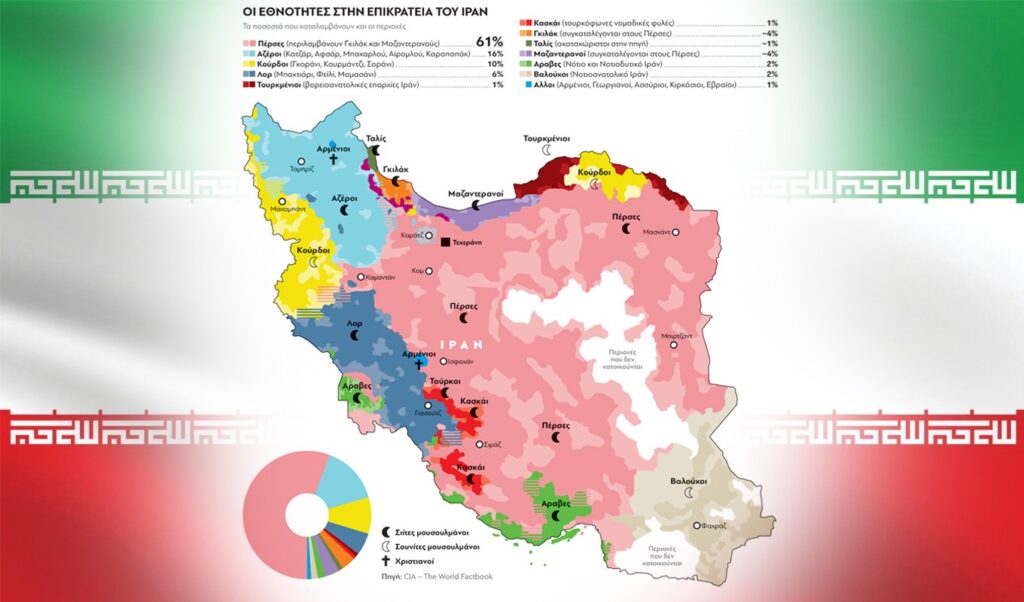
Iran: Population composition
The Kurds, however, do not constitute the largest minority ethnicity within Iran. According to available data, first are the Persians, comprising 61% of the population, followed by Azeris (16%), Kurds (10%), and others like Lors (6%), Baloch (2%), and Turkic tribes (2%). A common element in essentially all these cases (even in the case of Persians, who are found as a tribe in neighboring Tajikistan) is that these ethnic-racial groups “spread” across more than one state, something that has its own significance: The Azeris (in the northwest) certainly share the same ethnic origin with the majority of the population in neighboring Azerbaijan and “extend” beyond the two aforementioned states to Russia. Shiites, many of them, often played roles even after the Islamic Revolution, despite continuing pressure especially regarding language use both under Pahlavi and during the theocratic regime period. Major uprisings took place in 1981 and 2006, with protests that occurred 20 years ago leaving behind (on the Azeri side) about 150 dead from the regime (some in particularly harsh ways) and starting from a cartoon in a pro-regime publication, in which the Azeri community within Iran was reportedly compared to cockroaches.
Beyond that, special mention can be made of the Baloch as an ethnic group. One and a half to two million live in Iran (in the southeast), while they also have presence in Pakistan and Afghanistan. Being mainly Sunnis, they often clash with the theocratic regime, even engaging in suicide attacks, while their central organization from the Iranian side is “Jaish al-Adl,” which in December 2025 merged with additional groups into the “Popular Fighters Front” and declared struggle against the theocratic regime.
Perhaps the goal is to bring forth more “cooperative” figures, even from the existing regime, however difficult such a thing may seem
The scenario, therefore, with the utilization of appropriate elements, tends toward Iran potentially becoming a state with clearly decentralized administration that would have strong autonomist elements. After all, it shouldn’t be concluded that aversion to the current power structure necessarily means agreement for the day after, which is “murky” in any case. This is certainly recognized by Trump himself, while analyses abound in American media about possibly reduced interest in what will happen after a potential overthrow of the current regime: Perhaps the goal is to bring forth more “cooperative” figures, even from the existing regime, however difficult such a thing may seem. The example of Venezuela and cooperation with Delcy Rodríguez is indicative.
*Published in Parapolitika on March 7*