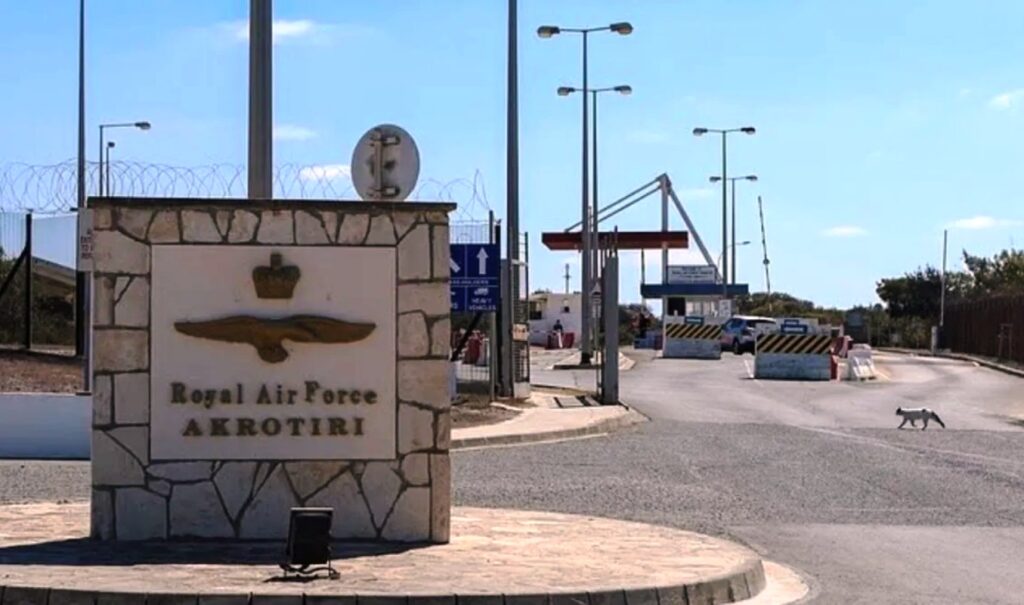
The Middle East escalation is gaining new dimensions, with Cyprus now at the center of European security discussions. Israel’s ambassador to Berlin, Ron Prosor, warns that Iran is attempting to drag Europeans into the ongoing war, sending a clear message to Brussels. Following the Iranian strike on Cyprus, the Israeli diplomat calls on the European Union to take responsibility, making explicit reference to the mutual assistance clause of Article 42 of the EU Treaty. Meanwhile, in a joint statement, German Chancellor Friedrich Merz, French President Emmanuel Macron, and British Prime Minister Keir Starmer warn that “defensive military measures” against Iran’s attacks are not ruled out if deemed necessary. The emerging scenario shows that the conflict is no longer limited to a regional level but directly affects European interests and tests the Union’s solidarity mechanisms.
Cyprus and Article 42: The mutual assistance clause in the spotlight
Speaking to dpa agency, Ron Prosor argued that Iran seeks to drag Europeans into the conflict. “I hope Europeans will understand this and react; how they will react is a decision that must be made in Europe,” he stated characteristically. He made special reference to Article 42 of the EU Treaty, which provides that member states must provide aid and assistance in case of armed attack against one of them. “As Cyprus is part of Europe, it is Europe’s responsibility to defend Cyprus,” he emphasized, shifting pressure to the European level.
This position highlights the question of whether the EU is willing to activate its solidarity mechanisms in practice, in an environment where geopolitical balances are changing rapidly. The reference to the mutual assistance clause is not procedural but politically charged, as it transfers the burden of response from the bilateral level to the collective European framework.
Macron, Merz and Starmer: “Defensive measures” on the table
In their joint statement, Friedrich Merz, Emmanuel Macron, and Keir Starmer warn that “defensive military measures” may be taken against Iran’s attacks, which they characterize as “indiscriminate and without observing the principle of proportionality.” According to government circles in Berlin, “we will take the necessary measures to protect our interests and those of our allies in the region.” As stated, these measures may include, if deemed necessary, defensive military actions that observe the principle of proportionality, aimed at eliminating “at the source” Iran’s capability to launch missiles and drones.
On Tuesday, the German Chancellor is expected in Washington for talks with American President Donald Trump, focusing on assessing developments. These contacts are considered crucial for coordinating the Western stance toward Tehran, at a time when tensions are moving closer to European borders and decisions to be made may have broader consequences for regional security.