The news that the spiritual leader of Iran Ali Khamenei is dead comes like a thunderbolt, with American President Donald Trump himself confirming the news. Ali Khamenei, Iran’s absolute leader since 1989, the spiritual father of the Islamic Republic, the man who held the fate of a nation of 87 million in his hands, is dead. Assassinated by American or Israeli strikes, or perhaps by internal conspiracy. The critical question is the regime’s future after this development. Iran stands at the most dangerous crossroads in its modern history, and the coming hours, days and months will determine whether the theocratic regime will survive, transform into a military dictatorship, or collapse.
Ali Khamenei: The smooth succession
One possible scenario, at least in the short term, is the activation of the mechanism that Khamenei himself established. The Supreme Leader was not naive. He knew that the US and Israel had him in their crosshairs, and had prepared his succession with meticulous methodology. He had appointed four replacements for the top positions of power, and had selected three possible successors for himself.
In this scenario, the Assembly of Experts—the 88-member body that elects the Supreme Leader—will convene urgently. The Revolutionary Guards take control of the streets, ministries and media. The process is ceremonial, the successor has already been chosen, and the vote is merely formal.
The most likely candidate is Ali Larijani, the 68-year-old former Revolutionary Guards commander and current Secretary of the Supreme National Security Council. Khamenei had already appointed him as de facto leader since January 2026, entrusting him with negotiations with Russia and Qatar. Larijani has the trust of the military, security services, and conservative clerics. But he lacks one basic qualification—he is not a senior Shiite cleric (marja), an essential prerequisite for the position of Supreme Leader.
If Larijani takes over, the regime becomes de facto a military dictatorship with a religious cloak. The Revolutionary Guards, who already control 60% of the economy and all weapons, become the absolute sovereign. The elected institutions—Parliament, President, mayors—will be weakened. Iran will transform into a country governed by generals and security service officers, with clerics now playing a secondary role.
This scenario guarantees continuity, but not stability. Larijani lacks Khamenei’s charisma or spiritual legitimacy. He is a war technocrat, not a mass leader. And in a country where legitimacy comes from religion, the absence of a cleric at the top is a fundamental problem.
The successor son of Khamenei
Another option could be Mojtaba Khamenei, the deceased leader’s son. Mojtaba, a student of radical cleric Mesbah Yazdi, controls a significant portion of the security services (Basij) and Revolutionary Guards. His influence strengthened after the January 2026 uprisings, when his father brought him closer to the center of power.
But Mojtaba faces two insurmountable obstacles. First, he lacks the religious qualifications to become a marja, as he doesn’t have the required level of study in Islamic sciences. Second, succession from father to son would turn Iran into a monarchy, something that contradicts the founding ideals of the Islamic Republic. Khomeini and Khamenei had been elected and had not inherited power.
If Mojtaba attempts to succeed his father, he could cause a schism within the regime. Traditional clerics, who already question the dominance of the Revolutionary Guards, will react, and the Assembly of Experts may refuse to elect him. And then, Iran could enter a period of civil war, with factions competing for control of power.
The collapse
The most optimistic scenario for the regime’s opponents is the collapse scenario. According to analysis by the Council on Foreign Relations (CFR), Khamenei’s fall could lead to “transitional chaos” if combined with simultaneous elimination of multiple leaders.
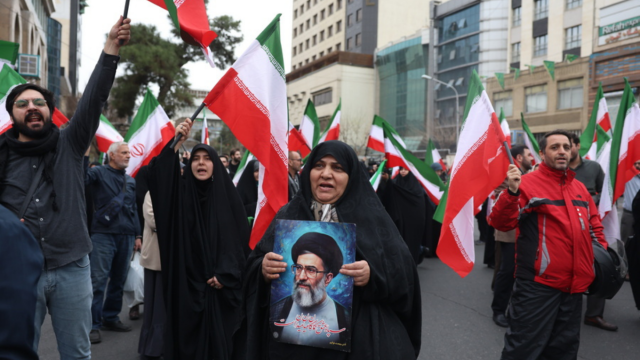
In this scenario, the succession mechanism would have failed. The Guards, instead of uniting, would split into factions. Clerics refuse to legitimize any successor. And the people, who had already risen up in January 2026 with slogans like “death to Khamenei,” would pour into the streets with even greater force.
The regime has developed plans for such cases according to which police, intelligence services and Revolutionary Guard units would patrol major cities to maintain order. But if the leadership is divided, these forces may also split and fight among themselves.
In this case, Iran would experience Syrian-style uprisings, as ethnic minorities like the Kurds in the north, Baluchis in the southeast and Arabs in Khuzistan would revolt demanding autonomy or independence. Paramilitary groups, from the Basij to Shiite militias, would compete for control of provinces, while violence would escalate for years, with countless deaths and mass refugee exodus to Turkey, Pakistan, Afghanistan and Europe.
The nuclear program? Out of control. The Natanz and Fordow facilities, already hit by American strikes, would fall into the hands of unknown forces. The possibility of nuclear material leaking to terrorist organizations becomes a real threat.
The next day in Iran
Whatever scenario prevails, one thing is certain: the regional implications will be enormous. Iran’s allies—Hezbollah, Houthis, Shiite militias in Iraq—will find themselves in a vacuum. Without Khamenei, without Tehran’s money and weapons, they will be forced either to negotiate with their opponents (Israel, Saudi Arabia) or become autonomous, transforming into local militias without national strategy. Meanwhile, Saudi Arabia and the UAE will try to exploit the vacuum, strengthening their influence in the Persian Gulf. Israel will seek to definitively eliminate the Iranian threat, either through new attacks or diplomatic channels.
In any case, Khamenei’s death is not simply the loss of a leader, but the deconstruction of a system built around him for 37 years. Iran has survived wars, uprisings, economic crises, but it has never survived without Khamenei.
All possible scenarios will have costs for Tehran. There is no good scenario, only less bad ones. Khamenei’s death is the beginning of a new era for Iran. And no one can predict whether this era will be better or worse than the previous one. Only one thing is certain: the Middle East will never be the same again.