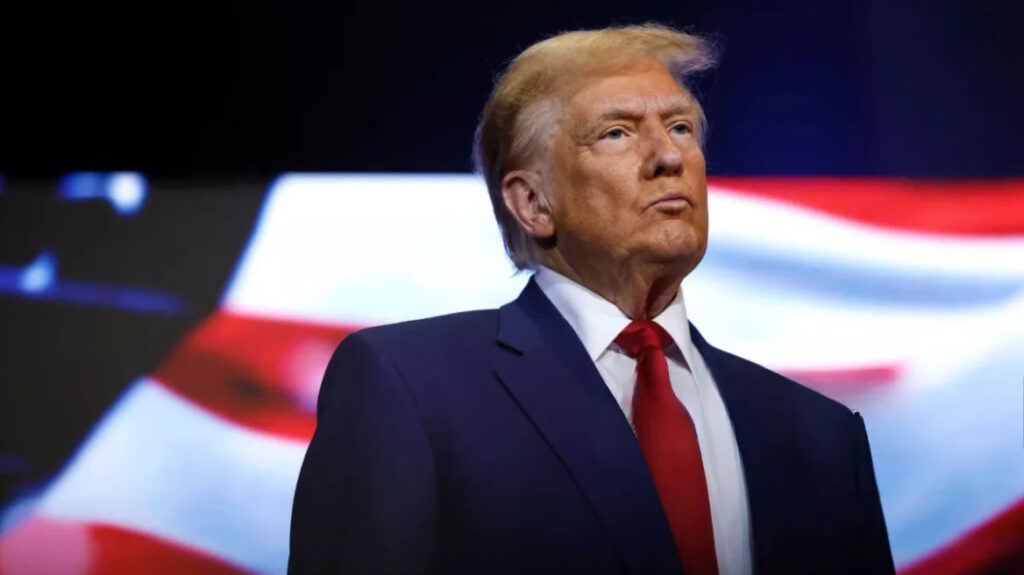
Since diplomatic efforts have not proven satisfactory, American President Donald Trump admitted on Friday that he faces a difficult choice on how to proceed with Iran. “We have a big decision to make,” he told a crowd in Corpus Christi, Texas, where he attended to promote his energy agenda. Trump emphasized that the decision “is not easy” and that Iran has been displaying malicious behavior for some time.
“We have a country that, for 47 years, has been destroying people left and right,” he said characteristically. “They want to make a deal, but they have to make a deal that makes sense,” the president said. He also said he had consulted the two Republican senators from Texas, Ted Cruz and John Cornyn, on Air Force One as he returned, according to CNN.
“I would prefer to do it the peaceful way. But they are very tough people,” he added.
Trump: Latest warnings to Tehran
Earlier, the American president, just before traveling from the White House to Texas, once again sent a clear message to Tehran, saying it “cannot have nuclear weapons.” He simultaneously expressed his dissatisfaction with contacts with Iran’s delegation and developments at the negotiation level regarding nuclear issues, while appearing ready to exhaust every diplomatic effort for an agreement to be reached.
However, he was clear in his position, emphasizing that he expects more from Tehran on Friday, implying that it might be the last opportunity before he decides to use military force against Iran. “I don’t want to do it, but sometimes you have to do it,” he said, responding to a related journalist’s question.
The next round of talks
A new round of negotiations is expected to take place “very soon,” following talks between “technical teams” this Monday in Vienna, with the contribution of “experts” from the International Atomic Energy Agency (IAEA), according to Iranian Foreign Minister Abbas Araghchi.
The head of Iranian diplomacy yesterday called on the American government to avoid presenting “excessive demands” in order to close a deal, tempering the optimism he had displayed the day before, after talks in Geneva, the most “intensive” since the beginning of the current round of indirect negotiations.
Meanwhile, the head of American diplomacy Marco Rubio will travel to Israel on Monday for talks that will focus on the Iran issue. “He will also have talks on a series of regional priorities, Lebanon and ongoing efforts aimed at implementing President Trump’s 20-point peace plan for Gaza,” said Tommy Pigott, deputy spokesperson for the US State Department.
Oman, which mediates the indirect negotiations, assured that it has secured a commitment for significant progress from the Iranian side, in its effort to avoid the outbreak of a new war in the region. Yesterday, Oman’s Foreign Minister Badr Albusaidi, mediator in the indirect talks, assured that “peace” is very close, following his meeting in Washington with American Vice President J.D. Vance.
American President Trump gave an ultimatum on February 19th of “10 to 15 days” before deciding whether reaching an agreement is feasible or he will order a military operation.
The UN High Commissioner for Human Rights Volker Türk declared himself very “concerned about the risk of regional military escalation.”
The two sides—which have had no diplomatic relations since 1979—resumed talks at the end of last year. They had been interrupted when Israel’s 12-day war was unleashed, in which the US was also involved for one day—bombing three key Iranian nuclear facilities.
The potential American strike on Iran
The American embassy in Israel has allowed non-essential personnel to leave Israel for security reasons, while also preparing further restrictions on US government employees and their families regarding travel to certain areas of Israel, the Old City of Jerusalem and the West Bank, advising American citizens to consider leaving Israel while commercial flights are still available.
China issued guidance to its nationals in Iranian territory to leave “as soon as possible.” Britain announced measures to protect its diplomatic personnel against the risk of “rapid” deterioration of the situation. Germany issued “urgent” guidance to its nationals to avoid travel to Israel. Turkish Airlines, the Turkish carrier, announced it canceled last night’s flights to Tehran from Istanbul. India canceled flights to Israel from today for one week. Italy called on its citizens to leave Iran and recommends “extreme caution” throughout the Middle East. Warsaw called on Poles to leave Iran, Israel and Lebanon.
Greece’s Foreign Ministry also sounded the alarm ahead of a possible military confrontation in Iran, which in its announcement urges Greek citizens not to make visits to Israel, Palestinian territories and Iran in the near future, for security reasons.