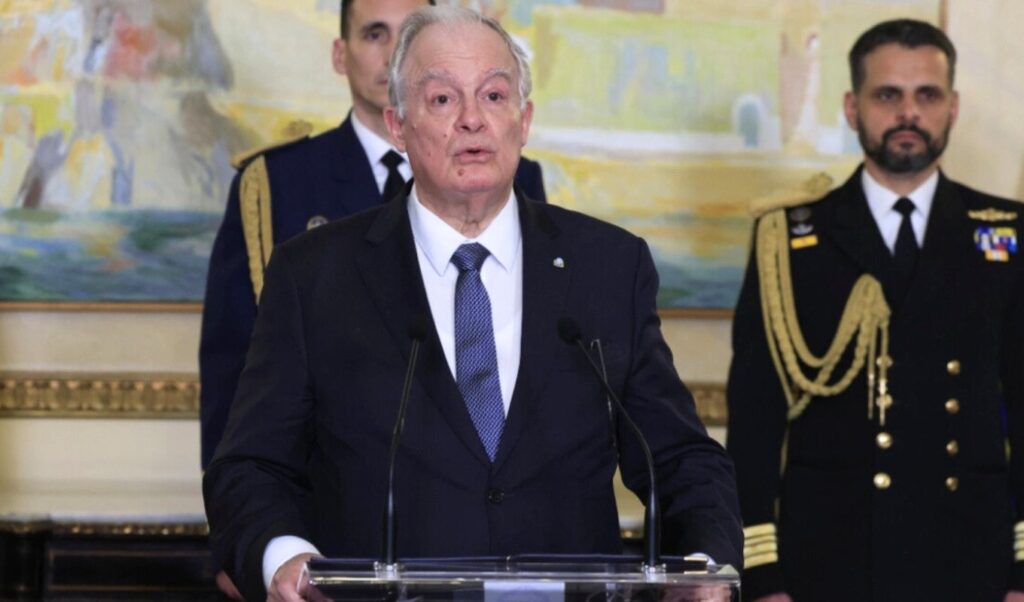
Greece’s unwavering support for Ukraine and Cyprus was emphasized by President of the Republic Konstantinos Tasoulas, during the reception of the diplomatic corps at the Presidential Mansion. The event was attended by, among others, Prime Minister Kyriakos Mitsotakis and Deputy Foreign Minister Alexandra Papadopoulou. “We live in a period during which the security architecture of the post-World War II era and the rules-based international order are being challenged, in a period during which geopolitical tensions and conflicts are increasing and the politics of power are being strengthened at the expense of multilateralism, dialogue and cooperation,” emphasized Mr. Tasoulas.
As he noted, the vision of the UN Charter provided that “the threat or use of force against the territorial integrity or political independence of any state must be prohibited,” while differences “must be resolved by peaceful means.” However, “today these fundamental principles are being violated,” while “human rights and international humanitarian law are ignored in many parts of the world.”
Tasoulas: What he said about Greek-Turkish relations, Cyprus issue, Middle East and Ukraine
Mr. Tasoulas made special reference to Greek-Turkish relations. “Despite the fact that disagreements continue to exist, we keep channels of dialogue open,” he noted, adding that the region “should not be shaped by rivalries, but by common prosperity, based on the fundamental principles of international legal order.” Regarding the Cyprus issue, he emphasized that it “remains still unresolved, despite the fact that almost 52 years have passed since Turkey’s illegal invasion,” stressing that the sovereignty and territorial integrity of the Republic of Cyprus “is a matter of UN credibility.”
The President of the Republic emphasized that Greece has supported Ukraine from the beginning “in its struggle for national sovereignty and territorial integrity” and will continue to support every effort for “a just, sustainable and comprehensive peace.” The war is the deadliest in Europe since World War II and “does not constitute simply a regional conflict, but has global implications.”
Regarding the Middle East, he spoke of an “escalation of violence that has caused enormous loss of human life, pain and destruction,” highlighting the need for “new momentum towards a political solution” that would allow “the creation of a Palestinian state alongside a secure Israel.” He also stressed that “all diplomatic avenues must be exhausted” to prevent further destabilization in the broader region.
“The world is changing and we must adapt”
The President of the Republic also referred to Greece’s role as a non-permanent member of the UN Security Council, as well as the importance of a strong and resilient European Union, especially in view of the Greek Presidency in the second half of 2027.
In this context, he noted, “the global landscape has become extremely unstable and unpredictable” and that security is being eroded not only by armed conflicts but also by “hybrid threats, climate change, rapid technological developments and migration.”
“The world is changing and we must adapt,” he noted, concluding that we have a “duty to ensure that future generations will live in a more peaceful, sustainable and just world.”