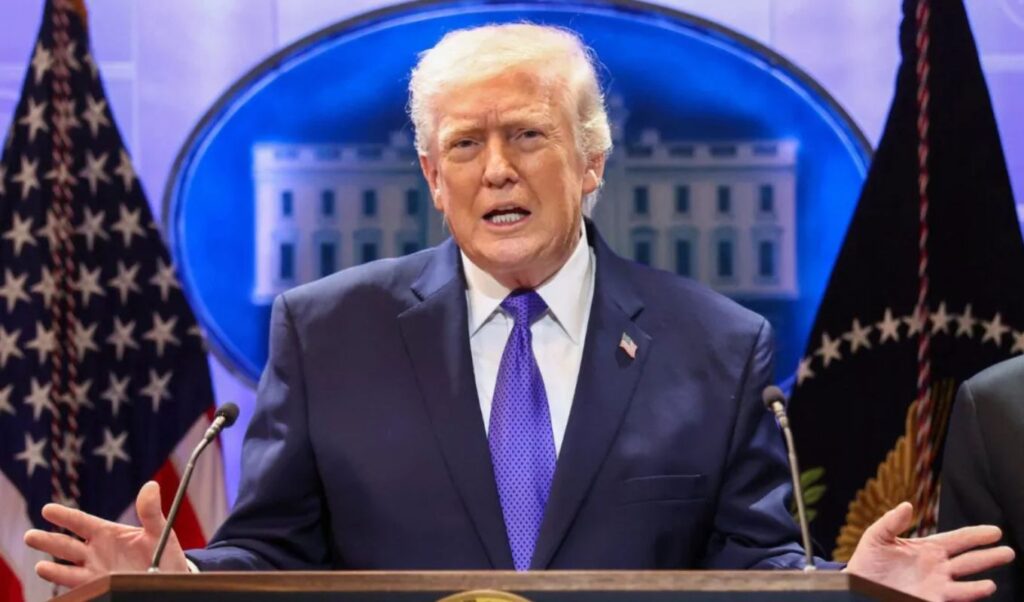
New tariffs of 15% were announced yesterday, Saturday (21/02) by Donald Trump, following the US Supreme Court’s decision to overturn his global “retaliatory” tariffs, a move that dealt a significant blow to the American president’s economic policy and, as expected, provoked his reaction. The announcement of new 15% tariffs based on different legal provisions is causing political and economic turmoil, with European bodies speaking of prolonged uncertainty.
Trump: Uncertain climate in Europe and markets after tariff increase
The main global tariffs imposed by the president were ruled illegal by the Supreme Court, with support from even two justices appointed by Donald Trump himself. This significantly limits the American president’s powers in trade policy, a decision considered by many to be the most significant judicial reversal of his second term.
Trump responded by announcing he would proceed with imposing global tariffs of 10%, which he subsequently increased to 15%, invoking Section 122 of the Trade Act of 1974. As he argued, the Court’s decision makes his authorities “stronger,” something that is not confirmed by legal analysis of the decision.
This specific section limits tariffs to 15% and for a period of 150 days, unless Congress decides to extend them. Additionally, it requires the existence of a balance of payments problem. Other available legal avenues require time-consuming procedures and special findings by competent authorities, which reduces executive branch flexibility.
“Avalanche” of political and economic consequences
This decision comes at a time when the US economy is showing a slowdown. It should be noted that the Bureau of Economic Analysis announced that GDP increased by only 1.4% year-on-year in the fourth quarter, making 2025 the second-worst year for growth since 2016. Additionally, employment also showed weak performance, while inflation remains persistent.
The political cost that tariffs have caused President Trump is significant, as according to polling data, his net approval rating for the economy declined from +6 to -12 points after announcing global tariffs on April 2. A CNN poll showed that 62% of Americans disapprove of his tariff policy, a percentage that includes 25% of Republican-leaning voters. Furthermore, the Court’s decision may encourage Republican congressmen who view tariff policy with skepticism, especially ahead of midterm elections.
Reactions from Germany and the European Union
Government and business leaders in Germany estimate that the Court’s decision does not remove uncertainty. Finance Minister Lars Klingbeil told Frankfurter Allgemeine Zeitung that, despite the cancellation of “retaliatory” tariffs, sector-specific tariffs remain in effect, such as those affecting the automotive industry and steel, emphasizing that “great uncertainty remains.” Business groups echo this sentiment, warning that trade turmoil is not disappearing but rather its legal framework is changing, with potential consequences for both sides of the Atlantic.
Paris: Considering countermeasures
Speaking to the Financial Times, French Finance Minister Bruno Le Maire advocated for the European Union to impose countermeasures. As he stated, France and its Union partners are currently analyzing the implications of the US Supreme Court decision, which ruled “retaliatory” tariffs illegal, considering that the president exceeded his powers. As Le Maire noted: “We are in close contact with the European Commission and member states to proceed with analyzing the decision and assess the consequences.” Should the new 15% tariffs be fully implemented, Paris’s stance strengthens scenarios for a more coordinated European response.