American President Donald Trump has his finger on the trigger, as he did not rule out a limited-scope strike on Iran in his statements before the weekend.
US moves after the “Twelve-Day War”
The latest moves by the US and Iran remind the global community that the “game” of pursuits, mutual projection of interests, and readiness for immediate responses is now beginning. As it appears, the “game” did not end last summer, when in the 12-day war between Israel and Iran, the US decided on a pivotal strike emphasizing Tehran’s core strength: its nuclear facilities. The laying down of “arms” is not yet a reality.
The unprecedented unrest with historically significant episodes in Iran, in the heart of this winter, demonstrated the exhaustion in the core of Iranian society and gave Washington the “foothold” to speak of a possible need of Iranian society connected to overthrowing the theocratic regime. However, a possible US intervention toward transitioning to another regime might awaken memories from 2003 with the Iraq War, which would mean establishing chaos.
For some, however, the changes in the Middle East, following the overthrow of the Assad regime and efforts for the next day in Gaza, are connected to a new “Arab Spring.” With many scenarios and even greater concerns, it remains to be seen how the Iranian theocratic regime will face the new challenges.
The US attacked Iran last year in the framework of the so-called Twelve-Day War, which Israel started in June. The US used B-2 bomber aircraft to strike Iranian nuclear facilities. Satellite images published by Reuters show that repair and reconstruction work has since been carried out at various nuclear and military facilities, including the Natanz and Isfahan infrastructures.
Geneva talks and Tehran’s stance
Iran’s leadership, meanwhile, stated that talks in Geneva, Switzerland indicate “progress,” but substantial results are not apparent. Iran, for its part, denies seeking to build nuclear weapons. Tehran has also begun its own military exercises, including missile tests and a naval mission in the Strait of Hormuz, in which Russian forces also participated.
US mobilization: Aircraft carriers toward the Middle East
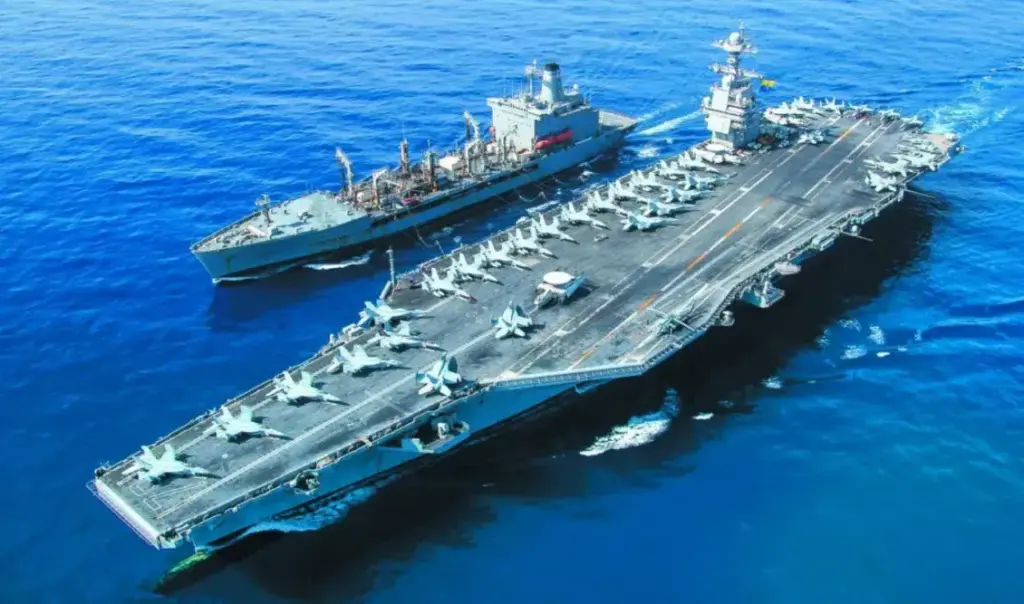
Meanwhile, the aircraft carrier USS Gerald R. Ford, the world’s largest warship, activated its Automatic Identification System (AIS), showing its position in the Atlantic Ocean, according to MarineTraffic. Two of the 11 active aircraft carriers of the US naval force have been ordered to move to the Middle East region. According to the American news outlet USNI News, a series of other warships are operating in the Strait of Hormuz, the Red Sea, and the Eastern Mediterranean.
Tehran, for its part, is reminded to have stated that it does not enrich uranium. Trump emphasized last geopolitically hot summer that the attacks “destroyed” Iran’s nuclear facilities, but the exact extent of the damage is unknown, as Tehran has banned access to international inspectors. Iran insists its nuclear program is peaceful. The US and other countries suspect, however, that Tehran ultimately aims to develop weapons, which constitutes a direct threat to Israel as well. In a letter to the UN Security Council, Amir Said Iravani, Iran’s ambassador to the UN, stated that while Iran does not seek “tension or war and will not start a war,” any aggressive action by the US will be met “decisively and proportionally.” “In such circumstances, all bases, facilities, and assets of the hostile force in the region will constitute legitimate targets within the framework of Iran’s defensive response,” Iravani declared.
Fears of widespread Middle East escalation
Days ago, Trump warned Tehran that it has few days to reach an agreement regarding its nuclear program, with the US continuing to gather military forces, Iran conducting exercises with Russia, and Europe fearing an imminent regional war. Trump’s other warning that 10 to 15 days is “enough time” for Iran to reach an agreement cannot be overlooked, as Washington demands Tehran commit to ending its nuclear program.
The question is what the aftermath of an American strike on Iran will be, to what extent substantial limitation of the nuclear program will be achieved, how potential consequences from Iranian retaliation will be addressed, and what will happen to the Iranian regime – whether time will turn back to 1979 to rewrite history, this time according to the dictates of democratic normalcy…
Published in Sunday’s Afternoon Edition