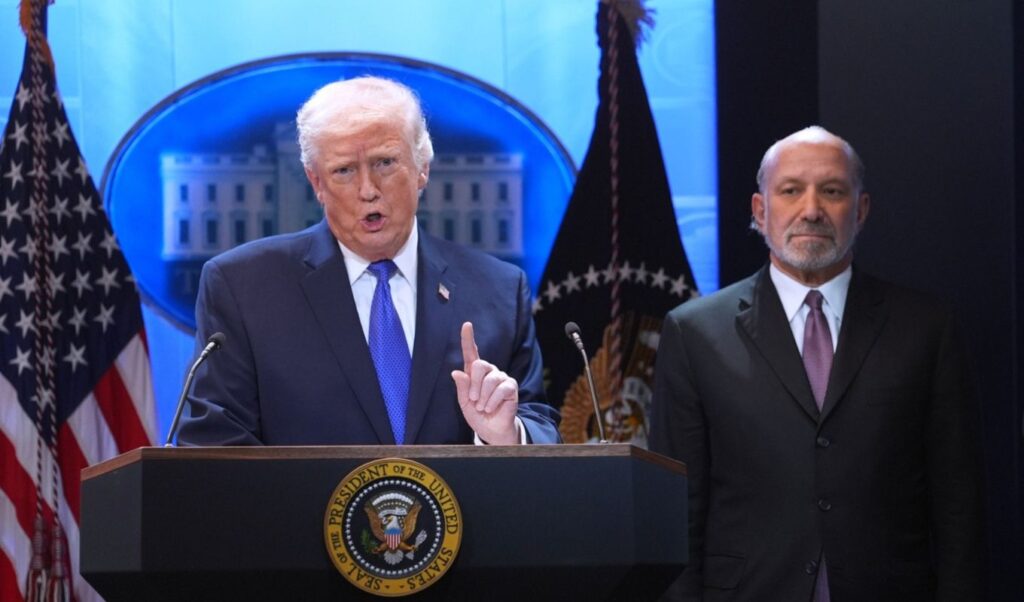
The Supreme Court imposed on Donald Trump what may be the most significant rebuke of his second term on Friday. The justices, including two appointed by the president himself, struck down Trump’s signature economic policy: his global tariffs. In the long run, the court may have saved him from himself — at least politically, as CNN emphasizes in its analysis.
Some Republicans are openly praising the decision. This is because while the ruling is clearly a major blow to Trump’s agenda, it also removes tools that appeared to be causing short-term economic damage to the country and were clearly causing short-term political damage to Trump’s party. This is not the end of the tariff story. Trump rushed to declare he would impose 10% global tariffs based on different authority, which, as he announced Saturday, he would increase to 15%. On Friday, he even claimed the Supreme Court decision had actually “strengthened” his ability to impose trade sanctions in some way. But this isn’t true. Trump’s tariff powers have been significantly curtailed. And while Republicans were happy to let him try to do things on his own, even when those things were powers assigned to Congress by the Constitution, this setback could also lead to some introspection within the Republican Party about whether to continue supporting Trump’s trade moves. The big question is whether any of them will seize this apparent opportunity for de-escalation.
How tariffs hurt Trump
It was coincidental that the Supreme Court decision was issued on Friday. Just 90 minutes before its release, the Bureau of Economic Analysis announced that gross domestic product grew at an annual rate of just 1.4% in the fourth quarter. This made 2025 the second-worst year for GDP growth since 2016. Last year was also one of the weakest years in recent decades for employment. And of course, there’s inflation, which finally declined slightly in January but remains persistent. In other words, aside from the stock market, the economy isn’t doing very well. It’s not clear to what extent the stagnation is specifically due to tariffs. However, the uncertainty surrounding them and the additional costs they’ve created have clearly worsened an economic picture that wasn’t that good to begin with. At minimum, they gave Americans a reason to blame Trump for economic difficulties. Trump voluntarily took responsibility for a struggling economy, using a method that, according to economists’ predictions, would cause more problems, at least in the short term.
How the Supreme Court paralyzed Trump
In an often confused press conference Friday afternoon, Trump pointed out that Justice Brett M. Kavanaugh’s dissent suggests Trump could simply turn to other authorities responsible for tariffs. And there are several available. Trump quickly grabbed one of them, announcing 10% global tariffs under Section 122 of the Trade Act of 1974. “Now I’ll follow the path I could have taken initially, which is even stronger than our original choice,” Trump claimed. But this isn’t true. While there are many available options, there’s a reason Trump chose the initial route he followed. If the court had allowed him to impose tariffs based on emergency power, it would have given him much greater flexibility to quickly implement massive tariffs and make changes — often to punish or persuade other countries. The only limit was that Congress could vote to cancel emergency situations. However, the intense opposition to tariffs didn’t even come close to gathering the required majority to override a veto.
In contrast, Section 122 limits tariffs to 15% and to a 150-day period — after which Congress must extend them. Given that majorities in both chambers recently voted against Trump’s tariffs, this seems unlikely. And it’s not even clear if Trump can use this section, given that it requires some kind of international payment problem. Other tariff authorities require more process before implementing tariffs. Trump has promoted tariffs as a means of revitalizing American industry and as a tool that gives him great influence in negotiating trade agreements with other countries. However, the shorter duration and lower ceiling provided by Section 122, as well as the more extensive procedures involved in alternatives, mean he will have to face constraints he otherwise wouldn’t have. And other countries will know he faces these constraints, thus reducing his influence.
All eyes on the Republican Party
It will also be interesting to see if this will encourage the many skeptical but silent Congressional Republicans who want to close this chapter. Many Republicans spent the past year holding their noses (and tongues) as Trump imposed tariffs. These tariffs, ultimately, conflicted with the Republican Party’s long-standing efforts to brand itself as the party of free markets and free trade. However, the decision represents a significant blow to Trump’s individualistic approach, which could jeopardize his other efforts. In his concurring opinion, Justice Neil Gorsuch seemed to be pleading with Congress to start handling these issues through legislation. This doesn’t mean they’ll suddenly break ranks with Trump en masse on this issue. And Trump is a proud man who certainly doesn’t want to appear to be yielding to the Supreme Court or pressure from his party. But if he continues trying to impose high tariffs, he could miss a (political) opportunity being offered to him.
Criticism of Trump after tariff increase to 15%
As expected, Trump’s move provoked reactions. German Chancellor Friedrich Merz said uncertainty over tariffs is the “greatest poison” for US and EU economies and “must be ended.” Speaking to German media outlets, Merz stated Germany would coordinate closely with other EU countries for a common position ahead of his upcoming trip to the US. For his part, French President Emmanuel Macron appeared not particularly worried by Trump’s move. Speaking during a visit to an agricultural exhibition in Paris, he said “we will carefully examine the precise consequences, what can be done, and we will adapt.”