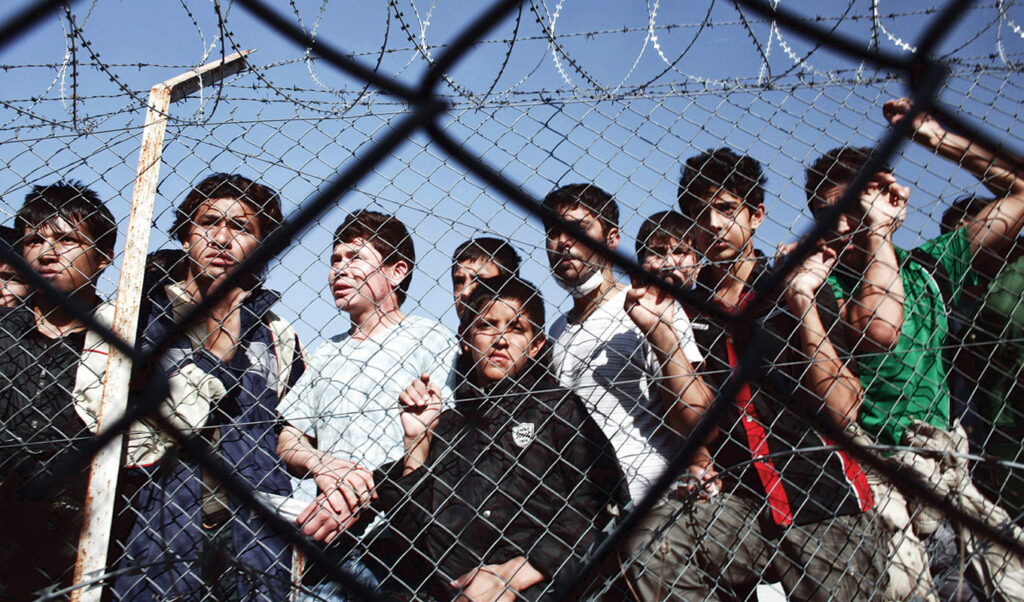
Against the backdrop of deadly tragedies, the shipwrecks that reveal the harsh face of illegal human trafficking based on profit without regard for human life as sacred, the European Parliament approves new rules for asylum. The goal is to prevent both the continued illegal activity of smugglers and overcrowding conditions, as well as to establish a policy based on fair burden-sharing.
New conditions are established so that EU member states can decide whether a country is safe for asylum seekers who are not nationals of that specific country. EU countries will also be able to conclude agreements with third countries where international protection applications will be examined.
Specifically, the European Parliament – as noted on its website – approved changes to EU rules for the asylum procedure, to enable faster processing of related applications. With 408 votes in favor, 184 against and 60 abstentions, the European Parliament approved the creation of a Union list of safe countries of origin. MEPs also approved the agreement on the regulation for implementing the concept of safe third country, with 396 votes in favor, 226 against and 30 abstentions.
New asylum rules: Safe countries of origin
The new pan-European list of safe countries of origin will allow rapid processing of asylum applications from nationals of countries included in the list, namely Bangladesh, Colombia, Egypt, Kosovo, India, Morocco and Tunisia. According to the new rules, it is up to each applicant to prove that this provision should not be applied due to well-founded fear of persecution or risk of serious harm in case of return to their country.
EU candidate countries
Countries that are candidates for EU membership will also be considered safe countries of origin, unless special circumstances exist. Such circumstances include, first, indiscriminate violence in the context of armed conflict, second, EU-level asylum recognition rate above 20% for their citizens and third, the existence of economic sanctions due to actions affecting fundamental rights and freedoms.
Suspension and national lists
The Commission will monitor the situation in countries included in the list and candidate countries and will react in case of changing conditions, for example by deciding that temporarily a country is not safe or proposing its permanent removal from the list. Member states will be able to designate additional safe countries of origin at national level.
Implementation of the safe third country concept
EU countries will be able to apply the concept of safe third country in relation to asylum seekers who are not nationals of a specific country – and therefore declare their application inadmissible – provided that one of the following three conditions is met.
First, the existence of a connection between the applicant and the third country such as the presence of family members, their previous presence in the country or if there are linguistic, cultural or similar ties.
Second, if the applicant passed through the third country en route to the EU and could have sought effective protection there.
Third, if there is an agreement or arrangement with the third country at bilateral, multilateral or Union level for the admission of asylum seekers, excluding however unaccompanied minors.
Agreements concluded by the EU or member states with a third country regarding the application of these rules must include a provision obligating the country to examine the substance of every request for effective protection submitted.
Immediate implementation of certain provisions
The designation of a third country as safe both at Union and national level can be made exceptionally for specific parts of its territory or clearly identifiable categories of persons.
Both this provision and the accelerated procedures at borders for applicants whose nationality has an asylum recognition rate below 20% can be implemented before the start of implementation of EU asylum legislation in June 2026.
Statements
Rapporteur Alessandro Ciriani (Conservatives, Italy) stated: “The list of safe countries of origin represents a political turning point in EU migration management. This legislation ends a period of uncertainty and charts a clear course: common rules, faster and more effective procedures, protection of the right to asylum for those who deserve it and decisive action against abuses. The EU is equipped with clear, applicable rules based on burden-sharing.”
Rapporteur Lena Düpont (EPP, Germany) stated: “With today’s vote on designating safe third countries, we are delivering another structurally important tool for a functional and reliable asylum system. By enabling manifestly unfounded asylum applications to be rejected faster and more effectively in the future, we accelerate procedures, decongest member state systems and help people avoid being trapped in legal uncertainty for years.”