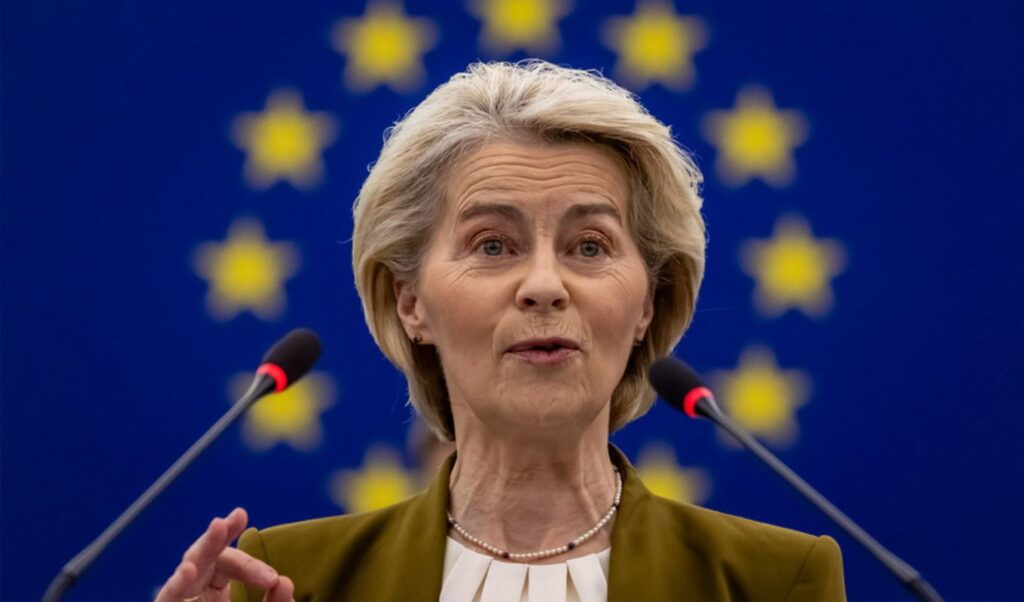
The President of the European Commission, Ursula von der Leyen, speaking at the Munich Security Conference about the need for a new security strategy for the continent, noted that no “taboo” must remain untouched when it comes to European defense. She also emphasized the need for Europe to become “more independent” in order to face global crises.
The Commission President stressed that the world has caught “fire,” referring to the state of **EU-US** relations, the ongoing Russian invasion of **Ukraine**, and “the very specific threat of external forces attempting to weaken our Union from within.” She added that there is only one way for the bloc to respond to all this: by making Europe “more independent… in every dimension that affects our security and prosperity – defense and energy, economy and trade, raw materials and digital technology.”
The Commission President rejected the view that an independent Europe could somehow lead to a weakening of its relations with the US.
Von der Leyen from Munich Conference: “An independent Europe is a strong Europe”
Citing earlier statements by US Secretary of State Marco Rubio, she emphasized that “an independent Europe is a strong Europe, and a strong Europe makes the transatlantic alliance stronger.” She noted that “for many decades… Europe’s security was not always considered primarily our own responsibility,” but pointed out that “this has fundamentally changed” now. “Admittedly, it took ‘shock therapy’ and some red lines have been crossed that can no longer be reversed. But at least we all agree on what is needed and we are implementing it,” she stressed.
On the EU’s SAFE program
Von der Leyen referred to recent decisions on the EU’s SAFE program aimed at rearming the continent, as well as further funding for Ukraine. “This is a substantial European awakening, and this is only the beginning of what we need to do,” she noted characteristically.
The Commission President also stressed that the EU must give “life” to Europe’s mutual defense clause to clarify what this means in practice, and added that it should move faster, increasingly resorting to qualified majority voting instead of unanimity, to bypass individual countries seeking to block decision-making.
“We must strengthen the European ‘backbone’ of key strategic capabilities in Space, intelligence gathering and long-range strike capabilities. No taboo must remain untouched,” she added.
Call for closer relations with Britain
Ursula von der Leyen, speaking about the new European security strategy, emphasized the need to “institutionalize the ad hoc beginnings of new security cooperation” and forge closer relations with the United Kingdom, noting characteristically that “ten years after Brexit, our future is more interconnected than ever.”
She praised the UK’s contribution to the bloc’s expeditionary forces, its participation in Upper Northern Europe and the Baltic region, as well as in the “Coalition of the Willing.”
“This means that, in this truly unstable period, Europe – and especially the United Kingdom – must come closer together on security, economy, and defense of our democracies. Ten years after Brexit, our future is more interconnected than ever, dear Keir, so it is in our common interest to be ambitious about our cooperation.”
Need to recalibrate security strategy
The Commission President continued by pointing out that Europe must “recalibrate” its security strategy to meet the challenges of the times. “We in Europe must be ready and willing to use our power decisively and proactively to protect our security interests,” she noted characteristically and added: “We need a new doctrine for this, with a simple goal: to ensure that Europe can defend its territory, economy, democracy and way of life at any time. Because this is ultimately the real meaning of independence.”
Drawing on lessons from the war in Ukraine, she noted that “strength, deterrence and ultimately lives depend on industrial capacity: production, scaling and sustaining the effort.” She emphasized that Europe must “tear down the rigid wall between civilian and defense sectors,” and pursue “dual-use industries” and how its experience as a global power in automotive, aerospace and heavy machinery can be leveraged in European defense industry.
“Some ask whether we can afford it financially, but I say we cannot afford not to do it,” the Commission President said, noting that Europe must do more to strengthen its defense, to honor Ukraine’s sacrifice and become more independent.